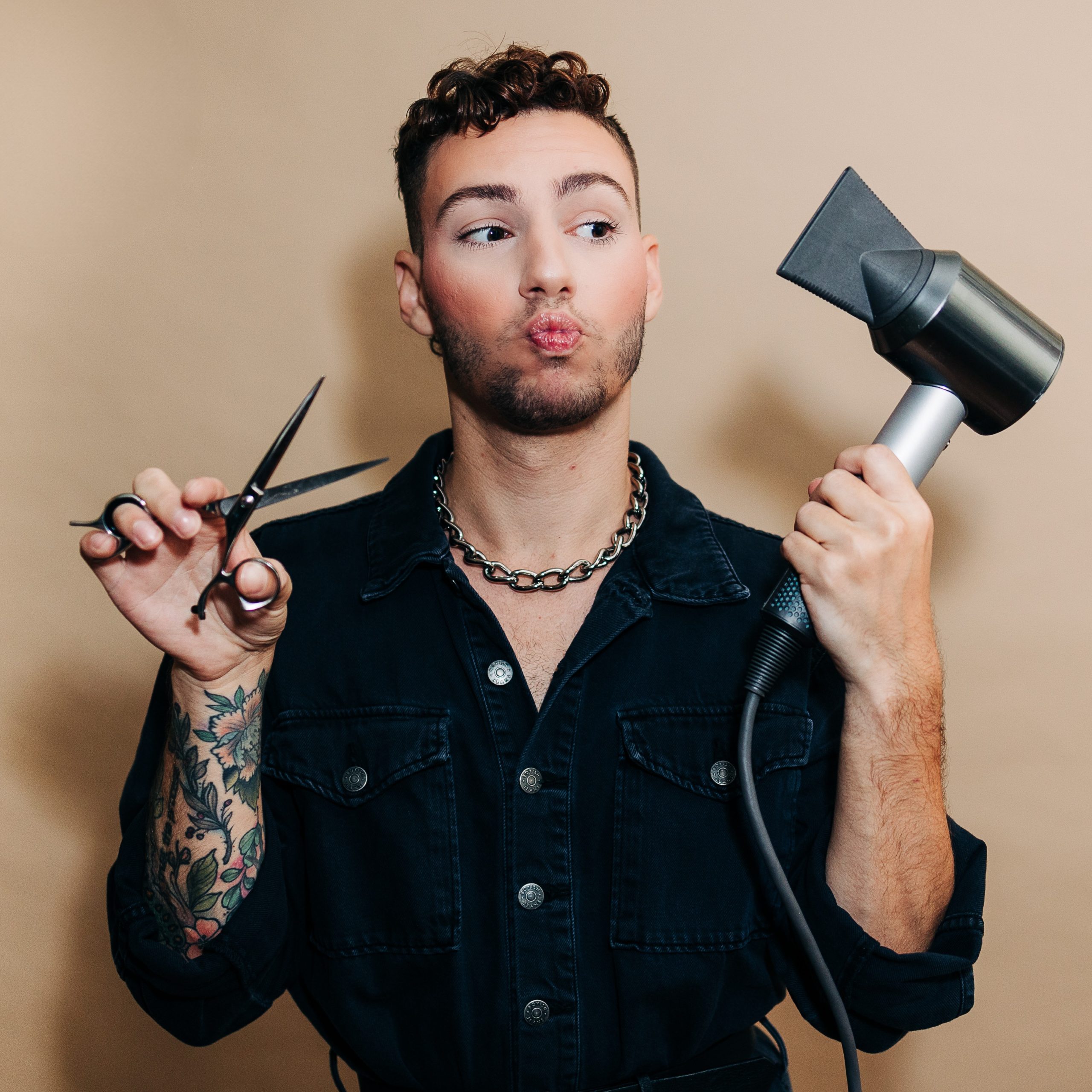
Some interviews feel like work. This one felt like sitting down with someone who has lived the same chaos, asked the same hard questions, and then decided to build better answers.
When I sat down with Hunter Donia, I knew we were going to get into the real stuff: career starts, bad industry advice, business growing pains, and what it actually takes to make this work long term. What I didn’t expect was just how many moments in Hunter’s story would feel familiar to anyone who has ever stood behind the chair, loved the craft, and then gotten smacked in the face by the business side of beauty.
Hunter has been in the industry since they were 15, started assisting young, and was in the salon on their 16th birthday. That alone tells you a lot. This wasn’t a casual “maybe I’ll try cosmetology” path. It was commitment early, all in. And one of the biggest things that stood out to me was how much they credit assisting and mentorship for building real confidence, real relationships, and real readiness before taking clients at 18. In an industry that loves to rush people to the floor, Hunter made a strong case for why foundational experience still matters.
Then the story takes a turn that feels very beauty-industry-core: they moved to rural Pennsylvania for a relationship, landed in a completely different environment, tried to build again from scratch, and learned the hard way that posting on Instagram is not a magic spell. Hunter was doing all of it—referrals, client experience, old-school outreach, the whole hustle—and it was still hard. That part of the conversation mattered because it cuts through a lot of the nonsense. Sometimes you are working. Sometimes you are doing the “right” things. And sometimes it is still hard.
What changed everything was the pandemic pivot. Hunter talked about how online education suddenly opened up, how they dove into business and marketing education, and how that pushed them to take the leap into a salon suite—even while openly admitting they barely had the clientele for it. Their phrase was basically: would not recommend. And yet, that risky jump, paired with strong business theory and timing, turned into a massive shift. Within a few months, they were booked solid and fielding steady new-client demand. That is the kind of story stylists need to hear in full, because it was not luck alone and it was definitely not just “post more.” It was strategy meeting opportunity.
The heart of our conversation, though, was what happens after you get busy. Hunter said something that beauty pros need tattooed on the inside of their booking hand: being booked is not the end of your problems. It just gives you a new set. More clients can mean more admin, more scheduling, more emotional labor, more pressure, more inventory, and a faster path to burnout if you do not build structure around your success. That is where Hunter’s world really comes alive—systems, automations, boundaries, and the kind of practical business setup that lets a stylist keep their sanity and their career.
We also got into one of my favorite shared truths: boundaries are not mean. They are useful. I talked about cancellation policies and how being firm tends to attract the right guests, not scare them off. Hunter took that further and put it perfectly—if you are letting one disrespectful client steamroll you, you are not actually serving anyone well, including them. That part of the conversation was sharp, honest, and probably a little too relatable for anyone who has ever bent over backward for a Karen and regretted it immediately after.
And then we got into something even more personal: ADHD, systems, and why so many stylists are incredible at the chair work but struggle with everything around it. This was one of those behind-the-scenes parts of the conversation that made the whole thing feel more human. Hunter connected their love of systems directly to how their brain works. Online booking, boundaries, structure, fewer moving parts—it all becomes less about being “organized” in some generic way and more about building a business that actually supports the person running it. Honestly, that part hit home for me.
If there was one big takeaway from my chat with Hunter, it’s this: talent matters, but talent alone is rarely what builds a sustainable career. The stylists who last are the ones who learn how to support their artistry with systems, boundaries, better decisions, and yes, some above-average work outside the chair. Hunter said it plainly: if you want more than the average outcome, you have to be willing to do more than the average work. Hard to argue with that.
This conversation had a little bit of everything: vocational school, salon-floor reality, small-town rebuilding, pandemic pivots, business education, ADHD, and the power of saying no. In other words, the real stuff. Watch the full interview for the deeper version, because Hunter brought the kind of honesty and practical insight that can genuinely change how a stylist thinks about their career.
You can find Hunter at:
https://www.instagram.com/hairbyhunty/?hl=en
Transcript:
Liam Shea (00:02)
Okay, fantastic. Okay, so I’m here with Hunter Donia ⁓ and we’re gonna have a little chat about industry stuff. Would you like to start by just telling us a little bit about yourself?
Hunter Donia (00:15)
going on? Liam, thank you so much for having me. Yeah, dude, my name is Hunter Donia. I am an industry business educator. mostly teach hairstylists how to systematize and automate their beauty businesses. I’ve been doing this for about six years now. I’ve been in the industry since I was 15 years old. I started when I was in vocational school. And I’ve been in the salon since my 16th birthday. And I have gotten to a space in which I’m just so passionate about serving
Liam Shea (00:17)
super great.
Hunter Donia (00:43)
other people in this industry by showing them what’s possible and teaching them how to achieve what’s possible within this career path with my own experience working with hundreds of stylists, thousands of stylists if not at this point, and also ⁓ my own experience and success that I’ve achieved. And it’s just such a blessing and I absolutely love getting to do it. And I love getting to have conversations with people, with platforms who…
are doing the same thing, gifting that same type of opportunity and the tools to be able to achieve that success and make it as easy as possible. So I’m really, really excited to be here.
Liam Shea (01:18)
I’m super excited to have you here. Yeah, I mean I Sounds like you’ve been in the industry for a plenty of time. I’ve been behind the chair for 26 years Still doing it two days a week in that bright Blurried area on the other side of the shelf where my friend rents my chair the day I’m not behind it and then we started this software company to try and help me and then my friends and then my co-workers so I am with you about being passionate about
Hunter Donia (01:27)
badass
Liam Shea (01:47)
partly trying to give back and equip people with tools. I don’t know about you, when a few years in I started to realize how many people…
failed early and left the industry. They were told how much money they could make. They weren’t told how much money they’d probably make and they weren’t told how much they had to do. ⁓ When you were coming, so you started vocational school. When you were done that, at what point were you behind a chair in a salon?
Hunter Donia (02:20)
Yeah, good question. So funny you say that, it’s so true. Like nobody actually tells you and sets you up with the expectations of what you’re getting yourself into. I mean, especially when I was a kid and I was like telling my parents that I wanted to go to vocational school. And for anybody who’s listening to this, who doesn’t know what vocational school is, it’s basically like grade school that you can do while you’re in high school. And so in my case, at least. so.
When I asked my parents if I could go, I remember both of them from their stigma of trade school. They just thought that’s where all the unmotivated, lazy kids go or something like that. ⁓ Cosmetology was something that I was super passionate about and I could really see myself making a career out of. I remember my dad, me and him were driving in the car at some point, I don’t know where we going, but we passed this house and I was like, I want a house like that one day. And he was like, well, you’re not going to be able to afford it being a hairstylist. ⁓
And it’d be such a cooler story if I was able to say like, and I own that house now, that’s not true, but I could probably afford it. I absolutely could make that happen. And nowadays, and I proved him wrong, ⁓ but they are both so grateful that they allowed me to take that step into that space, because of where it’s gotten me now. ⁓ And I started that vocational program and I actually…
Liam Shea (03:16)
Right. ⁓
Hunter Donia (03:36)
was getting my hair done with my mom’s hairdresser at a salon close by. And she and I had become pretty close and she was like really encouraging me. She was like, hey, like you just started vocational school. Why don’t you get a job here as an assistant? And so I was, I just, was barely 16 yet when she was suggesting this to me. I didn’t think, I didn’t even think about like, I didn’t think I was old enough. It was my, hadn’t had a job yet at all. And I was like, I don’t know. Like that’s a little bit crazy. So it was my very first job I ever applied to.
I looked insane because I was very expressive with my identity at the time. My hair was a crazy color, crazy makeup, really cheap, ugly clothes. I was not ready for the bougie salon that I was applying to at all. And they took a chance on me. I went through four interviews because they were probably really slowly contemplating as well. so literally, my first day was my 16th birthday. My manager was like, hey, if this is your birthday, you don’t have to work.
You don’t have to work on that day. We can start you the following week.” And I was like, no, like this is the best birthday gift ever. I was so excited. ⁓ then it just went on from there. And so once I got my cosmetology license before graduating high school, ⁓ but then I graduated high school and I shortly after, probably like six months after I graduated high school, I had finished up being a personal assistant with my mentor at the time. And then they put me onto the floor and then I started taking clients right when I was 18.
Liam Shea (05:04)
That’s amazing. That is early to start taking clients, like in a legitimate way. That’s amazing. Good for you.
Hunter Donia (05:09)
Yeah, I don’t know
how the hell I got anybody to trust this little sassy 18 year old, you know, I think that what was really helpful and I think what a lot of, you know, and I feel like it’s funny, I’m like, I kind of like classify myself as a millennial. I’m like right in the middle of like Gen Z and millennial, but I’m technically Gen Z. I’m like just like the older side of Gen Z. I feel like I sound so much older than my generation when I say this, but like
That experience, like I had like three years of assisting basically almost. And that experience is so lost upon this generation that we have now coming into the industry. And it was so essential for my success because I was able to make so many really great deep relationships with the clients that were going to those stylists at the time. And I was able to take so much time like learning from my mentors.
And I was totally ready even at that very young age to, to interact with those people in the way that I needed to, ⁓ to have a skillset, to be able to take care of them confidently. But then they also trusted me as well too, cause Hunter’s been washing and toning my hair for like two years. You know, like I’m ready to, I’m ready to, you know, move on from this mentor whose prices are now very high to this lower price new hairstylist that I already have a relationship with. so.
It really set me up for a lot of success starting that young and spending that much time assisting and growing my skillset before actually taking clients. But it’s a very privileged situation. I was very lucky to have those experiences. I worked hard for them and I definitely went for them, but not everybody has the same opportunities that I had, of course, but it was a great place to be.
Liam Shea (06:38)
Sure.
It shouldn’t count as a privilege. Everyone should have that opportunity. It’s a shame. I did an apprenticeship, like a legitimate government sanctioned apprenticeship that required this many hundreds of hours and a person would come by the salon and check in with me and make sure I was getting the things I’m supposed to get in an apprenticeship. ⁓
Hunter Donia (06:58)
Yes.
Right.
Liam Shea (07:12)
And so all of my, I maybe I did six weeks of school towards the end to prep for my exam because none of the, I’m sure it’s the same in lots of states throughout the U.S., none of the stuff on the exam when I took it, the stuff you’d do in the salon. I could practice roller sets, but not if I was actually assisting in a legitimate way all day long. ⁓ yeah, but yeah, I loved my apprenticeship. And you’re right, is, again, shouldn’t count as a privilege, but it’s-
Hunter Donia (07:33)
Right. Yup.
Liam Shea (07:43)
It changed everything. I I learned how to, ⁓ I did inventory. I was the receptionist. I cleaned the place. I folded the towels. I put away people’s color orders. I helped people mix color when they needed it. I got to do everything but do hair. And then probably the same as you, got to start blow drying a little bit of hair and then, and doing shampoos and all that stuff. It’s, yeah, it is a privilege to come at it from that way. How long were you at that shop?
after your, ⁓ like when you when you went out onto the floor officially.
Hunter Donia (08:17)
Yeah,
when I got onto the floor, honestly, it was pretty short because I ended up meeting a boy, which I just don’t meet boys. This is my biggest takeaway whenever I tell this story. I met this boy and I was probably there for two years actually on the floor. I had no problem building a clientele, like I said, like I had.
the, the, mentors, their clients just carters come see me when they couldn’t get them with the mentors. And I retained them. had tons of people who had already was like in my high school was like, we’re like, I was just doing their hair on the weekends, you know, ⁓ practicing on them and, and, know, just charging them like a cheap amount of money or whatever it be. and then I, ⁓ so I had built up my clientele, but I met this boy and I was like,
I’ve always lived in my dad’s house and I had never made like big changes in my life. First relationship that I ever had. And then I moved out to live with him an hour and a half away into the middle of rural Pennsylvania. So I’m in Philadelphia now. I’m in Philadelphia now. And I grew up in the burbs of Philly, probably like 45 minutes outside. Um, but then I moved even more to like more central, um, more West. And, uh, it was literally, we’re talking like Amish land, Pennsylvania, like
Liam Shea (09:19)
Okay.
Yep.
Yeah.
Hunter Donia (09:35)
horse and buggies on the road. are like literally like horse poop on your tire, on your car tires. Like that’s very much the situation. does not smell pleasant. that’s the, that’s place I moved to. And, ⁓ I started in a employee salon, trying to build my clientele there. ⁓ it was a little bit difficult for me because of just being in this environment that was so different and also not very welcoming to who I was as, you know, with my identity and things like that and what I was used to, but I was marketing and all that. And, ⁓
⁓ eventually, so I left that salon that I’d been at for like five years that I’d worked so hard to like build my name within. And then I had to kind of build from scratch over there in that space. And eventually I was successful once, ⁓ once I moved out on my own. ⁓ but it was really difficult. It was a difficult move for sure.
Liam Shea (10:23)
That’s, I mean, I left, my apprenticeship in junior styling was about four years total at the original salon I was at. And then I left and went right to renting and share, which was tough because I didn’t have a huge clientele, but I only did it a handful of blocks away. It’s not like I moved to Amish country afterwards. It was like, hey, I’ll rebuild from scratch in a small town. Totally the same. ⁓
Hunter Donia (10:35)
Mmm.
Right.
Hahaha
Yeah, dude.
and I was like, like I said, I’m young. it was literally, I was 20. I think I was 20 years old. And so was like, yeah, I’m young. I know how to do this Instagram thing. I’m just going to post on social media as I do that nobody else is doing and grow my clientele. And it was absolutely, that was not the case. And I was not just posting on Instagram how everybody tells you to. I was also doing the things that, the old school things.
Of course, I was asking my clients to send me clients, you know, and I was knocking the client experience out of the park. I’m very confident that I was doing that. And I was going to the mall, handing out my going up to people that I thought would be ideal clients, like handing them my card, like doing the pitch, like I was doing everything. And it was really, really hard for me to grow. honestly, I’d say that like I didn’t even get there. Like I didn’t even make that happen. But then the pandemic happened.
and then everything kind of shortly changed for me. But I’m gonna stop yapping. If you’d like to hear the next part of the story, then I’ll keep going, but I’ll take a pause.
Liam Shea (11:52)
probably continue to. mean, the pandemic was, is and was a huge shift, especially the digital side of things. I mean, it’s not like any of us had ever taken a Zoom class prior to the beginning of the pandemic or knew what Zoom was. I mean, I’d used Skype back in the day, but,
Hunter Donia (12:12)
Yeah, dude.
Yes, love Skype.
Liam Shea (12:20)
That was just to talk to a friend that was overseas or something, not a work-related thing. ⁓ I mean, there was an aspect of me that found it really amazing because where I am, so I’m in Vancouver, BC, Canada, and traditionally, if you wanted education, you had to go to in-person education. And if you weren’t close to a place that had great in-person education, you had to fly somewhere.
Hunter Donia (12:25)
store.
Right.
Liam Shea (12:50)
go to the States and there would be an exchange rate that hurt a little bit. And so it was just, it was harder to do. And then all of a sudden it was all, not all of it, but lots of it was online. There were a few people ahead of the curve. I know like Pony Studios in Oakland was already doing, I think I was already subscribing to their app at the time. They were already doing really high quality productions with multi cameras of people. when pandemic hit, I imagined it was easier for them to pivot.
Hunter Donia (12:54)
Yeah.
Night.
Liam Shea (13:21)
⁓ so you were in that small town when pandemic hit, right?
Hunter Donia (13:25)
Yeah, I was. And so I was
in this employee salon and you’re so right. the pandemic just like changed everything. Like it was so crazy. And like you said, like it made that education so much more accessible. made learning and like doing everything more accessible as far as the digital side of things go. And I had already kind of had this like weird gut feeling that like I wanted to go off on my own at some point. But in Pennsylvania,
Uh, booth rental is actually illegal. think there’s like four to five states in the United States where, where booth rentals are illegal. the only option is you own the salon or you are an employee, like period. Like that’s the only way that you do hair. Right. And so salon suites, um, I’m not sure if California is the same way. It’s just that
Liam Shea (14:10)
California might be like that. Or like maybe it was like
Charon? No, I’m sorry, it’s commission that I think was not allowed in California.
Hunter Donia (14:17)
Yes.
Yes, I think that like the employment laws are just so insane that it’s like almost like it’s very, very difficult to have an employee salon ⁓ because of how insane the employment laws are is from what my understanding is at this time. yeah, New Jersey is the same way. I forget what the other states are, but there’s it’s like four or five of them in the United States where boot rentals illegal. the loophole is a salon suite because you own the salon like you own the business. It has us.
Liam Shea (14:45)
Sure, that’s the salon.
Hunter Donia (14:47)
Yeah, it’s a salon. You have a salon license and then you have a hair license, right? Like an individual license and then a salon license and you’re working under the salon license. so the salon suite was really my only option if I really wanted to go off on my own. And I had poured it and looked at it when I was totally not ready to do it. When I was in this employee salon, like trying to build my way up. but I don’t know, there was like, there’s just like gut feeling inside of me. Like I was like, if I could be in control of like everything.
client experience from beginning to end. If I could be in control of the color of this wall, which no offense to my, my past owner, that the turquoise wall was just, the turquoise wall was just not give doing it for me and my clients. So like, just was not, it was just not doing it. So, so I just had this gut feeling that like us, we is probably where I wanted to go eventually. And I was thinking maybe like in three years, you know, when I really built up really had a good foundation, then pandemic hit.
Liam Shea (15:22)
No, that’s the jam.
Yeah.
Amen. Yeah. ⁓
Hunter Donia (15:43)
And all of sudden, like you said, like all this education just became very accessible. And I was already really interested in like business, the business side of things. I had actually became a brand educator when I was 19. I started educating for Eufora, if anybody’s familiar. And, oh yeah.
Liam Shea (15:56)
I used Eufora back in the…
Yeah, it’s been 10 years since I was at that shop, but I loved that line at the time.
Hunter Donia (16:04)
Yeah, it was excellent. mean,
it’s still as is an excellent line to this day. I love you for and I love my time with them and they train me very well. when I started with you for they just gave me so much like great business education from like the sales side of things as far as like client experience, but then also like selling retail and upselling with add-ons and things like that. was the very first like corporate corporate situation in which I really was exposed to really good business education. I think at the time and prior most
Most hairlines of most hair brands that were teaching their professionals, they just could not sell business classes because people didn’t give a shit. Like stylists did not want to hear it. They didn’t care about it. And so they didn’t put them out there. Euphora was different where they really cared about it. And so I had to learn a lot of that stuff and I was just super fascinated by it. And I was really good at selling retail and like became really good at selling retail and interested in it. But the one thing that they were missing was like
the marketing side of things, felt. ⁓ And when that pandemic hit and all this education became super accessible, I took a lot of it. And then I was even just listening to outside of industry education and reading up on books outside of the industry about business and particularly marketing. And I was like, okay, I feel super equipped with the knowledge. And I was working a lot marketing myself just over the pandemic, as if I would just be back at the salon I was working at.
It was like two weeks. was ridiculous. It was like three or two, two to three weeks before our quarantine lifted. And I just decided I’m going to go into a salon suite. couldn’t imagine going back to my salon after all that work that I put in all the knowledge I had. couldn’t imagine going and being an employee again. And so I felt super equipped. just took the, took the chance and I opened up my salon suite. And by the way,
wouldn’t recommend. barely had a clientele. I had gaps everywhere. And the only clients that I really had were from my salon owner feeding me some of her old clients. It really was nothing crazy. Would not recommend, but I did it. And with just really strong actual business marketing theory and all that education and work that I did over that summer, I was able to blow that puppy up real fast. And of course, there was a lot of
Liam Shea (18:01)
Ha
Hunter Donia (18:27)
interest and demand from the pandemic as well too. Like people hadn’t gotten their hair done in a long time. So the timing was also very helpful for me as well. I had that as far as my luck goes, but ⁓ I opened up and I blew it up really fast. It was three and a half months book solid, five new client requests a week. And I was doing hair at the Wazoo very quickly. And it was, ⁓ it was awesome. was big blessing.
Liam Shea (18:50)
That’s amazing. Yeah, I shifted into a one room. I mean, the equivalent to a salon suite. A friend of mine had rented like a little one room office that happened to have water access and just made it into a one room salon and offered me her chair on her days off. ⁓ And I needed to leave where I was at because I was renting a chair, but they wanted, they needed people to pay the chair rent for the months that we were shut down. And I just couldn’t.
Hunter Donia (19:08)
Cool.
Mmm.
Y-yeah.
Liam Shea (19:19)
couldn’t do it.
I didn’t have it, like I wasn’t working. ⁓ And so I made that move. And there was an aspect of it that was actually better for my career. It made some people comfortable, first of all, just being in a one-on-one setting and not being in a room full of people, like the people who were really sensitive to the pandemic were very pleased to just not be around a whole bunch of other people. ⁓ And then, you know, when it’s your baby,
I mean, assuming you’re a person who can be motivated, it’s motivating to be like, I have to, I have to, it’s not optional. I can either fail horrifyingly and live in my car or I have to do this. ⁓ Good for you, that’s amazing. So how did it transition to wanting to share that business information with people?
Hunter Donia (19:52)
Yes.
Thank you.
Yeah, I love that you just said that. It’s so true. Like sometimes you need to be like, I had a mentor one time tell me this, like you have to be pushed into the middle of the ocean with a canoe and you just have to row. Like that’s all you got to do, you know? And you’re so right. Like you take it with a different level of responsibility. And I, what I’d wish is that was the case because you did say, you also said like, if you have the motivation, right? Because sometimes people will do it.
Liam Shea (20:24)
Mm-hmm.
Yes.
Hunter Donia (20:35)
as like an escape almost like to leave what they’re doing before instead of like in like, in like, well, of course, like that can be a part of it, right? But with also the understanding that now I’m going to have to run a business, you know, and I don’t, and I think that a lot of people and we’re seeing it are recognizing, like you signed up to run a real business, you know, and if you don’t run it like a business, you’re not going to be able to do this like sustainably for a long time. ⁓ and so that’s really where that came into play for me was like,
I got into the salon suite quickly got kind of hit in the face with the reality of running a business. Although I was definitely ready and I had all that understanding from like the self learning that I had done. I still was not expecting it to be what it was. don’t think anything prepares you for that. Or you’re ever going to know what actually feels like until you actually do it. Right. And it’s interesting how, you know, like being super booked and busy also brings like a whole different set of problems, you know, like
Liam Shea (21:22)
No. Yeah, you can’t. You can’t.
Hunter Donia (21:32)
The first set of problems is like, you just have to grow your customer base. think that’s like the main thing, right? You always have to have like customers coming in, make sure your books are filled, whatever it may be. But then when you have a lot of clients, then that also brings on more admin work for you. It brings on more pressure on your time and how much time you have to spend. It brings on a lot of communication and scheduling back and forth. It means more inventory ordering and all of that stuff, right? And so
That is what really challenged me when I got into the salon suite. wasn’t growing the clientele that came easy because of all the work that I’d done prior, but it was the streamlining, the success that I had and the stress and the overwhelm that it brought me. That was the challenge. And I was able to really like do some alternative, scary, risky things that I like knew needed to happen myself that were very successful for me and like creating like systems, automations, boundaries.
that I could enjoy the success that I created, but also have like a personal life outside of work and make it so I could sustain this success without, ⁓ without burning out basically. I don’t know how I would be able to move forward at that point, like have this as a long-term career if I didn’t make it more sustainable. So I did all of those things. And if you want me to share examples, can, but like, I just, I was integrated with some communities of hairstylists, whether it been
through me being a brand educator, because I was regionally educating and people were asking me questions about how I was doing things. instead of teaching the color, I would go on rants about the business side of things because I loved it. And that’s what people were asking me about. And then I also just were getting to, don’t know if you, were you, did you ever indulge in Clubhouse, Liam? Clubhouse, that social media app?
Liam Shea (23:09)
Hmm.
Yes, absolutely. Yeah,
I certainly spent several months in there and it was a really, at least for a bit, it was a really interesting place in our industry, I found, because everybody went there. I don’t think it, I mean, it was a flash in the pan in general. ⁓
Hunter Donia (23:27)
Yes.
Liam Shea (23:35)
But everybody was there for a hot minute and everyone was accessible. There was no closed doors and you were just in a room chatting and nobody even knew that you could stop half the people from being able to talk in the first place. ⁓ Yeah, yeah, I forgot about that actually. Thank you for that. That was a really, there was just so many facets to sort of being trapped at home that had cool stuff like that. That was cool. Yeah, so you jumped on the clubhouse.
Hunter Donia (23:37)
Yes, everybody. Yes.
Yes
Yeah, dude. I’m so glad you remember it. It was this very interesting, intense popularity of this app. And it was so invigorating to me to have these conversations with other hairstylists. again, that was another place where I had built this little community very quickly and got really great connections with people who are very close friends of mine now, like Nina Tullio and Jay Ladner, who I probably would have never otherwise been able to have a relationship with. ⁓
Basically they kept on asking, everybody kept on asking me how I was doing the stuff that I was doing. And the best way to teach it, especially cause I was teaching a lot of tech was just like a course, know, like a digital step-by-step course. So, ⁓ I launched it and surprisingly 84 people bought it. And that’s kind of what started it all, which was just like, it was so great. I literally was like, if I just have like five people join this, then that would be so exciting and so fun that I get to like teach five hair styles, how to do this stuff. Like that would be so cool.
Cause I loved educating, you know, and I was really excited to like, see how it would work in this facet and also do it without rules because as a brand educator, you know, I’m like doing it within like the parameters of how the brand wants me to teach things and the classes I was teaching. But this time it was like all by my own rules. And the fact that like 84 people signed up was just like, so nuts. And I remember being so scared. I was like, how the hell am I going to manage these 84 people and like make sure that they all had the results and like all the things it was terrifying. ⁓
Liam Shea (25:04)
Yes.
that.
Hunter Donia (25:32)
But that was the start of it all. And then it just grew and grew and grew from there. And it’s been such a beautiful and lovely journey. And I’m so, so appreciative of it and still very appreciative of it today.
Liam Shea (25:44)
It’s so awesome. And it’s super fun just helping people succeed. It’s rarely, I mean, one of the sad things I’ve found over the years is it’s, you know, your success is very rarely due to your skill level, unfortunately. I mean, it absolutely helps, and being terrible at it is gonna be problematic. ⁓ You know, if everybody’s just coming for one…
Hunter Donia (25:50)
Yes.
Right.
Hahaha right.
Liam Shea (26:13)
service and never coming back. That’s a problem. But that’s not… it’s like one part hustler mentality, one part organization. ⁓ Yeah, learning how to use tools. One of the things I do lots of walkthroughs, I do most of the walkthroughs with our new or prospective users with Salon Monster and…
you know, I’ll give them the demo of the app and talk to them about that, but a lot of the time it’s people who are going out on their own for the first time and we’ll always discuss. I’ll show them my website and then I’ll take them to my booking page and I’ll show them my cancellation policy and my booking introduction and how I gatekeep who gets in and the form that I use for some people, you know, for people who want a chemical service and not just a haircut.
Google form I use that they have to fill out before I tell everyone you can steal anything you want. Please have a cancellation policy. For the love of God, have a cancellation policy. And please enforce it. Please make it real, enforce it. You I usually tell them that I have a weird cancellation policy so they don’t have to steal mine, but that if they can. But yeah, I just, you know, I don’t know if you found this. I found when I’m…
Hunter Donia (27:15)
⁓ If anything, if anything, please.
Liam Shea (27:34)
firm about my boundaries with my guests, I get the guests that I want and they don’t have an issue. Yeah.
Hunter Donia (27:42)
true. I say like, I say like, it’s, say if you’re truly like, especially to the people pleasers out there, I normally say, if I say, if you are not holding up a boundary, because you are trying to take care of everybody, right, then you’re actually not taking care of them, like you’re doing them a big disservice, because you can only serve people to your highest level when you are served first, right? And so like, you if you’re stressed about
Karen because, her, she’s, know, you have an appointment with Karen this week. All you’re doing is you’re thinking about how awful Karen is and how disrespectful she is and how she’s probably going to cancel on you again, stressing you out. You take that out on your family. You take that out on your other clients. It, drags you down and you take it out on Karen. know, you’re like terrified doing her hair and you’re just like nervous about her yelling at you and telling you, telling you that she hates, she hates it.
Liam Shea (28:36)
Good job.
Hunter Donia (28:37)
And so you’re not going to be able to do your best work. And so it’s really truly doing a disservice to her to keep her around and to let her stomp all over you. And it’s also doing a disservice to everybody else who deserves you at your best. Right. So I love that you shared that. And it’s so true with like the cancellation policy. like, if you just have one, it just like, let’s please start here. Let’s at least have this one policy in place.
Liam Shea (28:50)
Yeah, agreed.
Yes. Yep.
Yeah. Yeah. I’m a big fan of it.
you started with that course.
You had, what’d say, 84, 87 folks the first time? That’s bananas, I don’t know how you would even keep, I mean, that’s probably like the size of my client, my regular clientele, give or take.
Hunter Donia (29:14)
Hit it 84, special, so lovely, amazing people join us.
Hahaha
Liam Shea (29:29)
So it worked right away. I mean, relatively speaking, I’m not saying you then retired afterwards and now you buy boats for fun, but it worked right away. You got people immediately. ⁓ What was the next step? it grow? I mean, obviously you can’t, it’s a limit to the quantity of people you can grow to within that. As far as your involvement.
Hunter Donia (29:32)
Yeah.
Liam Shea (29:53)
I was taking a look, what was I seeing here? Do you have more than one group now?
Hunter Donia (29:59)
Yeah. So
great question actually. And you bring up an interesting point. yeah, so we kept growing. Demand was pretty intense for us. And what I always really found to be important was for me to be a part of it. And I think that any, any business consultant from outside of the industry, they’d probably say like, no, like you need to remove yourself from this. Like you need to like scale your way out of the business, you know, exactly. And for me, I, you know,
Liam Shea (30:17)
Yes. What’s your exit strategy? Absolutely.
Hunter Donia (30:24)
I never started this because I wanted to make money. And I think that that’s like where a big part of people wanting to do what I’m doing, people start in the wrong way. It’s like, if you’re not passionate about this and genuinely love it, then you’re never going to make it work, you know? Or you’re going to make it work and it’s just like, you’re going to be left with like no fulfillment or like passion, you know? But I really started it because I was so excited to share this information and I had to charge for it. It just was what it was.
But I always wanted to stay an intimate part of it. And it was a big part of the success. And I love the community that I created. And I really liked the impact that I made when I was able to have real conversations with people. And so as we’ve grown, I’ve had to make it a little bit less accessible, like with the price, or I have an application only program. So that way I can stay in it and we can make my business successful, because I have to make money doing it to be able to serve these people.
But then also to serve the people who like are really committed and gonna do the work I think I’m in I’m definitely in a space and time in which like I’m really only interested in working with people who are in this industry who see the potential who are willing to put in the work even though it’s hard ⁓ and I’m here to make that as easy as possible for people as long as they’re willing to meet me halfway and where they’re at so ⁓ as of right now ⁓ we I started with that course it evolved into like a
group program because I started to recognize like a lot of people they come in from such different circumstances whether it be you know, they want to grow the clientele or they’ve already grown the clientele What’s next or I want to do XYZ? This is my real issue over here so instead of like a Linear like this is just take this step one step two step three now I have a program in which you come in I give you a customized plan we have
curriculum that you can choose from and pick and choose from and then you have our group coaching where like I’m there I answer all your questions and ⁓ We have other special stuff that goes in there, but I won’t keep on yapping about it So yeah, we have a group program and then I have a ⁓ smaller intimate program for super high achievers in which we do super like just intimate ⁓
one-to-one coaching and there’s a small group coaching and things like that. So it’s a larger program called Modern Stylist Movement. That’s where you get all the core curriculum. That’s where you can grow the business in all the different ways. And then I have an intimate group where once you achieve like a really high level of success and you’re ready for more advanced stuff, then you join me in there and then we get really cool stuff going. ⁓
Liam Shea (32:56)
Yeah, I mean
it seems like if you’re if you’re lucky enough to reach the right places on on these paths You know you want to you want to grow your clientele you want to get really busy And then you hit this point where you’re like that’s too busy. I don’t want to be that busy. I can’t do ⁓ Five ten hour days of hair and not die a horrible slow death I would like to make more money and work less so how do I do that so like how can I shrink my clientele?
Hunter Donia (33:10)
Yes.
Yes.
Liam Shea (33:26)
and yet make more, right? mean, that’s…
Hunter Donia (33:26)
No.
literally becomes the situation. And maybe, you know, for my, my, my hairstylist friends who are listening to this, you may think that’s crazy. Like I would kill to be that busy, but then you get there and you, you recognize like, this is actually like really overwhelming. ⁓ and you can’t keep going like that. And, know, it’s a shame because I have like students who will join my program and it’s people who have been doing hair for like, as long as you, know, and, but, they’ve been like as stressed and overwhelmed for as long as you, but they’ve never done anything about it. And, ⁓
Liam Shea (33:41)
Yeah.
Hunter Donia (33:55)
And I’m really passionate about helping people get past that point because that was like my core struggle of my career. Like it was, it was really like the, it was like a breaking point of my career where I was like, I don’t know if I can keep doing this hair or not, you know? ⁓ but it’s so cool that like you, think, like you said, there’s a, there’s a cost, a very risky cost of living like that and having your career be like that. And there’s also so much opportunity you’ve created for yourself.
And so net, but you don’t realize it, right? You think that this is just going to be like forever, right? With this career. And you feel super scarce about letting that go or changing anything because you’ve worked so hard to build what you’ve built. ⁓ but what people don’t realize is like, when you have all of that demand in your time, like now you can scale it. Like it’s so you get to scale it now. And, it’s taking big risky swings that a lot of people aren’t, aren’t naturally. Thought to do or have the courage to do.
And I’m just so passionate about helping them take the swings because what happens on the other side of that is just like so magical and beautiful.
Liam Shea (34:56)
Yeah.
awesome. Okay so you’re talking to you as you’ve just entered vocational school or anyone they’ve just entered hair school they’re not sure if it’s a good idea or a bad idea and they’re thinking about what’s gonna happen afterwards what are one or two pieces of advice you give sort of new or up-and-coming stylists whether it be education mentors or whatever it is what one or one or two tidbits you would give anybody listening that just started
Hunter Donia (35:31)
say that you are joining an industry in which the stigma or the general averages, because it’s true, like the general averages are low quote unquote to the majority standard as far as income goes, right? Like when we look at the average income of most hairstylists, it is on the lower scale. And so like that’s okay.
If you want to join this industry and you’re willing to put up with that because like that’s what you want, you’re able to live off of that. And like you enjoy that. That’s great. Right. That is awesome. You can go in and you can just be a hairstylist, be good at what you do, serve your clients. Well, have the same clientele forever. And that’s awesome. Badass. Right. But if you want to sign up, you’re making more than that. Just tapping into the very unlimited potential that you have in this industry. It requires you doing a
above average work. And by that I mean quantity and quality. And when I say work, I don’t mean the hair that you’re doing. As we’ve illustrated in this podcast today, I mean the work outside of doing the clients. I mean, how are you going to market yourself? How are you going to do that strategically? I mean, when you are working with clients, how are you going to raise your average ticket and make the most out of every client that you have? How are you going to create a client experience that gets you organic referrals that people actually are, is, makes it worth talking about?
Liam Shea (36:34)
Yeah. Yes.
Hunter Donia (36:57)
That makes it so getting your hair done is not a chore, but it’s an exciting experience that people are addicted to and want to scream from the rooftops about. that is the work, but it requires you putting in the above average and not everybody is willing to do that. So if you’re signing up in this industry, signing up for this industry to be creative, to do something that you love and make an impact on other humans, think that is so beautiful.
and you get to decide and there’s no right or wrong, you get to decide, am I going to settle for the average because I am only willing to do this average amount of work or are you going to want more for yourself and grow beyond that average by putting in above average work and you get to decide that. And there’s no right or wrong to do it today. But if you’re willing to do the above average work, I am very passionate about helping you make that as easy as possible and to do that.
the best way I know how to teach you. And I know that Salam Monster is there to help you along the way as well too.
Liam Shea (38:00)
Absolutely, I love, yeah, we’ve been starting to work. We’re free for students, schools, and apprentices. ⁓ Yeah, we haven’t advertised it heavily, but we’ve started doing that, and I’m just in the process of trying to squeeze more time out of time so that I can put together something that I could offer to them as far as, you know, I’d be happy to do a 60-minute.
Hunter Donia (38:06)
That is so badass. Thank you for that. That is so cool.
Yes.
Liam Shea (38:26)
class talking about digital tools just so they can understand what that’s going to look like and how to use it. Yeah, it’s just it’s important to help our industries. I mean, that’s why I’m doing it. Certainly didn’t do it for the money.
Hunter Donia (38:35)
Right.
Very cool. Absolutely.
Dude, and that’s the thing, it’s like… like… Period.
Liam Shea (38:47)
Well, there wasn’t any for a long time. So it’s like, don’t do it for the money. Do it because you love it. And then if
you get paid for it, fantastic. Awesome.
Hunter Donia (38:56)
100
% yes. And normally if that’s the approach, you will eventually get paid for it. I think that that’s the case. It’s like, if you are so passionate about something that you like want to put in the work to do it, then the money will eventually come. 100%. I love that perspective.
Liam Shea (39:12)
Yeah, yeah, that’s a fun industry. I love it. I’m cognizant of the time, so I want to just ask a couple more things before we wrap up, but we should do this again for sure.
Hunter Donia (39:24)
Okay.
Dude, I would love to.
Liam Shea (39:29)
You did a podcast about ADHD. I’m assuming you did it because you got diagnosed at some point. I’m not sure. I certainly did. I was talking to everyone in my chair for the last five years about it, but did about two years ago actually get ⁓ the diagnosis and it was certainly life altering. Medication was life altering for me. And thank you. Yeah, yeah, it was awesome. It the best thing that ever happened by far.
Hunter Donia (39:31)
Yeah.
Yes.
Yeah, congratulations, it’s a big deal.
Liam Shea (39:57)
it puts a name to it, it made me understand things. It would have been great to have known at the beginning of my career so you could find out it’s not just that you’re a garbage person, but you just can’t approach everything this way, know, like dealing with taxes and all the things that were like, I’ll just put that over there, we’ll figure that out later. ⁓ What did you find, how did you find that changed things for you, that diagnosis?
Hunter Donia (40:07)
Right, I totally get it.
Hahaha! ⁓
Yeah, well, okay. So another thing where, again, super privileged, especially, you know, in so many factors, but I was diagnosed from a young age. I had a very sweet teacher, ⁓ Mrs. Maloney. She was, she was like, this kid’s nuts. Like she was like, this kid is crazy and suggested to my parents that I get evaluated. And so I was very lucky to be diagnosed from a young age and, ⁓
That doesn’t mean that it doesn’t still come with its challenges. And I’m sure that you can absolutely still stay that, you know? Like a diagnosis is awesome because it allows you to properly manage it. It also helps you understand like why you are the way that you are and like why you think the way that you think. And it’s so interesting how I like learn more about myself and how it affects my life every single day. And it’s so powerful to be validated.
with the diagnosis 100%. And so I would absolutely, and I’m sure that you would relate, I would absolutely recommend if you believe that that’s the situation for you, to try if you can, if you have the resources, to get diagnosed. Because definitely understanding from a young age that I had AHG helped a lot. But nonetheless, the condition still brings about so many struggles.
⁓ not being able to pay attention is the classic situation, but it’s like, it’s so much more than that. It’s like. I remember my, my, that boy that I moved to rural Pennsylvania, ⁓ for he actually had OCD. so OCD and ADHD in the same household is very interesting combo. And this is like very, this is diagnosed OCD and it’s also very traditional stereotypical OCD. So it’s like, it’s like, I want everything clean and pristine and perfect. Like it’s very that.
Liam Shea (41:56)
Yes.
Hunter Donia (42:05)
And that’s when I became extremely aware of my ADHD because it was like in my face every single day. ⁓ but the way that I like the way that like, it even affects how people perceive you, especially loved ones and close ones. For example, like my ex would feel so disrespected when he had to tell me like a million times to like put this thing in this place every single time I do it. When in reality, it’s just like, I don’t, my brain doesn’t even
think about. I don’t even have time to even think about that thing that I’m doing. Like, for example, taking off my shoes when I walk in the door, my brain is not thinking about taking off my shoes when I walk in the door. It’s thinking about the next room that I’m going to be in to go brush my teeth or to go like open up the computer. Like, and then even when I get to the computer, it’s thinking about making dinner. And then when I go to make dinner, I’m thinking about going to brush my teeth. Like, and like none of it gets done. None of it gets done.
Liam Shea (43:00)
Mm-hmm. No, no, no, it’s too overwhelming.
That’s too the overwhelm is real. I can’t I couldn’t Yeah, and it’s funny when you when you talk about the OCD side of things that having that person around me It’s not that I don’t want I want to live in the same environment you want to live in
Hunter Donia (43:03)
It’s way too overwhelming.
Yes.
Liam Shea (43:23)
I’m not consciously not doing the things that you’re asking. I can’t. And it sounds like a cop-out. ⁓ You know, I’ve gotten better. I’ve learned how to create systems for myself. And it’s interesting because on every page on your website, as I’m looking, I’m like, systems, systems, systems, systems. Yes. Learning how, not just how to get medicated, but I can’t do it that way. I had my partner the other day had said to me,
Hunter Donia (43:29)
Yes.
Yes.
Liam Shea (43:53)
You know, can you go and do, I don’t know, can you go and wash these dishes? Great, I’m washing the dishes. And then said to me, can you do this other thing? And I said, sure. And I walked away to do the other thing. like, no, no, no, not right now, after. And I’ve started to learn about myself a little better. And I said, well, there is no, there’s no after. I don’t have, I don’t have an after, I have a right now. So you can either, I can either go do the other thing or I can do this thing.
Hunter Donia (44:12)
Yes!
Liam Shea (44:22)
But you’re gonna have to tell me about the other thing after. can’t, I don’t have a batter’s box with me. can’t like, I’ll leave this idea here and I’ll just get to it when I’m done this. It’s gone forever. I don’t know where it’s gone. Some other place. You know, it’s like my never ending to-do list. I realize I have to stop doing just a to-do list. It’s just a place where things go to die. Yeah.
Hunter Donia (44:36)
Hahaha.
Dude,
yes, you’re like preaching like 100%. I really so hard. it’s so, think like one of the biggest parts about it is like being realistic with yourself and expecting and knowing what is going to work, right? And like not trying to sign up for something that’s not going to work because it’s like, it’s just like, you’re signing yourself up for failure and disappointment. And that disappointment makes the, makes the cycle of ADHD 10 times worse.
Liam Shea (44:48)
Yes.
Hunter Donia (45:14)
So I love that you’re just like, this is the realistic situation. Like I would love to do this for you. And you’re meeting me halfway by, by sharing with me, like by, by asking me to do this when it’s going to be best for me to be asked to do this. So that I actually get it done. Like, I love that. And again, like even, even in the broader definition of the word that is a system, right. ⁓ and so yeah, that’s actually what has really, I think brought me to where I am today, as far as teaching those systems. Absolutely is my ADHD. It has.
Liam Shea (45:33)
Yes.
Hunter Donia (45:43)
So much to do with it. has to do with like, I know that this is how I normally show up within these spaces or within this behavior or within this boundary. And I want to create parameters like bowling alley, you know, lanes. I forget what those things are called, right? The bumpers, right? So that way, like I have no choice or it’s very easy for me to follow through on the thing that is normally not easy for me. So for example,
Online booking, right? Like online booking is so powerful for me because let’s say that Suzy texts me at 9 a.m. and I’m like, okay, I’ll totally get back to Suzy. I’m not getting back to Suzy.
Liam Shea (46:24)
No. No. Well, I would if I did immediately. If I respond right then, the minute that message comes through, as I see the notification, if I click it and respond, we’re good.
Hunter Donia (46:26)
So, for me, go ahead. Exactly, exactly.
100%.
Liam Shea (46:43)
Otherwise it’s gone forever.
Hunter Donia (46:44)
It’s gone. so like, especially as business owners, you know, and it’s interesting. I think that, I mean, there is statistics out there that a lot of successful CEOs have ADHD. And I think that a lot of this industry attracts people with ADHD. think that this industry is really excellent. Just the actual craft and the basic job of doing hair. I think it’s really great because you have no choice but to be doing the job right then and there, right? Like the client is in your chair.
You have no excuses, no distractions, and you are held accountable to that person who booked that appointment with you, who is going to spend money with you. There is no time for getting lost or distracted or anything like that. You have to do what’s right in front of you. I think that that’s why this job is so great for neurodivergent people. But when it comes to, like I said, the above average work, which is outside of that, that’s when it becomes a little bit more difficult. mean, even when it comes to that client communication, like,
going back to like the online booking situation, even beyond just like the ADHD, like let’s talk about like the people pleasing side of things, right? Like if I’m like, if I’m talking to this person back and forth and they say, well, this date and time works best for me, I now have the option as a business owner who’s in full control of my schedule, I now have the option of squeezing Susie into a time and date that I know I probably shouldn’t be working, but I love Susie so much. So I’m going to put her in there, you know?
versus if I make it so online booking is the only way that you can book with me or in person, I pull up the online booking link and I share with her like, okay, these are my times and days. Then I have that system holding me accountable to my boundaries. So yes, like throughout my life, whether it, whatever my, my negative behavior or self-destructive tendencies may be in all aspects, especially of course, also in my personal life, but definitely in business, I’ve
I’ve had to be able to survive and function like a normal human being and like be happy, like had to create systems for myself. And it sounds like that you’re very much, you’ve done this, you’ve done those things and you’re also now even doing it even more because of your diagnosis.
Liam Shea (48:51)
Yeah, yeah, and it’s amazing when you, for somebody that’s sort of like a late diagnosis, looking back and realizing what systems you put in place. that was a system. When I started to take my career really seriously, when I wanted to be busy, I realized the best I could do was, I was taking the bus to get to the shop I worked at and I…
Hunter Donia (49:02)
Yes!
Liam Shea (49:16)
would either be exactly on time if I caught the bus or a couple of minutes late. And that’s all I could do. And then I decided I had to show up to work 90 minutes early. But right, I need to be there. It’s like when I go to the airport, I’d like to be there the day before and stay at the hotel and the airport on the other side of security and then just walk onto the plane. And so I started showing up to work an hour and a half early every day and I had a breakfast sandwich across the street and it came over and I set up what my chef clients call my mise en place.
Hunter Donia (49:21)
Uh-huh.
Mmm.
Yes! Yes!
Liam Shea (49:46)
my tools out and laid them out and everything was ready and then I got 30 minutes just to meet and I sat in my chair in silence and I was ready to go. I don’t actually take my meds when I do hair. don’t, I can always do the task in front of me. Like if it’s non-optional, you showed up and I know I have to be done at this time because the next person shows up and the fear of not being available for the next person is.
Hunter Donia (50:02)
Yes.
Liam Shea (50:14)
so outweighs my brain’s ability to screw me. That one helps. And then I think for me, was listening to Trevor Noah being interviewed the other day talking about ADHD. And I did something for my career that I’m now doing for myself since my diagnosis, which was learning to say no. Just learning to say no. It was one of the best tools that ever. You know, can you do this type of service? No. No, I’m not gonna get good at that. I don’t like doing that.
Hunter Donia (50:17)
Yes.
Yes
Liam Shea (50:41)
And so I’m just gonna do it badly and you’re gonna be displeased and I’m gonna want to commit seppuku because I can’t take anyone being disappointed in anything that I do and it’ll just be this horrible slippery. No, I need to, these are the things I’m great at and that I love to do and this is what I do. I don’t do anything else. No. Can you come in on your day off? No. Can you work outside your hours? No. And everything’s better when you…
Hunter Donia (50:57)
Yeah, dude.
100%. And I think that it’s taking me, it still takes you to learning those lessons and messing it up every now and then to be reminded of, this is why I need to say no in the future. And this is why I normally say no to the situation. From the past year or two, I’ve been much more viscerally protective of my time and how my calendar is even.
Liam Shea (51:11)
Mm-hmm.
Yes.
Hunter Donia (51:29)
like, functioning because like, for example, and this is like another thing that I become aware of with my ADHD. And I don’t think this is like an uncommon thing for any neurodivergent or, ⁓ neurotypical person, but especially when you’re neurodivergent, like having like, let’s say a meeting in the morning, trying to work on a project and then another call and then, and then going back into the project and then another call, like going in and out of those spaces is just.
Liam Shea (51:55)
No.
Hunter Donia (51:57)
so impossible. It’s so hard for me to go into the project. It’s so hard for me to be present with the person. So I’ve been like very protective over like, no, sorry, this is my day that I’m doing this and I’m just focusing on this. Like you have to book with me on these other days. It just is what it is. And I mean, I’m definitely seeing the benefits of it. So I love that you said like the power of no and like really protecting your time. ⁓ And I love also you said too, like every time you say yes to this thing, like
Liam Shea (52:12)
Yeah.
Hunter Donia (52:23)
you always end up being miserable doing it and nobody wins at the end of the day because you’re probably not going to love it. So like, what’s the point? Yeah. No, no.
Liam Shea (52:25)
Yeah. No. It’s the worst. Nobody wants bad hair on purpose. Why
would I do that to myself on purpose and to that person? It’s a terrible idea just because I don’t want to say no. It was hard, but it’s great. Like you’re saying, it’s better for everyone. The power of no is it is real. Learn to use it. Yeah. Well, I sure appreciate you ⁓ taking the time to do this with me.
Hunter Donia (52:40)
Yes. Yes.
Very real. Hell yeah.
Dude, thank you
so much.
Liam Shea (52:53)
Super fun. I would love to ⁓ delve into something else again before we wrap up What’s next with you what’s going on? We can talk about where people could find you or what’s the next course? What do we got going on? What’s on the?
Hunter Donia (53:08)
Yeah, so
anybody who’s listening to this, can tune in, you can hang out with me at Hair by Huntie on Instagram. I also have a podcast, it’s very helpful, the Modern Hair Stylist podcast. post every week ⁓ and it is, we just give away really bad ass strategy and advice within 20 minutes every week. And I just recommend that you guys, I’m biased, I know, but we put a lot of work into the things that we put up there and it’s just like, why wouldn’t you listen to it? So tune into the Modern Hair Stylist podcast, we’re on all streaming platforms.
⁓ and that’s where you can hang out with me. If you, heard me on this podcast, I would love for you to shoot me a DM at hair by hunting on Instagram so we can get connected. Liam, thank you so much for having me on here. I absolutely love getting to, like I said, like collaborate with other people and have relationships with other people who are, are, are also making an impact in the industry and also as passionate of doing about doing it as well too. So really honored to be within this space with you. ⁓ and thank you so much for today. I really appreciate it.
Liam Shea (54:02)
My pleasure, thank you. All right.