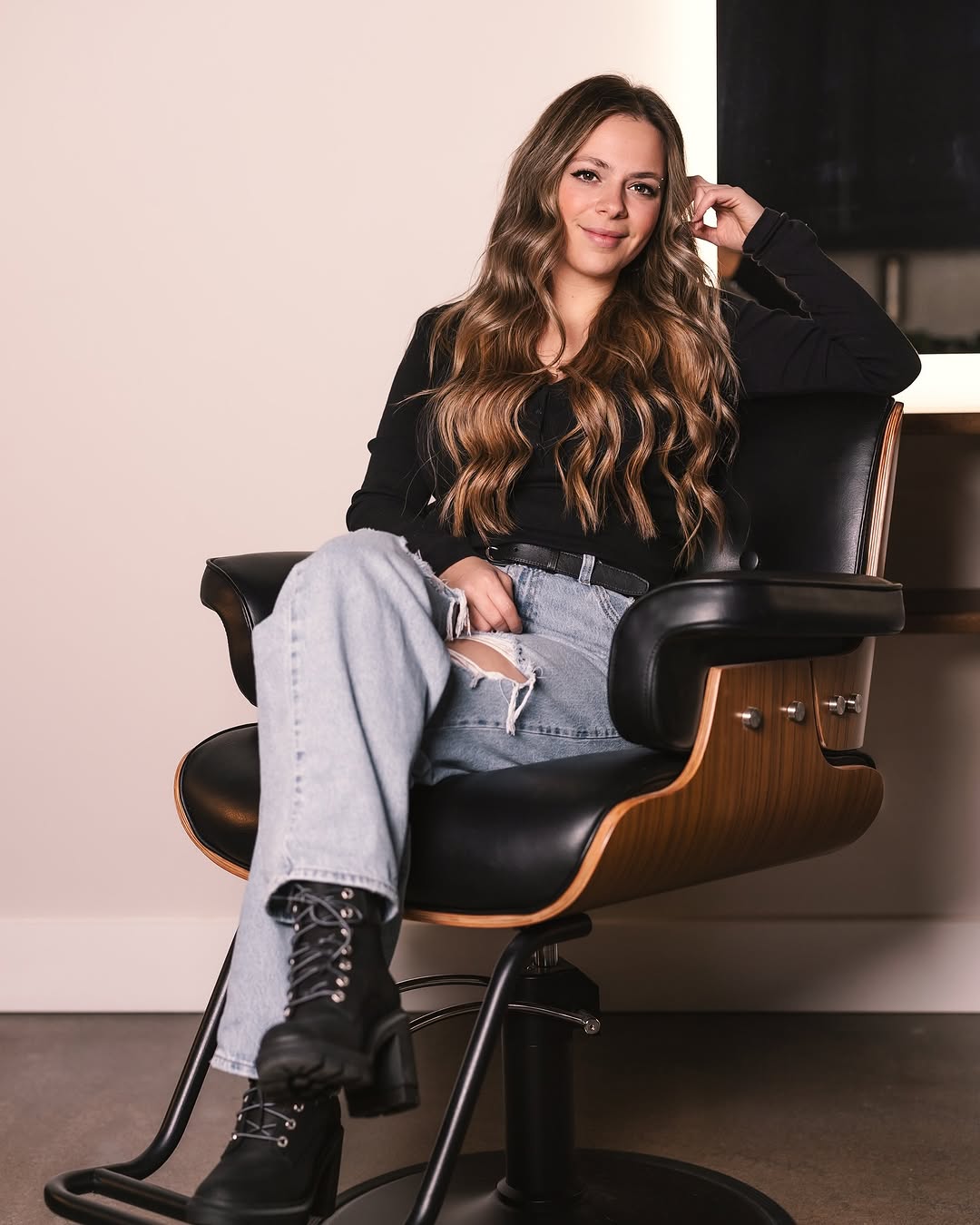
What happens when you mix raw talent, a fearless drive, and a vision for a better salon culture? You get Nikii Beis, owner and stylist at Elevated Studio in Squamish, BC—and my latest guest in our one-on-one salon sit-down.
Nikii’s journey into the industry started in the most relatable way—highlighting a friend’s hair in a bathroom at 16. That moment snowballed into an apprenticeship under a Redken educator, and eventually, the launch of her own luxe, four-chair salon with a big heart and even bigger standards.
We talked about the early hustle, the lack of money (seriously, nobody tells you how broke you’ll be those first few years), and how learning to “show up early and caffeinated” can change everything. “You have to want it,” Nikii told me. “If you don’t, you’re never going to make money doing this.”
One of the most refreshing parts of our convo? Nikii’s no-BS take on toxic salon culture—and her commitment to doing things differently. “I tell my team, if I ever come off the wrong way, I want you to tell me,” she said. “You can’t expect stylists to thrive if they’re walking on eggshells.”
She’s also built a business model that’s as flexible as a balayage blend—offering a mix of hourly, commission, and chair rental options so stylists can grow without needing to jump ship. It’s mentorship with room to evolve, and it’s working.
We got real about mentorship, burnout, continuing education, and why you should never assume you’re the best in the room. Her advice? Stay humble. Stay hungry. And always keep learning—whether it’s from a $1,100 blonding course or just watching a foil placement on Instagram that makes your jaw drop.
If you’re a stylist dreaming of opening your own space, mentoring new talent, or just navigating the highs and lows of salon life, this one’s for you.
🎥 Watch the full video for more behind-the-scenes stories, stylist wisdom, and laughs. Trust me—you’ll leave inspired.
You can find Nikii at:
https://www.instagram.com/elevatedstudio.hair/
https://www.elevatedstudio.ca/?fbclid=PAZXh0bgNhZW0CMTEAAaeG6dT2qgbrhXX1mEe2tsLi1XNSWq6W5Q8puK0pXw-BSDgLM8SEDbqNppX-iw_aem_wuCo0JEtHtHxjGmujmVzlA
Transcript
Liam Shea (00:00)
to okay fantastic. Nikii, thank you for joining me. Would you like to tell me just a little bit about who you are and what you do?
Nikii Beis (00:11)
All right, so I’m Nikki Bace. I live in Squamish, BC, and I am owner and stylist at Elevated Studio here. Yeah.
Liam Shea (00:20)
Awesome. We love elevated studio.
I was going to start at the beginning of you, but like we’ve just said elevated, we might as well. Where are you located?
Nikii Beis (00:31)
So Squamish BC, mid-Southern end of Squamish. Yeah. Since July 17th of 2024. few months here. Yeah. It’s good. It’s finally starting to settle down a little bit. was…
Liam Shea (00:33)
Yep. Yep. Awesome. And how long have you been open?
Okay, that’s brand new, relatively. How’s it feeling?
Yeah.
Nikii Beis (00:50)
hectic at first. was definitely days where I was like, what am I doing right now? But yeah, after the holiday rush and everything, got a little nice relaxing break and yeah, feeling good. Yeah, I know. 11 days away from the salon. was great. Yeah. There are four chairs.
Liam Shea (00:55)
Yes.
that’s nice. You took a break. Whoa. It’s amazing.
How many chairs are there? Okay, all full?
Nikii Beis (01:16)
They are all full most days. There’s five stylists of us, including myself. And so some of the girls only work two days. Some of them work four days. Just depends on what they’re feeling and how many clients they have. yeah.
Liam Shea (01:31)
Absolutely. I love
it. Where, okay. So where did you get your start in the industry?
Nikii Beis (01:37)
Okay, so I’m originally from Mississauga, Ontario.
And I was doing my friend’s hair in her bathroom. I just did like highlights of my friend’s hair when I was like 16 years old. I had no idea what I was doing, but I was like, I’m going to try this. And it actually turned out pretty good. Like, I’m not going to lie. looked back at it and like that was a little bad one. But yeah, my friend’s mom went to this super high end salon in Toronto called Exit Salon and her stylist has robbed the owner there. And he was like, Hey, who did your highlights? Probably like, my
Liam Shea (01:56)
Yeah
Okay.
Okay.
Nikii Beis (02:11)
those look terrible.
Yeah, she said, like, like my friend did them. And so, yeah, anyways, long story short, he saw some sort of potential that I didn’t know I had. And he had asked me to come and apprentice under him. So I started going into Toronto every day and started learning from, he was a red can teller technician. I basically like owe him my career, I would say. He definitely got me started, got me interested in it.
properly and yeah, it was a great little start to her. Yeah.
Liam Shea (02:47)
I love that. I love
that. know you’ve got you’ve feel like you’ve got the two, you’ve got the people that say finished or didn’t finish high school and didn’t know what to do and so thought it would be easy or something like that. And then you’ve got you and I, because I was what I left home at 17. I dropped out of high school and I was at the bar of a restaurant. Maybe I was 18 at that point, possibly 19. And I
needed a haircut and I wanted to quit the job I was at. I heard somebody mention a salon I knew of and I went and chatted him up at the bar and he offered to give me a free haircut the next day. I said, why are you trying to get a free haircut at a bar? I said, I want to go looking for a job and he said, we take one apprentice on every two years and ours is done in two weeks. Are you interested? So it’s that same like that’s lucky.
Nikii Beis (03:34)
That’s it.
Yeah, just happened to be in the right place at the right time. Yeah.
Liam Shea (03:40)
I liked fashion, but like hair, I’d never held a brush in my life.
I didn’t know what I was doing. It was like the error part of trial and error was was strong. Yeah, yeah. Mm hmm. So you did did you do an actual apprenticeship?
Nikii Beis (03:51)
Yeah, yeah, there’s definitely a lot of mistakes that happen
So I started my apprenticeship with him and he actually told me, I think it’s a right time for you to go to school, to go to school. And I was kind of surprised because he had always been like, oh, like, don’t worry about hair school. They just build bad habits, blah, blah, blah, which I was kind of like, ah.
I mean, there are some bad habits don’t get me wrong, but I still think it’s important. But yeah, he sent me to school. And then when I finished and went to return, he was like, look, I kind of knew I was like, losing my salon. So I’m going to send you it to the other people who work here and they’re opening up a salon. And then it kind of just kept going from there. I
Definitely butt heads with one of the salon owners at the new salon I went to. So it was a shorter lived experience there. I learnt a ton, but it was, in the end of it, was just, like I would go home crying at night, which unfortunately is actually like, it’s part of our industry. Like we, think it’s the toxic part of our industry.
Liam Shea (04:50)
Yes.
Yeah. Yeah.
Yes.
Nikii Beis (05:02)
However, it is a part of our industry that I learned quickly. I actually wasn’t interested. I don’t care what kind of education I was going to get. I wasn’t interested in it anymore. So yeah.
Liam Shea (05:12)
Good for you. Most
of us, I shouldn’t speak on behalf, many of us I think are a combination of too young along with too ignorant to know what you shouldn’t put up with. And so the stories I hear, especially depending on how long you’ve been in the industry, feel like it’s, I don’t feel like, I feel like the industry is better than it was when I started 25 years ago in that way.
I don’t feel
Nikii Beis (05:38)
Yeah.
Liam Shea (05:38)
like a new person in the industry is vastly more likely to understand, but it does seem like more people know it’s not okay to treat you a certain way. I worked with someone, I won’t say who and I won’t say where they started, but they were assisting at the salon they apprenticed at and they were holding a bleach bowl for their stylist that was doing color and.
think was 10 or 11 p.m. at night and they yawned and the stylist painted bleach on their tongue while their mouth was open and said that’ll teach you to yawn while you’re assisting me and she didn’t do anything about it she just sort of took it and I don’t think that would be as likely so there is you are right there is a toxic part of the industry
Nikii Beis (06:28)
say like there’s like I’ve been doing hair for like 16 years now right so there was it was a different time not that acceptable but it was a different time and I feel like it actually made me not saying I’m a great or anything but I do think that it makes me a better mentor because right now like I look at like my junior stylist my little baby stylist and like I’m trying to protect her from
Liam Shea (06:35)
Yeah.
No.
Nikii Beis (06:54)
everything possible. Like I’m like, hey, if you don’t like something, like I want you to tell me, like if I come off the wrong way at all, like please do tell me. And I think it’s important. Like I feel like more salon owners need to understand, like you cannot create a toxic work environment because they will not thrive and then they will not grow. And yeah, we’re setting them up for failure. So it’s a hard as is like clients are hard enough as is we don’t need the mentors and the owners being the same way.
Liam Shea (07:15)
And that
Yes.
you’re
already gonna cry at the best of times. Like you’re gonna go home in tears because you’re gonna take something someone said personal or you know when you start I’m sure it was the same for you. I don’t have nearly as much of a problem if someone doesn’t come back again at this point. Okay cool whatever we weren’t the right fit but at the time like I should go home and commit seppuku. Obviously I am a terrible person on every level and deserve
Nikii Beis (07:41)
Yes.
Yeah. Yeah.
Liam Shea (07:53)
something bad to have, yeah. It’s already gonna be difficult enough as it is at the best of times. Well, that’s lucky that they have you. And then they’ll all leave at once, right? You will always, like every five years, the entire staff will walk out the door at once.
Nikii Beis (07:54)
Yeah, no, I agree.
Yeah.
Yeah.
Yeah, I’m definitely prepared for it. I know it’ll happen.
Liam Shea (08:20)
Well, yeah,
but ideally, if you’re treating people right, you won’t get the total walkout. You know, you might get the version where one person goes off and does their own thing, which I’ve always felt is supposed to happen to a degree, especially with young stat. Like, I’m going to mentor you and then you’re supposed to leave home. It’s still hard and it still feels personal. But the goal is to create a productive member of our industry to me.
Nikii Beis (08:25)
Yes.
So something
I’m trying out and I’m not sure if it’s the right way to go. It’s just, mean, obviously it’s my first time having a salon. So something that I’m giving a go to this time around is I’m doing…
a salon that’s like, have my hourly baby stylist and then I’m going to have my commission stylist and then I have chair renters. So I’m offering more than just that whole, you’re on hourly or commission. In the hopes that, you know, instead of you leaving and going to a better opportunity because you don’t want to be on hourly or commission anymore, maybe we can switch you over to chair rental when it becomes appropriate time for you. Like you’ve filled up all your days. You feel like you could make
more on your own, you feel like you could handle ordering all your own products and making sure everything’s in here on time and then that. So yeah, I think that that for me was kind of my way of being like, you know, this way I can kind of take on different levels of stylists, different experience levels, and everyone can kind of help each other and grow that way. And yeah, hopefully that was the right.
Liam Shea (09:39)
Yeah.
I think that’s amazing.
Where I got my start was like that. It was mostly, I think, what was it? It was 12 chairs, 13 stylists, and an assistant slash apprentice at all times. And I, for two years, was the assistant slash apprentice.
Yeah, okay. I was the assistant slash apprentice and they you started on the floor as a they didn’t really say junior stylist, but you started as the floor is it on the floor as a new stylist and you worked your way into commission, whether your minimum wage or commission, whichever was higher as what you got. And then when you were ready, when you felt like you wanted to pay chair rental, you just switched to chair rental.
So that way, like you said, there’s a place for you to grow into if you not everybody’s going to be that person, not everybody wants to. And then a bunch of people will go independent and stop. and then some of us, and I’m guessing like you and I can’t help ourselves and we’ll have to keep doing the next thing.
Nikii Beis (11:05)
Yeah, I always told
myself I was going to open a salon, so this is kind of just like, okay, well, I’ve done everything else and I feel like I’ve succeeded in everything else, so, yeah.
Liam Shea (11:08)
Yeah.
Yeah. Do
you find
I had a tendency to, know, early on I kept my mouth shut. And then not that long after that, I started to voice my opinion. I’m not great at keeping my opinion to myself. And I think I wanted to be independent at a certain point because I wanted to, if I’m going to spend all this time talking about what I think would be a better idea, at a certain point I needed to prove to myself that it was a better idea and not just say it.
Nikii Beis (11:34)
Me neither.
Liam Shea (11:51)
I don’t know if you felt like you wanted to see if your idea was going to work or not or you just wanted to control your environment.
Nikii Beis (11:59)
Probably a little bit of both. Like I love the salon that I was at beforehand.
it was awesome. Chair renting and everything, it was just kind of that point where I was like, you know, I think I got to try this. I told myself in my 30s, I would give it a go. So was like, you know what, I’ll give it a try. I’ll see how it goes. And like another part of it was like control your environment, right? Like I would like certain things and I wanted to try different things. And I feel like when you’re in somebody else’s space, there’s only so much that you can do that feels appropriate and anything past that. Like I feel like it’s too much to ask too much.
to do it. So yeah, it was more so like seeing out something that I always had wanted. And yeah, it was just the next step.
Liam Shea (12:36)
Yes.
So you decided to open a salon. It’s really hard to do. It takes a long time from inception, from the point that you decided you were doing it, how long did it take until you were open, let’s say?
Nikii Beis (12:48)
I did.
Well, I had kind of said to myself, so I moved out to BC about six years ago now. I had said to myself, oh, like I’ll give it like a year or two and then I’ll probably open a salon. COVID happened. And so I was like, wow, this is probably the worst thing that could have happened at this point. And so I told myself, okay, I’ll look back at it a years from now, whatever. And then…
Liam Shea (13:14)
Yep.
Nikii Beis (13:26)
things just got easy. I loved the salon that I was at. Everything was easy. Everything was pretty flawless. The owner was great. And so I just got comfortable. then one day I was like, no, I told myself I wasn’t going to be comfy. What am I doing? So I started looking for places to lease. And I actually found this place very quickly because everything I had looked online, I was just like, yeah, not interested, not interested. I came to see this place and I was like, oh, it’s too big. I kind of just wanted a little studio for myself. And then I sort of
about
it, like, you know, it actually wouldn’t be a bad thing to have stylists and it wouldn’t be a bad thing for me to have somebody I can mentor. And yeah, I just kind of started thinking about it. I’m like, it’s just a little under a thousand square feet. So it seemed like it was going to be way too much. And now in hindsight, I’m like, I could have went bigger than this. Like, I mean, I have great stylists, but at the same time, like I have, like everything has worked out the way it has because of the opportunity I took and how it went. So, yeah.
Liam Shea (14:26)
Was it empty when you saw it the first time? Like a totally empty? Yeah.
Nikii Beis (14:29)
Totally empty.
Actually, the walls that are around me right now didn’t exist. It was a concrete slab. My unit actually was like one big unit that was then split in half. So there’s 101 and 100 of our units. And it was always originally 101 and then it became 101.
Liam Shea (14:34)
Right.
Nikii Beis (14:50)
We built a wall, we all the electrical, the plumbing, all that kind of stuff together, like we worked at it together and yeah, it was a lot of work. Like I to leave this place in…
December, like beginning of December, 2024. Everything was signed and done and decided on. And then like we got started. I think we got our building contract in like mid January or something. And then just kind of got started. And after every single delay that could have possibly happened, we opened in July. So we’re hoping for like March or April, which is probably like a unrealistic goal, but at the same time, it is totally.
Liam Shea (15:26)
Yeah.
That’s a little hopeful. That’s okay. It’s okay to hope.
Nikii Beis (15:36)
But I thought for sure like June would be the latest that we would open. And then I was like beginning in June and I’m like, don’t have a place to work as of April 1st, because I told my previous owner I would be out for sure. I’m sure she would have found me a space. But if she had leased to somebody else or something else had happened, then I wouldn’t have had a spot. So was kind of like, let’s go.
Liam Shea (15:54)
Yeah. It’s interesting when you see a space empty because you were saying you saw it thought it’s too big. It’s so different to see it empty. You imagine it’s larger than it is like a thousand square feet. Big empty, especially if it’s a big rectangle and empty. That’s a big space. But the minute you put walls and things, it shrinks quite quickly. You get to that point where you’re like, wait, how many chairs can I fit in here? that’s not a lot of space. How do I? Yeah.
Nikii Beis (16:00)
Yeah.
Yeah.
Yeah.
Yeah, I originally had wanted three hair sings in here and then I started looking at it and I was like, people are going to be like touching elbows and like my whole thing was I want it to be spacious. I want to be like more of a lux salon where you might want.
Liam Shea (16:24)
It can be sneaky.
Nikii Beis (16:41)
not being right next to your neighbor. You can have a private conversation and not worry about somebody listening in. So the four chairs, I mean, we could probably fit five or six in here. Not really the vibe that we’re going for those. Yeah, but it’s actually kind of cool because like for Vancouver Coastal Health, I had to create like my floor plan and have like, this is going to go here and that’s going to go there. And I did so many little iterations, but now when you look at
my floor plan that I submitted to VZH versus what you actually walk into, it’s almost identical. Like it’s actually crazy. Yeah, it’s actually crazy like how much thought had went into it. Like I drove myself a little bit crazy being like, I have to like, I have to figure this out. And now that we look at it, the only thing that changed was the color bar, which is where like, I wanted it to be big enough so that my chair renters and my, like my commission stylist could have
Liam Shea (17:14)
Mm-hmm.
That’s a… Wow. That’s…
Nikii Beis (17:39)
like their own cubbies. because of course chair renters supply their own supplies, right? So I wanted to make sure that everything could fit and that there would be enough spaces for everyone. However, when I put it in, I was like, my god, this thing is massive. So we actually cut it down to smaller and that’s the only thing that we changed in the whole plan. Everything else went exactly how we had planned it. So yeah, that was good.
Liam Shea (17:41)
Right.
That’s really impressive and super lucky. That’s great.
I love it. Okay, so if we went back into in time when you were just about to start your apprenticeship, would you what would you tell yourself? What would you tell a young you?
Nikii Beis (18:22)
The first eight years of your career are not going to make you that much money. And then you’ll make money. I think that that’s something that like, we need not like not to normalize necessarily, but we need to kind of explain to stylists. It’s like when you are learning, when you are growing, you’re not making much money. And you have to accept that. like, luckily, I was in a financial position where I could
Liam Shea (18:30)
Yeah. Right.
Nikii Beis (18:51)
not be as concerned and that’s not always the case right but I yeah I didn’t realize how little of money you made at the beginning and so I was always like my god am I gonna make money in this am I gonna make money like what’s happening and yeah
Yeah, I would tell myself that. You will make money at one point. And I do remember my, so the second salon I went to work at where I was saying I butt heads with one of the stylists, but not the other, or one of the owners. So the other owner, I remember she sat me down one day and she’s like, I just want you to know, like you can make six figures being a hairdresser. It takes time, it takes a lot of practice, but you have a skill and you’ll get there at one point. So she’s like, just don’t give up. And I think that that kind of always stood
Liam Shea (19:12)
Yes.
Nikii Beis (19:39)
out to me and that was always something that kind of yeah it hit pretty hard and so I think even one of the stylists that I brought on I had kind of said like hey like you know if you if you do go to chair rental like you do have potential to make quite a bit more than you would think so it’s something to look at so sorry somebody doing something outside of my door right now and trying to get me
Liam Shea (20:03)
It’s okay.
Denver will figure out to cut out certain parts. Is it loud? Did you say go for it?
Nikii Beis (20:08)
We will just ignore that.
No, I just don’t know what she’s doing.
Liam Shea (20:15)
You’re allowed to peek. You can be a looky-loo. You can wanna.
Nikii Beis (20:19)
That’s fine. I’m over it.
Liam Shea (20:26)
Yeah, I made pennies for a really long time. It also took me a while. So once I left where I did my apprenticeship, I went right to chair rental about four years in give or take.
Nikii Beis (20:30)
Yeah.
only four years in a.
Liam Shea (20:43)
Yeah, was just it was the only at the time it was the only way out that I saw.
Nikii Beis (20:46)
Yeah.
I think that’s amazing by the way, I’m not saying that in a bad way. just think that’s amazing that you felt comfortable and that you were excited.
Liam Shea (20:55)
No, no, no, it’s-
Well, I’m not going to say I felt comfortable.
think I was so uncomfortable at the time that there wasn’t anything that was going to be more uncomfortable. I already didn’t make money, right? I already made such a smaller money and I had lived with roommates from day one. My rent was relatively cheap. So I, you know, I was in a good position in that way. but it just kind of had to happen.
Nikii Beis (21:11)
Yeah.
Liam Shea (21:30)
But when I did it, I know for myself, and I don’t know, I don’t know, it sounds like it was a different place where you were. I struggled a little bit with that sort of high school mentality of.
I’m not busy because of other people. I’m not busy because of externalities. And it took me, I would say, maybe two years almost of chair renting before I realized I had to make the choice to hustle and to show up. To not do that thing where I glide in exactly the time my client gets there or two minutes after and…
and moving slow and blaming others and, and did you have a moment or did you find from early on you got that? Like, did you have a moment where you understood when that person said you can make money, that hustling was going to be the thing you needed to do?
Nikii Beis (22:28)
I think that…
When I moved out to BC, I just was like, I have to move. I have to start making money. Like, it to happen. And so when I moved out here, I was commissioned for a little bit while I was like building a clientele. And then I slowly started to see like, okay, like chair rental is going to make me more money as long as I hustle. And so I do feel like that mentality definitely kicked in when I was just like, I’m a chair renter now. I’m paying by the day. That means if I have to go in and I have to work a 12 hour day to make sure that I’m making enough money.
Liam Shea (22:49)
Right.
Nikii Beis (22:59)
I’m gonna do it.” And slowly that ended up being that like, aha thing for me where I was like, yeah, I don’t walk in right as the client comes in. Like, no, I’m there half an hour before. I’m setting up, I’m getting ready, I’m making sure that I have caffeinated myself because I’m not the best human if I don’t have caffeine in me. And I just like…
Yeah, you just, change. I think there’s like this point where you just realize, okay, like it is me and I’m the reason I’m not making money and you can make money doing hair. You just have to actually be pushing and you have to be wanting it. Like you have to want it. If you don’t want it, you’re never gonna make money. Yeah.
Liam Shea (23:35)
Yeah. Yeah. Yeah. Yeah.
I mean, I remember the day I made the decision. And so I started showing up to work 90 minutes early. I went to the cafe across as well.
Nikii Beis (23:46)
That’s it.
Liam Shea (23:51)
It might have something to do with I’ve been I’ve just come on the other side of a multiple year journey of finally coming to terms with the fact that I have ADHD and I didn’t want to come to terms with that fact and I fought it for a long time. But what’s been interesting coming on the other side of it is starting to realize which things are just how your brain works. So I know a lot of people have struggle with time management and I was thinking, well, why don’t I struggle with time management?
Nikii Beis (24:01)
Yeah.
Liam Shea (24:20)
And that’s not really true. I realized I had two modes of time, either on time exactly to a little bit late or the day before. Like those are the choices I had. So I decided I was going to try and show up to work 90 minutes early, go across the street and have a breakfast sandwich and a coffee, chat with the owner there, get in the head space that I needed to do, walk into the salon an hour beforehand, set up my, as my
Nikii Beis (24:31)
Yeah.
Liam Shea (24:50)
chef friends call up my mise en place, get all set up. And so then I have from my setup to when my guest arrives, I have like 30 minutes to just be in the space and not feel rushed and plan what I might need to plan for each person that’s coming in that day. And I, from that moment on that I did that, I started making more money immediately. I think sometimes some of it has to do with
your guests know if you want to be there or not. Like people can tell if you don’t want to be there so they tend to be drawn and attracted to a person who’s having a great time and wants to be there and shows up and the person is like all day long.
Nikii Beis (25:39)
also think that there’s a point where you have to realize if I don’t have fun being there, my client’s gonna see that. They’re not gonna have fun either. They don’t wanna come in when you’re just like, yeah, I guess I have to be at work. Your job should be fun. Hidressing is so much fun. I enjoy it every single day. Every client that comes in, okay, obviously there’s one or two here and there. There’s gonna be, but it’s…
Liam Shea (25:57)
me.
Yes, but-
Nikii Beis (26:03)
It is so rewarding to like listen to people say, hey, like this happened in my life. And like, like you like follow people’s journeys. Like sometimes.
It’s unfortunate things like your client will get cancer or something and you’ll like you’ll be following that journey. But other times it’s like, hey, I’m going to school for this. Hey, I went to school for this. Hey, I got the job doing this. And then, hey, I finally got my dream job. know, like it’s so rewarding to like take people’s energy on and then you feel.
I don’t know, you just, you show your clients like, I’m really excited to be here I’m really excited to hear everything that you have to say. But you have to be in that mindset. Like, Hey, I want to listen to this. If you don’t want that, then you shouldn’t be a hairdresser. Cause a big part of it is taking on your client’s energy and working with it, not just being like, I’m going to just be blah today. So yeah.
Liam Shea (26:46)
Yes.
Yeah, it’s such an intimate job.
I mean, you’re touching people immediately. So you get closer quickly because of that, or theoretically. Yeah, even the, even the sad journeys, like you were talking about a client gets cancer, even those journeys are just as special to be brought along with, with someone like to be a part of ups and downs.
Nikii Beis (27:12)
Yeah.
Liam Shea (27:30)
I feel like I’ve gone through wild things with people that just sit in my chair every six to 12 weeks. I feel a part of families that I’m not a part of. I feel like I’m best friends with people that I’ve spent 10 minutes with outside of the salon total. I feel really it’s a lucky, we’re lucky to get to do it, depending on who you are, obviously. I don’t think everybody feels lucky to do it.
Nikii Beis (27:41)
Yeah.
Totally.
Yeah, I will also say I’ve actually found a lot of like my good friends through work as well. Cause like you sit with clients for like two, three hours and it’s like, you like a free interview for like a best friend. It’s actually pretty cool. And I used to think like, no, there has to be this line with clients where like, oh, like, you know, they’re, clients, they’re not.
Liam Shea (28:10)
Yes.
Nikii Beis (28:18)
friends, but it’s like, no, you can kind of just be friends with all your clients and you can have more of a personal relationship. And if people want to like take that personal relationship outside of the salon, if you’re comfy with it, then do it. You might find somebody who you’re like, this is actually like, I think this person might be my new best friend. So you never know. Right. And I feel like when I moved to a new town, actually, I met a lot of people through work and created like a pretty awesome community because of that. So
Liam Shea (28:45)
I completely
agree. Yeah.
Nikii Beis (28:47)
something to remember as well.
Liam Shea (28:53)
Did you have any mentors early on? I mean, I know you talked about that first hairdresser who said that you should come. And so obviously that’s a mentor.
Nikii Beis (29:02)
Yeah.
Yeah, I would say Rob was definitely like, he stood out. was patient. I was 17 years old. Like I was a little shit for lack of better words. I like, I just remember he was trying so hard to teach me everything and like I took as much as I could, but I was still a 17 year old kid. So he did such a good job. And then when I moved on with like the next
Liam Shea (29:15)
He he.
Nikii Beis (29:32)
to people that I worked with. As I said, like I butted heads with the one guy, definitely. But he still taught me a ton. Like he taught me tons with cutting. And then the lady who owned the salon as well, she taught me a ton with like coloring and just giving me like the confidence to feel comfortable as a hairdresser. Like as I said, she was actually the one who mentioned to me, like you can be a six figure stylist, you just need to stay in it and you need to work at it.
Liam Shea (29:37)
Mm-hmm.
Nikii Beis (30:01)
that was pretty good mentorship in my opinion. Like I think they, all three of them did a great job, even though I would never go back to said salon. Yeah, exactly. I do think that they did a great job, like helping me mold into the person that I am today. everything else that I went on from there, I can’t, I can’t say I had a good time at any of the other salons I worked at.
Liam Shea (30:13)
One thing has nothing to do with the other. Yeah.
Nikii Beis (30:28)
I went independent pretty quick after those and I started working at a little studio that was actually a tanning salon, funny enough. The owner was awesome. It was a tanning salon. It was the only hairdresser there and it was good. I had my own little room and then we thought we were moving somewhere else so I like quit there and then it turned out we weren’t ending, like we didn’t end up moving somewhere else. So I started working from home and then…
Liam Shea (30:55)
Okay.
Nikii Beis (30:55)
We got to BC, so pretty independent after that.
Liam Shea (30:59)
love it. I feel like.
Access to mentorships is quite different now because I, you you said you’ve been doing it 16 years. So that would be a year maybe before Instagram even came into existence and several years before it was a tool that was used consistently by the industry.
Nikii Beis (31:22)
Yeah.
Yes.
Liam Shea (31:28)
If somebody were looking for like, what would you say to somebody now who was coming up in the industry and sort of wanted mentorship?
Nikii Beis (31:36)
I think courses are so important, but also just going on Instagram and watching how somebody does something. There is so much free education online.
Liam Shea (31:44)
Yep.
Nikii Beis (31:47)
you can pay for course X, and Z and like learn a ton, but you can also learn a ton like if you as long as you have those basics, which is where schooling comes into hand and everything, right? Doing an apprenticeship at a salon. As long as you have those basics, like Instagram teaches you so much. And like I still go to many courses. I do many courses online. Blonde Chronicles is actually one of like my favorite like go-tos with my junior stylist to be like, hey, go watch this, go check it out. I think she does like a
Liam Shea (32:13)
OK.
Nikii Beis (32:17)
great job with that, like the platform and everything, but I do think that you can just learn things by watching people. It’s like, like, look how she just put that foil in. Like, I wonder if I try doing that next time. So there’s a lot of times where I’m like, I’m just going to give that a go and either works or it doesn’t work and I never do it again.
Liam Shea (32:34)
Yep. I still 25 years in get my mind blown on the regular where you’re like, that’s an option. How did I not know you could do that? What do you mean your foil doesn’t slip? How did you, what?
Nikii Beis (32:39)
Yeah. 100%.
I
also think there’s something to be said. You are never going to be the best hairdresser. You will always learn something from every single person that you’re around. I can learn something from my junior stylist. I can learn something from any of the girls who work here. It doesn’t matter your skill level. You might know something that somebody else doesn’t know. So for me, it’s like important to remember don’t…
discredit anyone ever. You’re not better than anyone else. You are never going to be the best if you are not open-minded. And if you’re open-minded, you’ll take in so much knowledge, and that’ll help you be a better stylist.
Liam Shea (33:17)
Hmm.
Yeah, love it. think the Buddhists call that beginner’s mind. Approach everything as if you know nothing and you will learn everything. I also found, I don’t know if you found the same thing, I found at a certain point I started to realize the most successful hairdressers that I knew weren’t necessarily the best hairdressers I knew. And it didn’t seem like
Nikii Beis (33:33)
Yeah.
Liam Shea (33:57)
skill level had a direct correlation with financial success. Did you find anything similar?
Nikii Beis (34:05)
Yeah, kind of. definitely feel like there’s, ooh, I have to be careful how I say this. I definitely think that there’s like a little bit of like a god mentality with a lot of stylists.
Liam Shea (34:16)
Yes.
Nikii Beis (34:19)
I just, I think that being humble is a lot better of like an approach and being humble might actually help you make more money and help you just keep clients more. If you’re not humble, at least a little bit, I think that people will start to see through that fairly quickly. yeah, I do think that there’s a lot of stylists.
Who do you have that god mentality and we’ll see how it goes like I mean Instagram is an amazing tool sometimes It’s not necessarily the best tool for the client to find Silas because they’re really just they’re looking for like who thinks that they’re the best not is actually the best so There’s goods and bads to that
Liam Shea (34:55)
Yes.
Yes, it definitely Instagram definitely has. I find most hairdressers that are really active on social are probably speaking to other hairdressers more than they’re speaking to prospective clients like it tends to be a bit of a circle of showing off and trying to impress each other as opposed to hey, here’s the experience you’re going to have when you come in to see me. You’re going to feel like this when you arrive.
Nikii Beis (35:30)
Yeah. Yeah.
Liam Shea (35:33)
And this when you leave, which
like for me is my goal. I don’t really care what it is we’re doing on any given day, as long as you leave happier than when you arrived.
Nikii Beis (35:41)
Yeah.
Yeah, 100%.
Liam Shea (35:48)
Yeah. and so education, you talked about that. You’re obviously a fan of continuing education. Keep going.
Nikii Beis (35:49)
Yeah.
Yeah.
Always,
always continue education. I would say that that’s something that you should be doing like every few months do a course whether it be just, okay, I’m going to scroll on Instagram and follow like my favorite person who like I like her techniques. Let me just go and refresh on everything. That’s fine too. That’s education. You don’t necessarily need to spend a ton of money on education. You don’t need to go and buy that $1,100 course for Blonding. You can learn a lot.
outside of a course where, yeah, there’s a lot of courses that I find like I’m like, yeah, like I think that that would be awesome. Do I think that it would give me $1,100 worth of education? Or can I put that $1,100 elsewhere? I find that something that I struggle with a little bit. So sometimes I will not do a course based off of price. So yeah. Like I’m not saying that they’re not worth it. I’m not great. I just think that money can be put better elsewhere.
Liam Shea (36:43)
Yeah, I know I struggled early on. Pardon me? No, no, no.
Well, it depends how much money you have. I mean, if all you have is $1,100, I’m not sure that course is the thing to spend it on. I also find it depends on how you learn. I didn’t do well when there were only in-person courses where like day one was look and learn and day two was hands-on. For me, I needed to see a thing a thousand times in a row. And that’s okay.
Nikii Beis (36:56)
Yes.
on your.
Yeah, sorry.
Liam Shea (37:22)
Once I’d
seen something a thousand times in a row and then I replicated it a thousand times, I was good. So I found I’d usually get one or two things out of a course, but I struggled with retaining three straight hours of showing me how to do something. I’d only be able to remember a bit of it. Whereas now I find with online stuff and it’s not the same for everyone. Some people really like hands-on. I don’t like doing it immediately after I watched it unless it’s
Nikii Beis (37:35)
Okay.
Yeah.
Liam Shea (37:52)
Now it’s a little different. It’s a little easier for me to take a thing I saw briefly and go and put part of it to work. But yeah.
Nikii Beis (38:02)
think that there’s like this thing where if you have like a pretty solid base you can easily intake information right so where I am at my like in my career now it’s like okay yeah I can take in like I saw this thing on Instagram let me try it I wouldn’t have been able to do that five
eight years ago, whatever, right? Like it’s how strong is your base? And then from there, your education will depend on that, right? If you take a junior stylist and you send them to that $1,100 course, they might not intake that information because they don’t have the base of that, right? So like courses are so relative to where you’re at in your career and what you need to learn. So that’s also a big part of continued education for me. Yeah.
Liam Shea (38:47)
Yes. Yes.
Nikii Beis (38:49)
I love it, I encourage it. I think that it needs to be based off of what you actually need and what your base is.
Liam Shea (38:56)
that makes sense to me. Yeah.
I’m going to pivot a little bit in terms of what I do, the digital side of technology. So separate from just doing hair itself. At what point did you start using digital tools of any sort, whether it be like Salon Monster for online booking or, or just tracking things at what point did you, has it been the whole time in your career or did it happen at a certain point?
Nikii Beis (39:03)
Yeah.
Yeah.
When I went, like, independent back in Ontario, I had my body for a little bit, which is very expensive. Like, not necessarily what I needed for what I… It was. Yeah.
Liam Shea (39:43)
It was kind of the first at a certain point, but it wasn’t
really at the, mean, I know I tried it early on. It wasn’t really built for our industry.
Nikii Beis (39:50)
No, it was definitely built for more like yoga and RMT and like all those kinds of things. If honestly, if Salon Monster had been there at that point, I would have given that a go. Yeah, I went with the Garo at the old salon. That’s just what we had and it worked pretty good. I do like the online booking portion of it, but there’s times where I’ll see like one of my regulars book in and I’m like, you just booked in for root ketchup. Like you need highlights girl. What are you doing? So there’s this.
Liam Shea (39:55)
Yeah.
Awesome.
Yes, yes. You can’t book for the
amount of time you want to be here for. That’s not. Yes. Yes, exactly. Yeah. So how did you, did you find digital tools? How did digital tools help you the most? What was the aspect of digital tools that helped you the most?
Nikii Beis (40:22)
Yeah, or the amount of money that you want to spend. I promise you, it makes a difference.
I mean like there’s like like in terms of like online education and stuff or
Liam Shea (40:42)
Or just any
digital like, you find even with like salon software, did you find the having online booking was the thing that did it for you? Did you find having automated reminders, thing did you find tracking of client information? Like what are the things within digital tools you found effective for you?
Nikii Beis (41:00)
I mean tracking your formulas and stuff like that through an app is so much easier. Like if I can just pop open a client’s profile and be like, cool, like last time we did this and she said that it was too warm, then this time we’ll do this instead. Having clients be able to go online and book themselves is fantastic. And I do encourage it most of the time, but I do also ask my clients to pre-book before they leave. And I do like the feature of re-book.
or check out, I think that that’s awesome. I think that that’s been done very well. Yeah, it’s Automated reminders are the best thing. You cannot tell me that you’re missing your appointment because you forgot. Sorry, you’ve got however many messages you need to show up. yeah, it’s good things. then enforcing a cancellation policy, I love having the credit cards on file.
Liam Shea (41:33)
the pop-up message that comes in there. Yeah.
Yes. Yes. Yes.
Nikii Beis (41:53)
I rarely enforce it, however, that being said, when I have to, I will. So, yeah.
Liam Shea (41:59)
Yep. I’m
a big fan of of a structured cancellation policy to leave leave little room. I know for myself, I require 24 hours notice for every hour length of appointment time. So like if you have a three hour appointment, you got to tell me three days in advance. I have a cancellation list, but I can’t always fill three hours or four hours tomorrow.
Nikii Beis (42:24)
Yeah.
Yeah.
Liam Shea (42:26)
Like I
might be able to the day after or the day after that, you know, I can fill an hour tomorrow probably, but three hours might be tough.
Nikii Beis (42:34)
Yeah, no, I agree. That’s actually a really good idea per hour. It’s not necessarily a bad idea. Maybe I’ll give that a go.
But I’m like, as I said, I really enforce it. It’s one of those things, right? Like I had a client yesterday who was like, hey, there any way I can push tomorrow’s appointment, which is today, obviously, but tomorrow’s appointment to early April. And I was like, no, because I need like I needed 48 hours notice. I’m giving you a three hour appointment, right? She’s totally cool about it. She’s like, okay, I’ll show up if I have to. And I was like, look, I’ll try to fill it. If I can fill it. Don’t worry about it. We’ll just we’ll move you to April. And I found someone to fill it, luckily, but I was like, God, it’s a
Liam Shea (43:09)
Right? Yeah.
Nikii Beis (43:11)
pretty big appointment, right? So you’re like, I, it’s a Wednesday morning. How am going to fill a Wednesday morning for a three hour appointment last second? So it happens sometimes, but I won’t charge you if I can fill it. But if I can’t fill it, yeah, definitely.
Liam Shea (43:18)
Exactly. Exactly.
That’s a nice way of going about it too.
Yeah, yeah, I’m a huge when I do walkthroughs with new salon monster users, particularly people that are going independent for the first time, going into booth rental and salon suite rental, I usually sort of pivot away from the spiel where I show them how to use salon monster and shift towards by the way, do you have a cancellation policy? And do you know how to enforce it and
Do you know how to use these? I know within Salon Monsters booking settings, one of the things that I use for my cancellation policy is I don’t let clients cancel or move their own appointment within 72 hours of the appointment. So if they try to cancel it two days out, it’ll say, you can’t, you have to get in touch with me so I can say, well, the reason is you can’t. I mean, you can, you can.
Nikii Beis (44:11)
Thanks.
Liam Shea (44:22)
I say to everyone, especially no shows who I charge 100 % for, I always say the same thing to them because they always offer to pay right away. I say, can pay me to watch Netflix in my free time as often as you like. It is not a problem. Don’t feel bad if you pay me for it. Feel no guilt. I just sat back and got other stuff done if you’re paying for it. I don’t care one way or another. Yeah, although I prefer to be doing hair.
Nikii Beis (44:30)
Yeah, that’s nice.
Yeah.
Liam Shea (44:51)
Are there any other, so when it comes to those types of structures like telling, so you get, you know, a new, a junior stylist, do you talk to them about that side of the business, about cancellation policies, about…
Nikii Beis (45:04)
Yeah,
like slowly over time, right? Don’t want to throw too many things in there at once. But yeah, let them know over time how they have to go about dealing with all of that. So yeah, try to teach like the little basic things. I mean, she’s my first junior stylist. I’ve never had another junior stylist, I can’t say from lots of experience.
Liam Shea (45:15)
Love it. Love it.
Fair enough, nothing to compare it to.
are one or two things, if you’re speaking to somebody that’s about to open their own shop like you, and they’re about to bring on a junior stylist, what are one or two of the things you’ve kind of learned, either things to do or things not to do, both of which are equally important?
Nikii Beis (45:34)
Yeah.
guess if you’re if you’re bringing on a new stylist make sure they actually want it I feel like like my junior stylist wants it so that’s awesome I can’t even call her junior salad she was like older than me but my my baby’s Dallas she definitely wants it so was more so trying to find ways sorry trying to find ways to encourage her to want it even more
So we talked about that, we figured out more things, and that was super helpful. But yeah, finding that and then, I don’t know, if they don’t want to, just don’t bother. You can’t teach people who doesn’t want to be taught. If they don’t want to be taught, they’re never going to learn, they’re never going to succeed.
Liam Shea (46:25)
Yeah, it’s too hard. Yeah.
They just won’t. I don’t think you’re going to last. It’s not easy to do this and it will drain you a bunch of the time, especially early on. And if you don’t want it, I have a friend who rents my chair the days I’m not doing hair and they’ve only been doing hair for maybe 18 months total. They were already in their 30s. It helps when they’re.
Nikii Beis (46:36)
Yeah. No, it’s not.
Yeah.
Yeah.
Liam Shea (47:02)
You know, a 17 year old and an adult human are very different people to deal with as far as like teaching how you have to work. And one of the things I noticed, I talked to Britt early on about this and I’ve done an interview and we’ve discussed her methodologies that she’s used. She’s a hustler, like a hustler. And so she works two days a week on commission at a barbershop, but rents a chair three days a week. And she figured out how to get busy. She
She handed out cards, QR codes, social media. She boosted posts. She would post looking for hair models and boosted those posts. It’s so important to be able to hustle. So it’s great that you have someone that’s hustling.
Nikii Beis (47:36)
Yeah. Yeah.
Yeah. Yeah. Yeah, I think also,
like you want to encourage them to do that too, right? Like there is like, I’ll sit there and be like, hey, like, I’m paying you right now, but go and post on social media, like go do a post, go get yourself some extra followers, like whatever ends up working, right? There’s, yeah, you just want to encourage them. You want to tell them about all the little things, all the little things that you didn’t like and that you like and…
Liam Shea (48:06)
Yes.
Nikii Beis (48:20)
I don’t know, a lot of it is just like, tell your junior stylist about the bad things. Tell them about the good things. Don’t just like, yeah, don’t just expect them to just succeed right away. Like they need to know everything to be able to succeed. yeah. No worries. Thank you for having me.
Liam Shea (48:26)
Yes.
Yeah, I love it. Awesome. Thank you so much for doing this.
Where can people find you on the internets?
Nikii Beis (48:46)
at elevated studio dot ca is our Instagram page for the salon. It’s mostly my work, but also the other girls are all on there as well. We tend to collaborate quite often there and yeah, elevated studio dot ca.
Liam Shea (48:50)
nice.
I love
it. I’m gonna try and find some time to come out there so we can actually do a feature of the salon. I wanna video it and see it in person. So I’m really excited to make time one of these days.
Nikii Beis (49:13)
would be awesome. I’ve seen your space.
Liam Shea (49:15)
Yes, you have. It’s true. Yep. I’m coming. Well, thanks a ton for doing this. Appreciate it. Yeah.