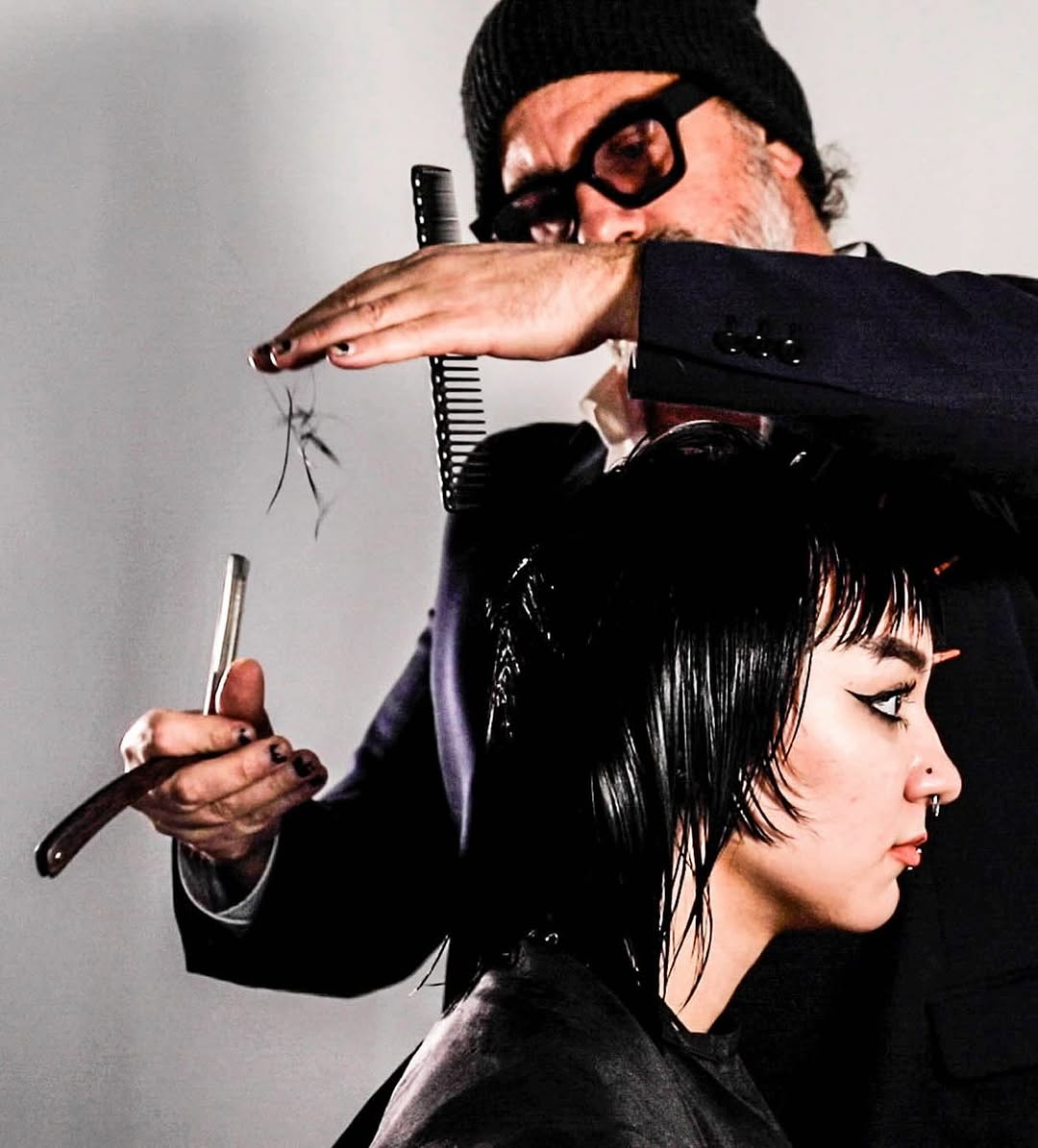
Stephen and I jumped on a call with the legendary Douglas McCoy — hairdresser, filmmaker, photographer, educator, razor nerd, House of Pop owner — and from the first few minutes it was clear we weren’t just talking technique, we were talking career DNA. Douglas has one of those stories that reminds you why you fell in love with this industry in the first place.
He said he “just needed something to do with his hands,” dropped out of high school in time to get into beauty school, walked in on day two and realized, oh… this is way bigger than I thought. From there it was all gas: competitions, apprenticeships, seeking out people he admired and straight-up asking for a shot — including literally getting on his knees in a Starbucks to convince a Sassoon-trained stylist to take him on. That kind of hunger is wild… and also such a good reminder for younger stylists: most doors open because you asked twice.
What really grabbed me was how intentional he was about mentorship. He didn’t “fall into” great training — he hunted it. Ron Matarazzo. Billy Wallace. Howard McLaren. He wanted the Sassoon structure and the Tony & Guy looseness, and he made sure he got both. That’s such a good blueprint for today’s stylists: don’t wait for the perfect salon to teach you everything — find the people who are doing the kind of hair you want to do, DM them, show up, stay on their radar. His take was simple: you’re never too old to go back to basics, and you’re never so good that you don’t need someone to tell you the truth.
We got into the Bumble & bumble era too — that New York pocket where modern razor cutting really cracked open — and you could hear the nostalgia in his voice. It sounded like a Studio 54 for hair: everyone under one roof, experimenting, filming everything, failing together, getting inspired by music videos, fashion, culture. And that’s where Douglas’ love of video started — not “for the ‘gram,” but for learning. Film your haircut, watch your posture, see where you overworked it, see where you should’ve stopped 10 minutes earlier. Stylists talk about growth, but almost nobody rewatches their own work. Douglas does. And he teaches his team to.
I also loved how generous he is as a salon owner. House of Pop started because the space he wanted didn’t exist in Spokane — so he built it. Now he trains people up and fully expects some of them to leave. That’s such a healthy, evolved approach: create a place you actually want to work, teach people everything you know, and be proud when they go start something of their own. “Leave it better than you found it” was his line, and I felt that.
If you’re an independent stylist trying to grow right now, there’s a ton in this convo for you: document your work like it’s your lookbook, get visible in your local community, ask your clients if you can film (most will say yes), and build a circle that actually critiques you — not just claps for you. That’s how you stay sharp in year 2 or year 20.
There’s a lot more in the full interview — stories from Fashion Week, why he still prefers a Feather Plié, why a white cutting cape is a power move, and how music, film, and hair all feed each other in his brain. Go watch the video to hear Douglas tell it himself — he’s funny, real, and he makes the craft feel alive again.
You can find Douglas at:
https://www.instagram.com/douglasmccoyofficial/?hl=en
Transcript
Stephen Parslow (00:01)
like a blessing and a curse.
How’s your day been there today Douglas? Yeah.
Douglas McCoy (00:08)
It’s been incredibly
hectic. Yeah, I’ve got three junior stylists in class right now. And of course it’s taking longer than planned. So I handed it the last bit over and rushed outside.
Stephen Parslow (00:25)
Totally.
Liam Shea (00:26)
That’s a lot.
Stephen Parslow (00:28)
But thank you so much for joining us and fitting us in.
Douglas McCoy (00:28)
Yeah.
Absolutely, my pleasure. Thank you for wanting to chat.
Stephen Parslow (00:35)
always. I’m just gonna do a quick intro here just for our thing. So, yeah, so we’re here today with Douglas McCoy, hairdresser, photographer, filmmaker, educator, and HairBrain Video Award winner. Thanks so much for joining us today, Douglas.
Douglas McCoy (00:52)
Thank you for having me. It’s a pleasure.
Liam Shea (00:56)
It’s such a treat. It was fun. What we first met in New York during the hair brain video awards. I wasn’t even clear that you were nominated until you won one of the awards when we were there.
Douglas McCoy (01:11)
yes, yeah. We’re, I’m moving, I’m moving inside, so it’s going to be a bit quieter.
Liam Shea (01:13)
which is pretty awesome.
Stephen Parslow (01:18)
No problem. Sounds good. Give you a moment there.
Liam Shea (01:18)
No worries.
Douglas McCoy (01:22)
Yeah, give me a minute. Give me second.
Stephen Parslow (01:23)
Yeah, sounds good.
Liam Shea (01:27)
We’re not live.
Stephen Parslow (01:28)
Yeah, exactly.
Douglas McCoy (01:28)
Yeah, I know. I know. And
it’s so wonderful. And it’s so wonderful.
Stephen Parslow (01:33)
Yep.
Liam Shea (01:34)
It’s nice out there right now. It’s the nice weather you got.
Douglas McCoy (01:37)
it’s great.
Yes, it is great. Hold on one second. Not yet. It will be this weekend. It’s been so cold. It’s felt like, felt like October.
Liam Shea (01:40)
Is it roasting hot?
Yeah, same here.
Stephen Parslow (01:54)
Yeah, it’s been a weird couple of weeks. It was the same here. It completely felt like October.
Thought I had the calendar wrong or something. Yeah. Perfect.
Douglas McCoy (02:01)
Okay. Yeah, I know, right? Okay, this should be better. There we go. Okay.
Sorry about that.
Stephen Parslow (02:09)
Hey, no worries at all.
Liam Shea (02:09)
Don’t be.
Douglas McCoy (02:11)
Okay, now we can continue.
Liam Shea (02:12)
You get comfortable, you get cozy, you feel like
you’re get where you want to be, get how you want to be and start whenever.
Douglas McCoy (02:16)
Yes, yep, we’re good.
Yeah, we’re good.
Liam Shea (02:21)
Awesome.
Douglas McCoy (02:23)
So what was the question? Let’s do it again. Take two. Take two.
Stephen Parslow (02:24)
Perfect. So yeah, go ahead, Liam, Liam, Liam, I’ll let you start off.
Liam Shea (02:27)
Hahaha
Well,
why don’t we start at the beginning? I always love starting at the beginning. How did you get into hair?
Douglas McCoy (02:36)
I always make the joke girls. ⁓ but that’s, that’s kind of the no brainer. ⁓ no, I was a musician pretty much since third grade. And, and I, my, everybody in my family is either professional musician or an artist of some sort. ⁓ so I thought, okay, I’m just going to be a professional musician. But when I got into the later years of high school.
I knew enough to where if I ever was in a band that got signed, I’d be the drummer that got cut. I was good enough, but not good enough for that. So I needed to find something I could do with my hands. I was like, I’ll go be a hairdresser until I figure out what that is.
I liked my hairdresser. thought she was really cool. And I was like, I’ll just go work with her and get through school. And I went to my local beauty school and the owner there informed me that it was the last month before Washington state said that you had to have your diploma or GED before you could attend a trade school. And I went home and told my parents I was dropping out of high school to
Liam Shea (03:58)
⁓ phew.
Douglas McCoy (04:04)
go be a hairdresser. And I believe I enrolled in school the next month, right at the end of that month. And just started going. And the really crazy thing is when I got in, I think it was day two, where we were in theory. And I realized I had stepped into a world that was way bigger than I had thought. And I really focused
Liam Shea (04:10)
Nice.
Douglas McCoy (04:33)
everything in that direction. I wasn’t playing music as much. Pretty much that whole time at school was spent finding out everything I could find out about this career and this craft and what it was about. I think that’s one of the drawbacks. When you go to school, most of the public doesn’t understand exactly what this trade is. If you say carpenter, if you say plumber, if you say electrician, you get an idea.
Everyone has a general idea of what that job entails. When you talk hairdressing, you don’t. So you kind of go into it blind. And yeah, that was kind of the start of my career there. School, I went to a, I did every competition, every competition I could get my hands on, get entered into, most of them on the student level.
was offered a, I won the International Beauty Show student competition and was offered a job from a big manufacturer. I was lucky enough that the owner of my school talked me out of that. She’s like, start at the bottom, work your way up. Don’t jump right into that. So I went to a chain salon, worked there for three years and then met somebody who had done a big apprenticeship, you know, and I was like,
Okay, I know nothing. I need to go do this. So I went and did my first apprenticeship, my first of three, and just went from there.
Liam Shea (06:10)
You did three apprenticeships.
Douglas McCoy (06:12)
Yeah, yeah. One was an official, the other two were like, I got to train with them while still working behind the chair. And yeah, those were another one was one of the second one was three years off and on that I spent with his name is Billy Wallace. He was one of the creative directors for assessing in London.
Liam Shea (06:14)
Wow.
Douglas McCoy (06:41)
and yeah, yeah, little, he did. He did. He opened a pub. He wasn’t, I don’t, I don’t believe so, but I could be completely wrong after I was done. I just remember he opened a pub cause he’s Scottish. So he, know, I knew he opened a pub, but he definitely could have opened a salon. Little old guy.
Liam Shea (06:43)
Billy Wallace. Didn’t he end up in Vancouver? I worked across, I worked, did he not do hair here though? Did he open a salon?
Bye.
Douglas McCoy (07:11)
both.
Stephen Parslow (07:12)
So with these
people that you seeked out, like, did you kind of pick who you wanted to go do apprenticeships with and approach them about getting set up with them?
Douglas McCoy (07:21)
Yeah, yes,
absolutely. The first one, Ron Matarazzo, Ron, a buddy of mine was his, because I was looking for an apprenticeship. Okay, how do I do this? I don’t know exactly what entails. And my buddy Eric was getting done with his and one of your requirements is you had to find your replacement. So he was like, hey, do you want to do this? And I was like, yeah. And the funny, I…
I went in to meet Ron and we chatted a bit and then we went to Starbucks and Ron had it in his head. He did not want another guy assistant. He wanted a girl. think Eric broke him, but this is no joke and no exaggeration. I got down on my knees in the middle of Starbucks in Seattle and basically told him I had to have this. I wasn’t taking no for an answer. You have to give me this job.
And I think that just kind of won him over, like, okay, he actually wants it. And we went from there and Billy was brought in from the salon that I was working in and him and I just clicked. I was like, Ron was from Sessoon in New York and LA. And I wanted to continue that type of training. So to get with Billy,
Stephen Parslow (08:19)
That’s amazing.
Liam Shea (08:45)
Mm -hmm.
Douglas McCoy (08:47)
Billy not only had the Sassoon bit, but he also went and trained with Tony and Guy. So he brought that in on top of it, which are two completely different worlds, aesthetically. And then I ended up going to work being educator for TG, because I wanted to learn more of that world. then my last one, Howard McLaren, the salon I worked at was just bringing Bumble in.
that Bumble had just launched, this was 96, I believe, 95, actually 95. And Howard came to do a demo. And when I saw him combine the texture and the artistic freedom that Tony and Guy had, but with the structure of what Sassoon had, I knew I had found a home.
Liam Shea (09:22)
Mm -hmm.
Douglas McCoy (09:44)
and somebody that I could really communicate with. And Howard, I worked on and on with them for 16 years after that. And then I just got through, Howard started Arranco, the brand. And so I was actually his first phone call when he was putting his team together. So I just spent 10 years with them, working side by side with Howard, which was great.
Liam Shea (09:48)
Yeah.
Stephen Parslow (09:53)
Wow.
Liam Shea (09:54)
Wow.
Awesome.
That’s amazing.
Stephen Parslow (10:14)
That really is. You really leaned into this like at so many points it seems like you really made the most of these and you didn’t just let this come. You took a huge amount of action towards making this.
Douglas McCoy (10:31)
Yeah, I had nothing else to do. So it was literally this or nothing. And being as young as I was, I was licensed, let’s see, I was licensed three days before my 18th birthday. So I literally, being that young, scared to death. Like I have to put everything in. It was all or nothing.
Liam Shea (10:34)
You
Okay, wow.
Douglas McCoy (11:00)
And then as I learned and learned and learned, it’s like, okay, I need more. I need to go here. I need to go here. I need to do this. I need to do that. I did eight seasons of New York Fashion Week. And the only reason I did that is because I thought that was the next level. If I want to go here, I have to do this. And then I realized I’m not an editorial style.
Liam Shea (11:19)
Right.
Douglas McCoy (11:26)
I don’t really want to lead a show or lead a team in that aspect, but it taught me so much. So anything I can do where it’s going to teach me something and help direct my career, you know, 30 whatever years later, I’m still doing that. It’s like, okay, now what?
Liam Shea (11:46)
Yeah.
Stephen Parslow (11:48)
It’s a continual journey, isn’t it? Yeah, and it’s the joy of learning.
Douglas McCoy (11:50)
Absolutely.
Yes, in the potential joy of failure. It hurts a lot more when you’re young, but to fail as you get older, you start realizing that it’s okay. I just learned something, don’t do that.
Stephen Parslow (11:59)
You
Liam Shea (11:59)
Yeah.
Yes.
Stephen Parslow (12:14)
So with…
Liam Shea (12:14)
So were you with
Bumble and Bumble at the beginning of sort of the, what now seems like the modern razor styling movement?
Douglas McCoy (12:24)
Yes. So Howard had came over, think in 80, was it 86, I think is when he made the move to New York and started with Michael Gordon with Bumble. And then when I came into it, we were still doing classes in the basement at Bumble. So I’d fly over to New York a couple of times a year to do the classes.
Liam Shea (12:28)
you
Okay.
Douglas McCoy (12:53)
And then they moved them up to the color floor, which is the third floor. And then we actually did our classes kind of demos and everything there. And we did that for years until the secret money from Estee Lauder showed up and all of a sudden they built the, big school in meatpacking. So I got to watch that transition. But yeah, the razor cutting, I was all about it I’m still all about it. It’s kind of what I’m known for.
But it all started there.
Liam Shea (13:27)
That’s amazing. I didn’t get a chance to get connected with that until I was learning from Jane Matthews when she first started teaching outside of her salon. I think I went down to Portland, Pony Studios in Oakland, places like that. But it became clear at that point, there was this whole generation of people that all learned from one place, from this one location. And I realized, I’d missed it.
Douglas McCoy (13:40)
Mm hmm. Yep.
Yeah, I mean, even
even Nick Orojo, his his foundation was there before he went to Cutler and Rod and then Rodney Cutler kind of jumped on board as well as this is this is, you know, this the tool is is new. It’s it’s refreshing. So so, yeah, and like with Pony and Karina, like I remember when Karina was an assistant.
Liam Shea (13:55)
Yeah.
Yeah. Yeah.
Douglas McCoy (14:20)
And to see her just blossom and her and I worked Fashion Week. know we were all on the same team. her and I worked together a lot and Jane I went and attended classes at her place. yeah Yeah, and they did all you know, they credit Howard for bringing modern razor cutting to the US and and III third when you look at When most people are like well most people don’t know how to razor cut
Liam Shea (14:27)
Awesome.
Douglas McCoy (14:49)
or razor cut properly. The ones that do, generally were taught by somebody who started there in that time. And it just branched out and now everybody’s kind of doing their thing. People are opening up their own education. So yeah, that’s super cool.
Liam Shea (14:58)
Yeah.
I love it. I love it.
Stephen Parslow (15:12)
It’s quite
mind blowing how much came out of that New York studio at that time, like the number of people who have gone on to create amazing careers and organizations out of that. Like it just seemed like such a hotbed of creativity and like one of those amazing
Liam Shea (15:16)
you
Douglas McCoy (15:28)
It was and it’s stuck.
The only thing I can compare it to is, you know, when Vidal first opened and it was so new and it was so refreshing and it was so modern. But then you also had Warhol where with the silver factory and inviting artists of all kinds to all create under the same roof. So what I liked about
That’s what I always said. That’s what that time was in that building, was all of us kind of coming together to experiment, to play, to push, to fail, to encourage, and really to inspire. And when I shoot video, all my video work and my photography work all came from that time. I didn’t know how to pick up a camera. I didn’t know how to film a haircut.
But that’s what they were doing. They were documenting everything. At that time, you actually had access to a portable video camera. And you can shoot all this. And that’s where I’ve really realized my love affair for MTV. I’m from the MTV generation. That was my morning, noon, and night, was watching music videos. And I didn’t really realize how important that…
time was to where I was looking at fashion and I was looking at culture and I got exposed to every music type, every clothing type, every hair style, makeup, makeup on guys. So when you start filming haircut videos and you don’t know what you’re doing.
The easiest fallback is, I know what music videos look like, so I’ll just shoot that. And they used to say all my early videos were drunk videos because I couldn’t hold the camera still. Because I was trying to get those zoom ins and zoom outs, and you couldn’t do that on your phone. So I was constantly moving it around. But all I was doing was just copying all the old 80s videos, 80s music videos. And as you play with that,
Liam Shea (17:28)
Yeah.
He
Douglas McCoy (17:52)
you start learning more, the camera gets a little more steady, you start framing your shots, and then you say, what’s the story? Story’s the haircut, the story’s the haircut from beginning to end, but it’s also the model wearing it. Facial expressions, you look for humor or sadness, God forbid, in their face, and that’s the story you’re telling.
you do that, end up doing that behind the chair. It’s the same when I look, it really changed. Learning to photograph and video work changes your eye in such a way where when you’re standing behind the chair, you’re looking at it as you’re looking through a camera. And you know where to zoom in and where the story is and where the drama is and where the humor is. And you start behaving that way behind the chair.
Your mirror is just a big monitor. So I always encourage people in my classes and everything is film everything, watch it back, see the progression of your work. And then 10 years down the road, you go back and watch the first ones. You’re like, my God, that was horrible. But it just shows your progression.
Stephen Parslow (19:13)
And I mean, it’s what they do in professional sports too. I mean, it’s all about film it, watch it, learn from it and see that progression. And it’s something that a lot of stylists don’t do or I guess are afraid of kind of getting into.
Douglas McCoy (19:25)
They don’t do, but I mean, now films everywhere. mean, thanks, Instagram. It’s like, but the thing is we’re filming for the gram. We’re not filming for the education and we’re not filming for the practice. I tell people it’s like, put your phone on a tripod or a stand wherever and film you doing a haircut. Watch your body position. Where’d you drop your shoulder? Where’d you drop your elbow? How’s your, is your head up straight or you hunched over?
Liam Shea (19:34)
Yeah
Douglas McCoy (19:55)
On top of that is when you’re styling hair, so many times you’ll watch the video back and realize you had the look 10 minutes ago, but you overworked it. You had it, it was right there, you can see it, but you pushed it too far. Or you’ll also find where you didn’t push it far enough. using video as a training tool. And then if you wanna cut that up and put it on Instagram, go for it.
But nothing, nothing, you know, it doesn’t, doesn’t lie. You know, photo, video, it’s, you know, as long as you’re not AI -ing it to death, you’re, you can really learn a lot. And it’s, it’s self -teaching.
Liam Shea (20:42)
Yeah. Was it natural for you to get into education then from the world that you came out of? I mean, you were around some great, great educators. At what point did you start educating yourself?
Stephen Parslow (20:44)
set
Douglas McCoy (20:56)
Education came by accident. It was basically in the environment that I was in, we were teaching each other. So when you had new people come in, I could step in or they could use me to, hey, will you show this person this? And then it starts becoming addictive. That light bulb, when it goes off and you see it and you see that person get it, you’re like,
You know, that’s amazing. I helped them get there. And you push the ego out really fast. Because now it’s, I do love inspiring and I still think that’s my job more than educating, is to inspire somebody to do something different. Try something new. Let me inspire you to do this. Take something you do every day, spin it.
Liam Shea (21:43)
Mm -hmm.
Douglas McCoy (21:54)
do it different. But the education, if I can inspire you to do it, do something different, but also educate you on that path, that’s where it is for me. So yeah, it was completely by accident.
Liam Shea (22:20)
And did you where, when did you end up in Spokane?
Douglas McCoy (22:25)
So my now ex -wife, she worked for Verizon and she got the phone company and got transferred over here. And so her and our son moved over first and I was like, that’s career suicide. Like I can’t leave Seattle to go to Spokane. That’s like, I’m doing something here. And it was a couple of years of kind of commuting back and forth.
I slept on a friend’s floor for about a year and then would come over here on the weekends and then go back. And then it just hits a point where we got a young kid, it’s like, okay, I have to be over there, but if I’m gonna be over there, I have to do something else. I can’t just be in a salon. So that’s when the education thing really kicked in because it got me out of town.
I got to travel. I got to start living in that world. So anything I could do to be out of town, that was good because I didn’t want to lose the New York. I didn’t want to lose the Seattle. I didn’t want to lose that kind of city scene to go to a small town. So yeah, I pretty much did that religiously. I was an art director for a salon here and I was helping them kind of rebrand and rebuild.
Liam Shea (23:25)
Right.
Douglas McCoy (23:53)
And then I did that for 12 years and then left there and just was freelance educating for three years. And then I was like, okay, I need a home base. So rent and property is fairly inexpensive over here. So I could open a space. So I did. And yeah, that’s how I ended up here. That’s House of Pop. Yeah.
Stephen Parslow (24:20)
And that’s how it’s a pop.
Liam Shea (24:22)
I
love it.
Douglas McCoy (24:24)
started with six chairs, now we have 14. And we’re about to celebrate 10 years open.
Liam Shea (24:28)
Amazing.
Stephen Parslow (24:28)
Wow.
Liam Shea (24:33)
Congratulations.
Douglas McCoy (24:34)
Thank you. But yeah, it is. It’s hard. I don’t recommend it to anybody. But the thing is, is I knew where I wanted to work. And I knew somebody way back when who informed me, the only reason you open a salon is where the place you want to work doesn’t exist.
Liam Shea (24:36)
That’s a feat, 10 years of a salon.
Stephen Parslow (24:41)
Thank
Liam Shea (25:04)
Right.
Douglas McCoy (25:04)
Otherwise
you just go work where you want to work. And I had hit that point where if I was going to be over here, where I wanted to work myself, didn’t exist. That environment didn’t exist. So, okay, I just basically built me a place to work.
And then it’s like you try to get people that you want to work with to work around you. So you have people to feed off of, you know, they teach me, I teach them. We’re all in it for a common goal, which is to make our clients look and feel amazing. And also do really cool stuff like video and photo and use the technology that we have at our fingertips to
Liam Shea (25:45)
Yeah.
Douglas McCoy (25:53)
tell those stories to get the hairdressers I work with, especially the ones that I get right out of school, build them up to where they’re in a place where it’s like, okay, if you want to go work for a brand, here’s how, I’ve got the connections. If you want to go open your own place, here’s how, I’ll tell you what not to do. And just build them up that way. I’m definitely one of the only salons where I don’t expect you to stay here forever.
push them out, get them out to the world. Yeah, it’s probably not the smartest business plan in the world. But, for me, yeah. Yeah, if I can help.
Stephen Parslow (26:22)
which I think is such a great approach. Yeah. You know, it’s about creating.
It’s somewhat inevitable though, so if you’re growing
people…
Douglas McCoy (26:37)
If I can help and, you know, help, if that’s what you want to do, go. You know, I should, if you’ve been here for, you know, 12, 15 years, we need to talk. If you’re good and you’re comfortable and this is where you want to be and what you want to do, great, stay. But the other thing is I want, everybody should go on to bigger and better. You know, I’ve got people that have…
Stephen Parslow (27:02)
And this way you maintain
the connection and the relationship and you never know where that’s gonna go.
Douglas McCoy (27:05)
Yeah, and I’ve got people
that have worked here, that have salons here. I’ve had people move to more of city environment. I’ve got people who are definitely heading down that education road. And that’s all I want. Leave it better than you found it. That’s always a good rule of thumb to follow.
Liam Shea (27:29)
Yeah.
Stephen Parslow (27:36)
So I’m quite fascinated by how deep you dove into mentorship, which is amazing. And I was wondering, do you have any recommendations for stylists either earlier or even later in their career who are looking to find good mentorship? Are there any processes or steps that you’d recommend they take?
Douglas McCoy (27:53)
Yeah, that’s a great question. I usually always go towards younger, to get it right from the beginning. Let somebody lead you, let you teach you. You got to find somebody who can get, especially right out of school. I think the things I learned from Ron, besides learning the basics, how to section, learning
proportion and balance and all of that is I also learned how to dress for the first time. learned how I would say I learned to be a hairdresser during that first apprenticeship. I learned how to talk. I learned how to communicate with a client. So when you’re younger, it’s find those people either in your area or elsewhere. If you can’t move away,
then find the person there. And if there isn’t an apprenticeship program, fine, just keep showing up. Can I shadow? Can I just watch you, ask questions? If the person you want to train with is elsewhere, call them. Everybody’s on Instagram, DM them. But don’t do it once. Keep doing it. You’ve got to stay on their radar to where they’re like,
I need a new assistant. this kid is always messaging me. You know, I’ll bring him out for an interview or something like that. Now, when I was with Billy Wallace, Billy was a barber in Scotland, in Glasgow. And he, for years, many years, I think he was like, I think he was 20 some odd years in when he decided he wanted to be a hairdresser. So he literally quit.
what was paying his bills and went to Sassoon as a student. So he went older, right? So he did all that, moved his way up, became one of the art directors or creative directors. can’t remember which title it was, but then what did he do? He quit there and went to Tony and Guy as a student and then started all over again. So it doesn’t matter how old or young you are. You can…
Stephen Parslow (29:52)
Awesome.
Douglas McCoy (30:15)
You know, if somebody that’s my age that’s never done a mentorship or an apprentice program, it’s like you can do it. You just have to find the people. It’s just like picking a salon. Am I comfortable here? Does this place push me? Do they push me in a good way? Am I learning something? Are they doing work that I want to do? The type of work. So you pick at this, you’re just finding a home.
You know, go find a mom or a dad and go teach me, show me, you know. I loved it because I had been doing it for so long that I went back and took a beginner class at Bumble. And I remember walking in and having one of the educators go, what are you doing here? Like, you’ve done all this. And I’m like, I know, I need your class to go to. You haven’t made a new one. So I’m going to start over again.
And it was really great because she showed me every bad habit that I had already picked up. And so taking that beginner course was a blessing because I got to fix a bunch of stuff. So you’re never too old. You’ve never been doing it long enough to go back to the beginning and do a basic.
Stephen Parslow (31:36)
I love that. And it’s so true. we so infrequently do that. We so infrequently put ourselves back there and, and question it like that.
Douglas McCoy (31:44)
Totally. Yeah, it’s important. And if you don’t know how to do something, find the people that do. You know, I take it back to when I was deciding. And I don’t think I wanted to do a salon. had left, so I was no longer with a brand. And I found myself kind of in limbo. And it was like, well, just make one. So I’ll make a pretend brand. And I found some friends who were…
The hair nerds, I do believe you know them. But I didn’t know about branding and marketing. And I was like, teach me. So they helped do a ton of stuff with the House of Pop brand, and it wasn’t even a brick and mortar. I was just trying to make a brand so that when I put images and photos out, the brand was the title, not me, not my name. I didn’t want my name on it. I wanted it to be for something.
So, know, hair by Douglas for House of Pop. And everybody’s like, where’s House of Pop? And I would get DMs of people going, are you in New York or LA? And it’s like, it doesn’t exist. It’s the same way of, same aspect of if you’re gonna make a soda, a soft drink, right? And you do all the imagery for it and the marketing, but nobody can actually buy it.
You know, it’s actually, right. And actually they ended up, they didn’t then, but now they actually teach this in marketing school as a way to do it. And, but I didn’t know any of that. So you got to go find those people that, that will help teach you and show you things. And that’s all a mentorship or an apprenticeship is.
Stephen Parslow (33:15)
Totally. You’re creating this demand already.
Liam Shea (33:31)
Yeah.
Stephen Parslow (33:37)
Yeah, we absolutely love the hair nerds. mean, they’re fabulous people to work with. And I’m that’s so fascinating the way you went through that, like not necessarily intellectual exercise, but this you kind of went through this formational exercise before you even created the space. So was it quite natural then when it came time to turn it into a physical space?
Douglas McCoy (33:58)
Yes, for me, but unfortunately or unfortunately, I had to bring some other people in, whether it’s be an investor or everybody’s got to put their two cents in. So I had a very clear vision of how this should be. But because you’ve got other people in the mix, things get tweaked and changed. I think that’s why right now I’m
getting the space. My friend Annie’s here and she’s been such a blessing of kind of bringing it back to what I initially wanted, even though it’s eight times the size. I wanted like three chairs, know, me and like two of my friends. But you can’t control necessarily how popular it gets or how big it gets. So, so.
What I’m doing now is just kind of trying to get it back to what that initial vision was.
Stephen Parslow (35:02)
That’s cool.
And yeah, we’ve seen, I’ve seen some video of Annie working on it. It looks like it’s coming along well.
Douglas McCoy (35:10)
She’s brutal. She knocks out whole walls.
Stephen Parslow (35:14)
That’s
amazing.
Liam Shea (35:16)
I’ve seen videos of it. I’ve enjoyed those thoroughly.
Stephen Parslow (35:19)
Yep.
Douglas McCoy (35:19)
And that’s
what’s been fun is, you know, get with your friends, get, you know, get those people that really have your best interests at heart to help you. You know, if you’re gonna start filming or photographing, get your friends that might, even if they don’t know what they’re doing, to hold a camera or to say that looked cool or that doesn’t look good. You know, it…
Having that feedback. I think that’s what’s so hard with a lot of people that are like leasing their suite like sweets now and they’re by their themselves I don’t think I could ever do it because or at least for a long period of time because I need somebody to tell me that looked great as validation I also need somebody to go that looked horrible and Again as validation where you’re looking at it going. you’re right. I didn’t
I need that constant feedback. so being able to bring Annie in as a friend that has the same direction in mind that I do is you can’t put a price on it. So whether it’s, again, whether it’s a mentor, whether it’s apprenticeship, no matter what it is, find those people who will really push you and speak to you honestly.
You know, if everybody’s telling you you’re amazing, that’s the worst thing in the world. Because you need to have that person to go, you’re not amazing, or you weren’t on that one. Like, you need to work on that. Otherwise, you have no idea.
Stephen Parslow (37:01)
I always want the people who love me enough to share the truth with me and to help me grow rather than just to pat me on the back. Those are the harder ones to find.
Douglas McCoy (37:06)
yeah.
Yeah,
Absolutely. And the paths on the back are great. The other ones, the other ones can sting a little.
Liam Shea (37:16)
yeah.
Stephen Parslow (37:17)
Definitely still want those, but
someone who you can trust and you, and you take what they’re saying to heart is just invaluable. Yeah.
Douglas McCoy (37:25)
Totally, totally.
And that’s a mentor. You don’t have to do an apprenticeship. You don’t have to quit what you’re doing and make minimum wage and live in poverty. You can have a mentor where you send, like Howard’s been mine for 24 years now, I think, and I’ll send him an image or I’ll send him a video and he’ll rip it apart. He’d be like, this is good, but.
Do tweak this, do that. And it’s like, great, thanks. It took no time, but the feedback you get is invaluable.
Just have somebody that can help direct you.
Liam Shea (38:13)
Agreed.
Stephen Parslow (38:13)
I love that.
So do you have any advice for independent stylists who are, I actually, sorry, I’m gonna back up. That wasn’t a great question. Did you have any questions, Liam?
Liam Shea (38:31)
No, no, go for it. What are you gonna ask?
Stephen Parslow (38:33)
I guess what are one or two tips that helped you manage and grow your business?
Douglas McCoy (38:38)
Mmm.
If we’re talking, well, it’s like independent versus having a staff or a team is going to be two completely separate things. I’m talking independent media, social media, and all that is is your lookbook. Back in the day before social media, we had a lookbook.
Stephen Parslow (38:50)
Mm -hmm.
Liam Shea (39:07)
Hmm.
Douglas McCoy (39:08)
So whenever you went into casting or meet with your agent or whatever, you brought your book because they wanted to see what your potential was. What do you do? What are you about? And that’s all Instagram is. doing a lot of things, learning to do them well, and then putting them out there so that you can generate, excuse me, clientele. And that’s free.
That’s free marketing. The other thing is get involved with your community, charities, attend every event, get out there. You have to be seen. You have to make yourself visible. And that’s, even if you have a salon and you have a team, it’s encouraging them to get out and meet people and mingle.
I know 2020 really threw everybody for a loop where all of a sudden we don’t have those big events anymore or as much, but you have to find those places where people are and go make an appearance and put yourself out in your community. And then the next thing is education. Learn everything. I don’t know how to run a business. I don’t know how to the accounting bit and everything. So it’s learning.
It’s taking classes. It’s just, those are the things you have to do in order to build a business is have all those systems in place, how you need them. systems are gonna be different for everybody. It all depends on who you are. So the more you get to know yourself and what you truly want and what you as an individual truly value, that will tell you what you need.
But as far as being a profitable business, education, getting out there and then documenting and putting your work out there so clients can see it.
Stephen Parslow (41:17)
And for those who are afraid of, know, starting to document their stuff or worried about like having to talk to clients to figure that out or just are nervous about it. Have you found that there’s any tips to kind of help those sorts of people who are just nervous about taking that leap?
Douglas McCoy (41:33)
House models. So you need people to practice on that will sit in front of a camera for hours while you give them the longest haircut of their life. And those are the people you practice on.
then you can start talking to your clients about it. Hey, I love this look that we’re about to do. Do you mind if I film it?
They’ll say, yeah, but I don’t, they’ll say yes, absolutely. You know, cause they want to be on the gram too. You know, it’s, it’s tick tock. It’s, it’s all of that. But then you get the ones that are like, yeah, but I don’t want you to show my face. Not a problem. So it’s positioning them. So it’s just asking. Don’t, don’t, you know, if you’re working behind the chair and you want to give somebody bangs or a fringe.
Liam Shea (42:27)
huh.
Douglas McCoy (42:34)
You can’t be scared to ask them. So it’s the same way with filming and documenting. Do you mind if I take your picture? Do you mind if, you know, always get that verbal, don’t just do it, always ask. They’ll usually say yes. You’ll get the ones that are like, nah, I don’t want to do that. Okay, no problem. You know, but you just have to be willing to ask. and right. And the fear, fear goes away. The more people say yes.
Stephen Parslow (42:59)
You never know unless you ask.
Douglas McCoy (43:05)
and then you can get out of that. yeah, just don’t, and don’t forget to take the after photo.
Liam Shea (43:15)
Yes. I forget to take the before photo.
Douglas McCoy (43:16)
That’s it’s the worst. don’t know how many.
What’s that?
Liam Shea (43:21)
I always forget the before photo. I can do the after photo. It’s the
Douglas McCoy (43:23)
⁓ yeah, see I get all excited.
I go over, I take the before, get the work done, they’re out the door. And I’m like, I didn’t get an after photo. And that’s when I text them and I say, hey, when you’re feeling really cute, can you take a selfie and send it to me? Because they take better photos than you’ll ever take anyway. So that’s another thing to use is if you like, suck as a photographer. Fine, your clients don’t.
Liam Shea (43:40)
Yeah.
Douglas McCoy (43:52)
Your clients know their exact angle. They know the exact filters they’re going to put on it. So just say, hey, and I always phrase it as when you feel cute, when you feel like, I feel good today, take a selfie, send it to me, and then give me permission to use it on my social or on the website or whatever it is. But yeah, just don’t be afraid. Just ask. Just do it. Just dive in.
Stephen Parslow (44:06)
I like that.
Douglas McCoy (44:20)
I’ve never used a razor before. Fine. Pick one up and use it. Just make sure there’s a guard on it. You know, it’s it’s, you know, I’m not good with clippers. Great. Grab a pair. Like, start using them. Not that’s it. Otherwise, it’s just that you just don’t do it.
Liam Shea (44:27)
Hehehehehe
Stephen Parslow (44:34)
It’s the only way you’re gonna get good at it.
Liam Shea (44:42)
I love it.
Stephen Parslow (44:43)
Do you have any favorite tools or treatments that you like to use? You mentioned that razor cutting is really one of your biggest passions.
Douglas McCoy (44:51)
Yeah, yeah, the Feather Plié is my razor of choice. And then I will either have custom handles made, I’ve bought vintage razors where I take the handles off and I put them on the new razor. That’s probably my favorite razor. My guarded razor is the guarded razor from Mizutani. I really do like the razor, it’s weighted well, it’s all metal.
Liam Shea (44:57)
Mm -hmm.
Stephen Parslow (45:08)
That’s a cool idea.
Douglas McCoy (45:20)
It reminds me of the old Tony and Guy razors from back in the day. So that’s what I use when I need a guard. My scissors almost all Mizutani. I’ve got a few from other companies, I think you just can’t go wrong with a really good Japanese shear. I’ve always used my classic Ultem blow dryer.
I still use one to this day. Everybody’s going for these Dyson’s or these blow dryers that look like old 80s microphones. And I’m just like, you know what? Tried and true. I like this dryer.
Combs, they vary. I tend to like more rigid comb. I tend to like a bigger comb, not a longer comb, but a thicker comb. Big hands, I don’t know. Products, right now depends on the year. gone through, it’s like, I spent so long where one brand was the be all end all.
Liam Shea (46:17)
Mm
Douglas McCoy (46:35)
And when they got sold, it was crushing. And I was like, now what I do. And then you realize that that’s what brands do. And there’s always going to be the new cool kid coming up behind that was probably inspired by the one you were with. So I actually now, I just love seeing little things that are out there and what’s coming and whether it’s…
Liam Shea (46:36)
Mm -hmm.
Yep, it’s crushing.
Douglas McCoy (47:04)
I’m not an ingredients guy. It’s like, does it work or does it not? And if it works, great. I don’t need to know that all those ingredients, there are people who are ingredient junkies and I’m like, you enjoy that. That’s one of the reasons I don’t do color. Cause the whole formulation and all of the, don’t just make sure it works. So those are kind of like a lot of my faves.
and a good white cape. don’t know why we’re where we got so addicted to black capes, but when you’re cutting hair on a brunette, the hair disappears at the shoulder. So I always tell everybody, get a light colored cape so you can see and then you can hold it up as a backdrop. You can see your silhouette and what your balance is. I’m always in black, so if I stand behind my client and they’re a brunette,
Liam Shea (47:38)
Yeah.
Sure does.
Douglas McCoy (48:04)
I can’t see any of the shape, so I need to be able to hold the cape up.
Stephen Parslow (48:11)
That’s a great hack, I love that.
Douglas McCoy (48:11)
Or
Liam Shea (48:12)
I love
it.
Douglas McCoy (48:13)
you get the hairdresser behind you who’s wearing all white to come, hey, will you come stand here for me?
Stephen Parslow (48:19)
You
So kind of at this point, what’s your favorite thing about being a hairstylist at this point in your career?
Douglas McCoy (48:32)
Great question. My favorite thing about being a hairdresser at this point is the exact same thing that why it was my favorite back then is the creative process. think a lot, like even when I was a steady musician playing with bands, it was always rehearsal. It was always band practice. That was the most fun.
because it was the process of creating something out of nothing. And so still to this day, it’s that beginning, middle and end are all my favorites. When you get done and you take your photos, it’s almost like at the end of the day, if you don’t feel like
a band coming off stage after an amazing show and you’re exhausted. That’s how I feel at the end of the day. just, I’ve put so much in that I’m just drained. And I want to feel that way at the end of the day because if I don’t feel that way, means I didn’t do enough. I didn’t push enough. I didn’t communicate enough. But I love looking at somebody.
whether it’s a client, a model, and breaking everything apart and see what makes them tick, and then where do I need to push weight in order to make this, the face, become them.
Liam Shea (50:22)
awesome.
Stephen Parslow (50:23)
Do you still play music as well?
Douglas McCoy (50:24)
Now I’ve got a little keyboard I play around with. try to do the music for my long videos, when they’re like three minutes long or something. So yeah, I still dabble in that. I still love to hear, just get a… I used to, I don’t do it as much anymore. I need to get back into it where you just get up in the morning, go over to the keyboard and you play something and just loop it and just let it run.
Stephen Parslow (50:33)
terrific.
Douglas McCoy (50:54)
throughout the morning and then as that’s running in your head, you’re like, ⁓ this will be, I’d add this. So you add that and loop it over the top and you start constructing. It’s a haircut, done the same way. If you’re an actor and you break down a part, you’d break it down the exact same way. It’s amazing how many things, you know, are
Stephen Parslow (50:56)
that’s so interesting.
Douglas McCoy (51:23)
are done that way, where you have to break it down, find the core, what makes it tick, and then build out from there.
Stephen Parslow (51:35)
parallels are fascinating. And like you were saying, back at Bumble and Bumble, that whole situation where you bring people together from different areas is always just so inspiring. When you get that cross pollination.
Douglas McCoy (51:37)
Yeah.
you learn it because what’s cool,
what’s cool where you are is not what’s cool down the street. You know what I mean? And, and so to bring in, in people from everywhere and go, okay, what’s, what’s cool with you? This is what’s cool with me. I never thought about that. Or I never looked at that. I still, still remember, ⁓ not to be inappropriate, but one of my other mentors, Raymond McLaren, who’s Howard’s McLaren’s brother.
Liam Shea (51:48)
Mm -hmm.
Douglas McCoy (52:15)
Raymond was great because he was doing these looks for a campaign and I’m like, where did you You know, I was trying to say I’ve made it look 70s But I’m trying to like really figure out where the inspiration was coming from and he goes I’ve been watching a lot of 70s porn and I was just like I Never even thought about that. He the hair is great Like hair makeup everything and it was he was right but to find
those different avenues or like you might be so into country music, right? You still gotta be able to look at the heavy metal guys and go and find those parts that are interesting that you can add into your life and your world. I always said that’s what makes hairdressers so incredibly amazing.
is because you should be so well -rounded and well -versed in every aspect of life that you can go to a punk rock show at eight o ‘clock, turn around, put a tuxedo on and go to a black tie event and feel just as comfortable. What’s that quote?
George Burns, I think, said it, the only people that know how to run the world are hairdressers and taxi drivers. You know, you should know everything. So don’t get too comfortable. If you’re comfortable, you’re dying. Go push yourself. Go to that place in town where you never go. See who’s in there. See what they’re about.
Liam Shea (53:43)
Mm -hmm.
Yeah.
Douglas McCoy (54:05)
Go to your local record store. If you go to the same coffee place every day, one day a week, pick a different one. Just to get yourself out of the monotony and you’ll be amazed on the inspiration.
Stephen Parslow (54:23)
so true. I absolutely love it.
Liam Shea (54:24)
Love it.
So what’s next for you? What’s the next step? What’s the next thing you’re doing? You said you’re doing some work on the space.
Douglas McCoy (54:33)
Yeah, I wanted to get the remodel done by the end of the year and just get it to a nice comfortable base to build off of and see where it goes next. I’m learning business. definitely working with my creative director, my head of education, which is Annie. I want to go back. I want to start teaching again.
outside and I’ve been with a I’ve been with brands for so long that it’s kind of like, okay, how do I do this on my own again? And so learning that kind of it’s like starting over again, which is cool. You can start over at 50 whatever years old. And yeah, I want to get back filming and everything. You know, it’s
Stephen Parslow (55:04)
wonderful.
Douglas McCoy (55:30)
You have those pauses in your career where it’s like, okay, take a step back, reevaluate and go, okay, where am I going? And also getting a great team around me. A lot of my senior people have just all left to go do their own independent thing, which is cool. You do that, but then it’s like, okay, I get to bring in all these new people and find out what they’re about.
Liam Shea (55:44)
Yeah.
Douglas McCoy (56:00)
and be like, okay, that’s cool. I’ll do that. I’ll use that. And you should start working off each other. So I think that’s really right now where I’m at is just getting the salon up and where I want it and then to start traveling again and start teaching. There’s enough room for everybody. Everybody’s doing razor cuts classes now, but I think
Liam Shea (56:11)
Yeah.
Douglas McCoy (56:28)
Adding photo and video work on top of it really kind of allows, I love doing a hands -on class and then helping people photograph their work afterwards, especially if they don’t really know that process. And then they get to use all that. And then they just start building from there. You just give them that spark to run with. And then they take it in incredible place. A buddy of mine, Howie,
Liam Shea (56:29)
Mm -hmm.
Yeah.
Douglas McCoy (56:58)
Howie held, Howie always says that I inspired him to start filming and all of that. He now does some of the craziest, most crazy, he’s so far beyond where I am or have ever been. Now he’s doing his own music recording. It’s so cool to see people just blow you out of the water, that you had something to do with the beginning.
Stephen Parslow (57:20)
Awesome.
Douglas McCoy (57:26)
And that’s the best you can hope for.
Stephen Parslow (57:32)
It really is. It’s just so beautiful to see where things can go from that, that, know, when someone else takes that and runs with it, it’s just so powerful.
Liam Shea (57:33)
I love it.
Douglas McCoy (57:37)
Totally.
Liam Shea (57:42)
Come take that class.
Stephen Parslow (57:43)
Yeah.
Douglas McCoy (57:43)
Cool.
Done.
Stephen Parslow (57:47)
Wonderful. Well, I’m sure you’ve probably got some apprentices to go help out and you’ve been incredibly generous with your time. I would honestly just sit and learn for hours. Thank you so much for sitting down with us today.
Liam Shea (57:47)
Love it.
Douglas McCoy (58:00)
⁓ absolutely. Thank you for having me. And I’m actually really looking forward to continuing working with you guys and sharing ideas and thoughts. And I think what you guys are doing is great. As far as Salon Monster goes, having that accessible to so many people, whether it be independent or salons, is a blessing. I’m one of those people where
You can have a great product all you want to. It’s the people behind it that I’m more interested in. And I love working with brands and companies that just have good people behind that you can talk to.
Stephen Parslow (58:44)
Yeah, we just feel so grateful to have the chance to work with Annie and Aaron. I mean, it’s just been revelatory for us to be honest. It’s like we found our people and we’ve been looking and trying to find that. And it’s like, honestly mind blowing getting to getting to work.
Liam Shea (58:45)
Agreed.
Douglas McCoy (58:46)
So thank you so much.
yeah, yeah.
They have helped my
career and the careers of so many other people so much that you could… I mean, I don’t even think they know it. How much help and assistance and encouragement and real talk that the hair nerds bring to the table. So yeah, the fact that both of our companies are working with them, yeah, it’s been an absolute blessing.
Liam Shea (59:36)
Hear, hear.
Stephen Parslow (59:38)
Yeah, it’s so cool. And just people that I just want to be around anyway. Besides that, like they’re just yeah, it’s great.
Douglas McCoy (59:43)
Right. I’ve worked for companies
where it’s like the people behind it, it’s just like, thank you. And when you get a company where the people behind the scenes you want to hang out with, they mean more to you than the actual product. You don’t want to lose that relationship, because it’s like they become your friends.
Liam Shea (59:51)
Yeah.
Absolutely.
Stephen Parslow (1:00:15)
It’s amazing. Awesome. Well, I really do look forward to when we get to connect again. Do you mind if I like this is a bit cheesy, but do you mind if I just rerecord one quick intro here seeing we did the one outside? it’s just awesome. Thanks. So welcome everyone. Today we’re here with Douglas McCoy, hairdresser, photographer, filmmaker, educator and hair brand award winner. Thanks so much for joining us today, Douglas.
Douglas McCoy (1:00:26)
no. yeah, absolutely.
Thank you, it’s a pleasure to be here. Thank you for having me.
Stephen Parslow (1:00:45)
Thanks. Perfect. this is honestly amazing. Yeah. Perfect. ⁓ thank you Douglas.
Liam Shea (1:00:46)
Awesome. Douglas.
Douglas McCoy (1:00:48)
I get it. You guys. Thank you so much for having me.
Liam Shea (1:00:53)
yeah. I really want
to figure out if the Billy Wallace you know is the same Billy Wallace that had a shop here in the late 90s for a few years. I don’t know if it’s possible.
Douglas McCoy (1:01:08)
It could be, where we’re at again?
Liam Shea (1:01:12)
So in Vancouver.
Douglas McCoy (1:01:15)
Vancouver, BC. He was my, my Billy was, I believe, in Toronto.
Liam Shea (1:01:17)
Vancouver, BC, yeah, not Washington.
Stephen Parslow (1:01:17)
Yeah.
Liam Shea (1:01:22)
Okay. Okay, interesting. What?
Douglas McCoy (1:01:24)
but I don’t know what happened
to him. Like, it was really funny. We spent three years off and on and when we kind of got done and it kind of wrapped up, he was gonna go do his thing. I remember him telling, I was like, well, if I’m ever up there, I’ll come see you. And he goes, please don’t. He goes, he’s literally like, I’m done with this. Like you go do your thing. Don’t come find me. I don’t wanna relive the good old day. You know, he was, he’s typical Scottish.
Liam Shea (1:01:46)
It’s interesting.
Did he have a partner that was in here?
Douglas McCoy (1:01:54)
you know, and it’s
his wife, his wife was a colorist. Yeah.
Liam Shea (1:01:58)
Was in here?
Okay, yeah, because there was a salon across the street from this men’s clothing store I worked at in Kitsilano on the west side called Wallace’s across the street and Billy Wallace and his wife owned it. And it’s the very, it’s the very first salon I went to. Yeah, very first salon I went to where it was like, I think it was.
Douglas McCoy (1:02:12)
Yep. Yep. That’d be probably be them.
It was in the 90s.
Liam Shea (1:02:22)
$50 for a haircut and I got a scalp massage and you know, like there were all these things that I’d never experienced at great clips and you know, whatever.
Douglas McCoy (1:02:24)
Thank you.
Right. So
I started working with him in the early 2000s, 2005 -ish, four or five. Right. So, so that’s
Liam Shea (1:02:39)
Okay. And this would have been long closed at this point. Not, well not long closed, but this would have closed
in the, towards the end of the 90s. It would have closed. I can’t remember what the reason was.
Douglas McCoy (1:02:49)
So he went to Toronto
and opened a pub. That’s what he did. That’s when that happened. Yeah, that timeline sounds right.
Liam Shea (1:02:54)
Okay, interesting.
Okay, yeah.
Amazing. I love that. That’s awesome.
Stephen Parslow (1:03:04)
That’s so cool.
would have been Sartori. Was it called? No, what was it called? The staccato. That was it. Yeah.
Liam Shea (1:03:07)
staccato with the name of the clothes. It’s still there. Yeah, a
little boutique clothing store on a sort of an unusual, cool side street tucked away. And yeah, it’s this big beautiful place called Wallace’s and I know it was Billy Wallace and his wife and it was hot stuff. was…
Douglas McCoy (1:03:21)
Yeah, Billy was the cutter
and his wife, what was her name? Anyway, she did color. And it was great because my first apprenticeship with Ron, Ron’s wife Lorraine just did color. So it was a very familiar dynamic for me to have those two worlds.
Liam Shea (1:03:38)
Okay.
Right. Yeah.
Absolutely.
Yeah, that cracks me up. It’s a tiny little industry. Go. Thanks, Douglas. You got it.
Douglas McCoy (1:03:48)
All right, so I’m gonna let you guys go. Let’s, yeah, let’s keep in touch. Let’s keep in touch.
Stephen Parslow (1:03:51)
Yeah, totally. Look forward to seeing you in Spokane sometime. Please,
Douglas McCoy (1:03:56)
We’ll do lunch. ⁓ yeah, definitely.
Stephen Parslow (1:03:56)
let us know anytime we can help.
Liam Shea (1:03:59)
talk soon. Well,
I’ll try and come out. Yeah. Awesome. Thanks Douglas.
Stephen Parslow (1:04:01)
Yeah. Cheers Douglas.
Douglas McCoy (1:04:02)
Yeah.
Stephen Parslow (1:04:03)
Bye.
Douglas McCoy (1:04:03)
All right, you guys take care.
Stephen Parslow (1:04:05)
You too.
Liam Shea (1:04:06)
You too.