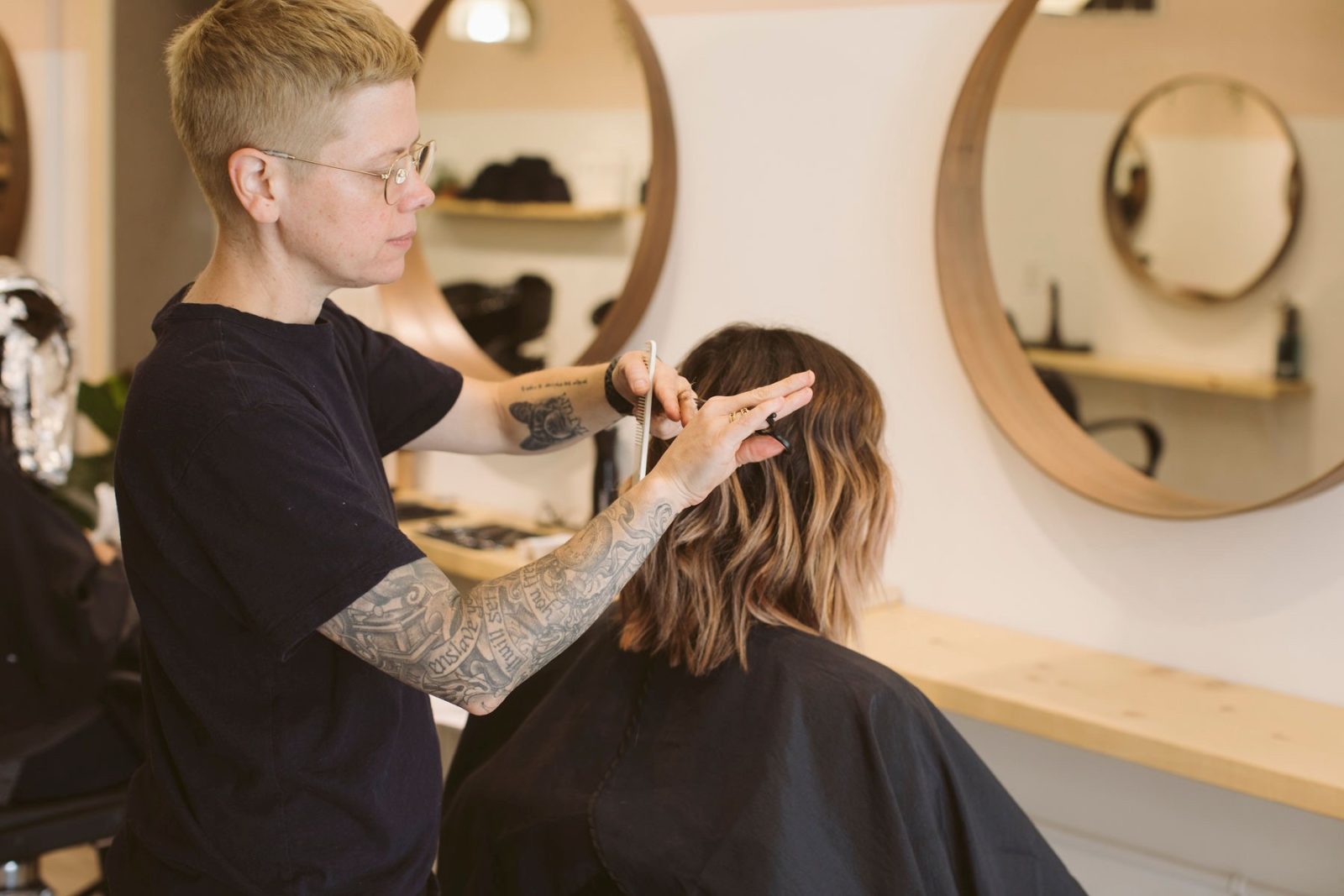
The second we sat down with Kristin Rankin, I knew this wasn’t going to be “just another industry chat.” It felt more like catching up with someone who has been quietly (and sometimes loudly) reshaping what salon culture can be, and doing it with zero patience for gatekeeping and gendered nonsense. This one’s for every stylist who’s ever looked at their service menu and thought, “Why are we still doing it this way?”
Kristin, a Toronto-based stylist and founder of the Dresscode Project, told us right off the top that salons didn’t always feel like home for them. Growing up in their mom’s salon, it was all perms, hairspray clouds, and very “ladies only” energy. As a young queer person, that space didn’t reflect them at all. And that’s the part that hit me: so many of us were trained to believe salons are inherently progressive because fashion moves, but culturally, a lot of our systems never did.
What changed things for Kristin was one client. A trans woman came in for a cut and later messaged to say it was the first time she’d had a haircut that made her feel like a woman, five years into her transition! That was Kristin’s “we have to fix this” moment. Not in theory, but in the most practical place we touch every day: the service menu. “Why are we still making people pick ‘men’s’ or ‘women’s’ when what they actually need is a haircut?” From there, Kristin ditched gendered pricing, explained it to clients, and — spoiler — the world didn’t end. One guy complained, and she basically handed him the world’s tiniest violin. Iconic.
What I loved most was how simple her advice is for any stylist who wants to make their space safer: stop trying to “spot” your queer client and just make everything inclusive. Talk about shape, length, weight, softness, structure — hair language, not gender language. Make the bathroom sign neutral. Put your values where people can see them. None of this is performative allyship; it’s just good salon practice. And for queer and trans clients, it’s the difference between “I tolerated that service” and “I was seen.”
And then there’s the scale of what Kristin’s built. The Dresscode Project isn’t just a vibe — it’s a vetted directory of salons around the world working to be safer, gender-affirming spaces. It’s education built with the 519 in Toronto. It’s the Gender Free Haircut Club — literal pop-up days where stylists donate affirming cuts to folks who need them. And now they’re taking that thinking all the way to Paris to help make the Olympic Village salon gender-affirming. From a single client moment to the Olympics — that’s the power of one stylist deciding, “We can do better.”
What really stuck with me, though, was Kristin talking about accountability in our industry — especially within queer spaces. They were honest about being one person, working 60 hours a week behind the chair and still trying to hold space for everyone. Their challenge to all of us was basically: don’t just critique, contribute. If you think you can do it better, amazing — let’s do it together. That’s 100% aligned with how we see salonMonster too: lift the whole industry, don’t hoard the mic.
If you’re a stylist, salon owner, or educator who believes salons should be for everyone — not just the people the old menu was written for — you’re going to want to watch the full conversation. We get into pricing, landlord nonsense, allyship, tour plans, and why inclusive salons aren’t a trend — they’re the future.
Watch the interview, steal the language, and start making those small, visible changes in your own space. Your clients will feel it. Your team will feel it. And you’ll actually be part of the transformation we keep saying our industry is ready for.
You can find Kristin at:
https://www.instagram.com/kristinrankinhair/?hl=en
https://www.instagram.com/thedresscodeproject/?hl=en
Transcript
Stephen Parslow (00:00)
Start chill.
Wonderful. Liam, do you want to lead us in?
Liam Shea (00:05)
Awesome.
Well, just really excited to have you here, Kristen. We’ve been wanting to do this a little chat for quite some time and we’ve finally gotten around to it. So thank you so much for joining us. Can you tell us a little bit about yourself and where you’re from?
Kristin (they/them) (00:18)
Thanks for having me.
Yes, my name is Kristen Rankin. I use they, them pronouns. I am a hairstylist from Toronto, Canada, and I am also the founder of a not -for -profit called the Dress Code Project that helps salons and hairstylists create gender -affirming hair spaces to give clients that identify outside of the traditional gender binary space and celebration within salon spaces.
Liam Shea (00:54)
that.
Kristin (they/them) (00:55)
Thank you.
Stephen Parslow (00:55)
Yeah,
we’re huge fans of the work you do and just so appreciative of what you’re doing in the community. So how did you go? Go for it.
Kristin (they/them) (01:00)
Thank you so much.
Liam Shea (01:03)
How did you get into
hairdressing?
Kristin (they/them) (01:06)
I did not want to be a hairstylist at all. Yeah, and my mom was a hairstylist. She finished high school early and then went to hair school. It was like called Bruno’s Hair Academy or something like that. And she went there and she became a hairstylist. She was a hairstylist for 44 years before she retired. And I spent a lot of time in salons when I was young, because I had to go there after school and wait for her to finish.
Liam Shea (01:09)
Me too.
Kristin (they/them) (01:34)
And, ⁓ and yeah, I had no desire at all because to me as a young person who was very aware of their, ⁓ you know, sexuality, hair salons actually really signified very feminine spaces. And as someone who early in my life recognized the feeling that I did not feel feminine or want to be seen as feminine, not knowing what that fully meant at the time, I really knew that I didn’t like that. So I thought.
⁓ this makes me feel like a girl and I don’t love that. So as I got older, I actually went to school for something else. And then when I realized that wasn’t the career for me, I took some time off and just worked, you know, whatever job and did not want to work at whatever job at all. Those are those whatever jobs are just so sobering, right? You’re like, ⁓ right. This is awful. Let me figure out my life. And then I was talking to my mom and she was like, why don’t you just do hair? You’re creative and.
Liam Shea (02:25)
Mm -hmm.
Kristin (they/them) (02:31)
And I was still sort of about it, decided to go to school, sat in school for the first day and thought, what am I doing? This is ridiculous. And then ended up really excelling and loving it.
Liam Shea (02:40)
Mm -hmm.
yes that’s store yes absolutely I did not want him to get into hair either
Kristin (they/them) (02:49)
And here we are. It was my mom, yeah, my mom was like, she was a great stylist and she was like one of those stylists that had those clients that she’d had for 20 years already and they came every week, you know, to get once a month they would get their perm and every week they would get their set and their blowout and their hairspray and yeah, it was one of those.
Stephen Parslow (02:51)
It was really in your blood, wasn’t it?
That’s so
interesting because you really found the spaces that existed then quite alienating.
Kristin (they/them) (03:16)
⁓ a hundred percent. Like I remember going in and into my mom’s in waiting and it was just like, you know, the smell you just walk into a cloud of hairspray, right. And especially then it was like bigger hair than ever. And yeah, exactly. And just lots of perm solution, you know, and just waiting, you know, just waiting and sitting there and, and like everyone there was, you know, female identifying and.
Liam Shea (03:31)
Ugh.
Stephen Parslow (03:34)
Lots of perm solutions.
Kristin (they/them) (03:45)
definitely looked that way. And so that’s kind of how I viewed it, you know? Like, yeah.
Liam Shea (03:51)
I
remember the first salon I went to was was unisex back when that was a thing that you’d write was like this isn’t a barbershop it’s a unisex hair salon ⁓ okay yeah yeah
Kristin (they/them) (03:55)
right, unisex.
Yeah.
Stephen Parslow (04:05)
I mean, it is so interesting just looking back in the short timeframe that we’ve been through. I mean, it’s just like watching 80s movies, like watching Breakfast Club and stuff like that. You go back to these things and you’re just like, wow, really? We said these things? Yeah. Yeah. So what inspired you to start the Dress Code project?
Kristin (they/them) (04:16)
Yeah.
Yeah, do they stand up? Yeah.
Well, I opened a salon on my own in 2008 in Toronto and it was in Leslieville, which is the east end of Toronto and at the time was like where all the queers were kind of going to start families and just get out of like Church Street and the gayborhood and the party scene and you know, try to buy houses because it was more affordable then and so, you know, I had a really diverse clientele.
and had a rainbow flag in the window and everything. And I had a client come in in 2016 and she had got a haircut from me. It was the first time I saw her. And the next day she had tweeted to my salon that it was the first time she had a haircut that made her feel like a woman. And she was a transgender woman. And you know, when we were talking, she was telling me she’d been out as a trans woman for five years. And so I, you know, I was just like, she’s not had anyone.
her in a hair salon for five years if she even felt comfortable going into a salon. You know, I can’t remember if she had had been growing her hair for five years and not really had it cut or trimmed it herself, but the point being there was just no space for someone like that, right? There was because we still, my salon did not, but there were still so many salons that had men’s and women’s haircuts on their menu. When you don’t identify that way and you look at a menu and that’s what you see, you’re kind of like, where do I fit into that?
And it becomes very risky to try to fit into one of those things. And just her comment just really gave me a lot of pause and made me think about it. And I thought, I love being a hairstylist. I love being queer. These two things are not working so well right now together, and we need to make space for it.
Liam Shea (06:12)
Yeah.
Stephen Parslow (06:13)
So when
you opened your salon there, did you start with non -gendered haircuts at that point? Was that something you had in place at that point or was that something you evolved to? Yeah.
Kristin (they/them) (06:22)
My God, no, I did not. I had
no, 100 % no. I followed suit, right? I went to this cosmetology school that was opened and run by this very, very straight flamboyant hair stylist, European hair stylist. And he absolutely was like men’s cuts and women’s cuts and you know.
Yeah, just a lot of that sort of rhetoric and machoism. And so you just sort of like go through the motions. I remember thinking, I just want to get a career started. I just want to be able to support myself. And then, you know, I think it was the second year that I started my salon. I actually forgot about this. And again, I had a huge clientele that was queer identifying and a lot of, you know, lesbians that had short hair and.
I had a lesbian write me an email saying, I love your salon, I love everything you stand for, I love who you are to the community, but I hate that I have to always pick a women’s cut on your service menu. And I can’t stand that I have to pay this amount for a haircut when there are people that identify as male going in with the same length hair and paying this amount. And I was like, you are not wrong. Just like totally stop me in my tracks completely.
made me think about it and I wrote her back and I thanked her and I was like, I’m so sorry that I did this for so many years and didn’t even think about it, you know? And I think it just woke me up and I immediately changed it and put out a statement on Facebook at the time, because that was the platform that everybody was using. And I just said this, we’re gonna be changing our prices and this is why, and it was…
Liam Shea (08:04)
Mm -hmm. Mm -hmm.
Kristin (they/them) (08:12)
Really fine, no one really, again, it’s Toronto, right? And it was fine. I think I had one guy, one male identifying human that was just like, no, I have to pay this much. And I was like, yeah, because your hair is long. Get over it, right? And then another guy that had short hair and it didn’t affect at all. And I was just like, let me get you a little tiny violin. Hold on one second. So hard. Well.
Liam Shea (08:17)
Yeah.
Stephen Parslow (08:28)
There’s always got to be someone, doesn’t there? Yeah.
Liam Shea (08:29)
Yeah. Yeah.
Yeah, it’s so hard.
Stephen Parslow (08:41)
It’s
interesting how the whole education process, you know, instills in us all these norms already. And, you know, just to get to that point, I mean, you’ve already talked about being alienated by the salon originally, even though you grew up very honestly in that space, then probably not feeling like you fit necessarily in the educational space as well. You know, it probably took a bit of fortitude to actually even get through the processes of opening your own place. And.
Kristin (they/them) (08:42)
Well, please.
Hmm.
Stephen Parslow (09:11)
There, there, there already been so much male oriented systems that you had to get through just to get to that, that end goal there.
Kristin (they/them) (09:20)
Yeah, it’s
so well said, Stephen. It’s really true. And I think, you know, it’s so much, it’s getting so much better. And, you know, I think a lot of people like yourselves and other people that realize that, you know, these constraints and rules that are put on us are actually pretty ridiculous, like, easily make the changes and stand for them and, you know, our great allies and stuff like that.
And for the most part, the people that are fighting it actually have, they have no, they have no game in it. You know what I mean? Like it has nothing to do with them. ⁓ so it’s really funny and I’ll always hold space for a conversation with someone if they want to genuinely talk about it. But if they just want to argue or insult or, you know, just generally be an ass, then I really don’t have space for that at all because I’m tired.
Liam Shea (10:08)
Yeah, pass.
Stephen Parslow (10:16)
Yeah, that’s a big fight.
Liam Shea (10:17)
It’s
Kristin (they/them) (10:18)
Yeah.
Liam Shea (10:18)
interesting how this industry gets considered progressive by many people just by nature of like imagining that fashion because it’s moving forward is progressive but how sort of culturally backwards it can be to begin with. I know I certainly found that early on. It was like the idea that I was able to change the industry did not occur to me early. It seemed really established. This is…
Kristin (they/them) (10:21)
Mm -hmm.
Yeah.
Yeah.
Yes.
Liam Shea (10:45)
you know, I think part of it had to do with sort of like Sassoon training and how regimented it was from a technical perspective. And then culturally, the people I apprenticed under also, it was regimented, like you do this, this and this, here’s your men’s haircut prices, here’s your women’s haircut prices. It never even occurred to me as a subject matter that you could change something like that. It took a lot, a lot of, a lot of people asking questions to realize that we could make this change.
Kristin (they/them) (11:13)
Yeah,
because it’s so indoctrinated, isn’t it? It’s funny. I think when I’ve had some comments from people just being like, queer people run this industry and so do women. And I’m like, can you explain or identify your version or explanation or definition of what a woman is, please? And let me just talk to a few other people and we’ll let you know if queer people run this industry.
Liam Shea (11:26)
Hmm.
Kristin (they/them) (11:42)
It’s funny the misconceptions, but the stereotypes, you know? I don’t know. It’s wow. So many.
Liam Shea (11:45)
Mm -hmm.
Stephen Parslow (11:47)
Yeah, a lot of damaging stereotypes that we have
and are perpetuated.
Liam Shea (11:51)
It might be more accurate that they make it run, but they don’t run it. Like they do the bulk of the work. I’m not sure that’s who’s profiting in most cases within this industry.
Kristin (they/them) (11:55)
Yeah, yeah.
Yeah,
yeah, definitely.
Stephen Parslow (12:06)
So what sort of challenges do you find that queer clients face in salons typically?
Kristin (they/them) (12:13)
I think that it really does come down to just feeling accepted. And I use that term purposefully here. I generally like to celebrate queer clients, all clients. But I think there is this level of where queer people and any marginalized community in general are saying, we just want to be accepted. And I’m like, do we?
I actually don’t. Yeah, it’s super low. And I mean, the heteronormative society as a whole is just so incredibly dangerous, in my opinion. And I don’t really want to be accepted by them. But what I’d like for them to do is just move the fuck over and make a little bit of space for other people because it’s really just getting so boring. And I don’t know, it’s just like I could talk.
Stephen Parslow (12:44)
It’s a pretty low bar, isn’t it?
Kristin (they/them) (13:13)
but you know.
Liam Shea (13:14)
Well,
and I’m not sure it’s beneficial to anyone in reality. I mean, it’s beneficial to a tiny group of people, but I think culturally, I don’t think it’s actually, you know, people, you know, this is a small group of people fighting it incredibly hard. I don’t think they understand what they’re fighting for. I don’t…
Kristin (they/them) (13:18)
Yeah.
for sure.
Yeah.
⁓ no,
I don’t think they do at all. I mean, I know that there are a lot of them out there that just like really believe that we are a cultish group of people that are devil worshipers. You know, they also have, have you all seen the series? We’re here. It’s called We’re Here. I believe it’s on, I think it’s on Netflix. I never remember what streaming service I’m watching anything on, but it is these three drag queens that go to different cities and they just try to like get drag happening.
Liam Shea (13:41)
Hmm.
Stephen Parslow (13:49)
No, I haven’t.
Liam Shea (13:50)
one’s that
I know that
Stephen Parslow (13:54)
Definitely check that out.
Liam Shea (14:03)
Yes, yes.
Kristin (they/them) (14:03)
Yeah, and they just
did their fourth season where they went to Nashville. And there’s this family that stands up that completely opposes drag happening. And they’re saying all these things about them being devil worshipers. And they’re a religious cult. And that gay people are a religious cult, which is a brand new one. That’s interesting. And that you’re just.
Stephen Parslow (14:21)
Wow.
Kristin (they/them) (14:30)
They don’t care. They don’t care that you’re gay. We just don’t agree with it. And, you know, but it’s like, well, how I don’t agree with you being straight, but I also don’t give a fuck. So be who you are. Don’t bother me. That’s how I look at it. You know, and I just don’t understand why there’s this particular small minded group of straight identifying humans that are usually on the side of very heavy religious beliefs of some sort.
Stephen Parslow (14:58)
Yeah.
Kristin (they/them) (14:59)
And they really do need to force their opinion about everything on everyone else, especially already marginalized, historically oppressed communities. Yeah.
Liam Shea (15:06)
Mm -hmm.
Stephen Parslow (15:09)
And it just boggles my mind that they feel they should even have a voice in that that they’re anyone wants to hear.
Kristin (they/them) (15:11)
you’ll see.
Yeah, it’s really wild.
Stephen Parslow (15:23)
Yeah. And so how do you recommend stylus approach consultations to ensure that they understand and respect a client’s gender identity and expression?
Kristin (they/them) (15:34)
Yeah, that’s a good question. And a lot of people always ask me like, what do I do if a queer identifying person that is non -binary, gender non -conforming or trans sits in my chair? And it’s kind of like, well, actually just do this for everyone. Don’t try to get your gaydar out and dust it off or use it for the first time. You know, it’s never a good idea. That’s not gonna go well.
Liam Shea (15:48)
Mm -hmm.
Kristin (they/them) (15:58)
Just make this the norm that you use inclusive language for everyone regardless. You don’t have to start sweating and put your pronoun pin on or be like, hi, I’m Kristen, I’m cutting your hair today and my pronouns are they, them, can I ask you what yours are? You don’t have to do any of that. It’s just more like use inclusive language. So talk about haircuts as a haircut. Talk about the dimension of a haircut, what you’re going to do to cut that person’s hair that way.
Liam Shea (16:02)
Mm -hmm.
Kristin (they/them) (16:27)
like all of the characteristics of the haircut, you know, whether it’s like, you know, soft or sharp lines or heavy or, you know, a lot of layering. These are all words that are very, very like neutral and they describe what you’re going to do as a trades person. And you can use photos as well, but just be like, if you find a photo, talk about the haircut, you know, even if it is on.
Liam Shea (16:49)
Mm -hmm.
Kristin (they/them) (16:50)
You know, someone who identifies as male or female, just talk about the haircut. You don’t have to be like, well, I found this really feminine photo on holly berry and blah, blah, blah, blah, blah. You know? Like, it’s just talk about the hair. It’s so simple. Yeah.
Stephen Parslow (17:04)
great just a simple shift in the focus there to yeah.
Kristin (they/them) (17:07)
Yeah, and try to
be cognizant of words that have been traditionally used as identifiers towards gender. So instead of this haircut is really beautiful, or I don’t know anybody that would say this haircut is so sexy. Right, exactly. Just like this haircut is really modern, it’s super current, and it’s very trendy.
Liam Shea (17:23)
No, this haircut would look really good on you.
Kristin (they/them) (17:35)
Those are all words that are 100 % safe to use.
I’m just laughing in my head of like someone saying this haircut is so sexy and not really knowing the client really well and that becoming such an HR issue. Yeah.
Stephen Parslow (17:42)
and
Liam Shea (17:49)
Yes, yes, huge.
I mean, practically speaking, it makes sense. I know even as like a parent on a playground, nobody can tell the gender of a kid that’s two years old. I mean, I find typically, you know, little boys tend to be pretty and little girls tend to be, you know, half bald on the playground. So to make assumptions, I found they and them vastly easier to use because how do I know? I don’t know. I don’t need to know. You can tell me.
Kristin (they/them) (18:01)
My gosh, no.
Hmm.
Yeah, yeah, for sure. Yeah,
yeah, exactly.
Stephen Parslow (18:21)
And so that that’s really helpful in terms of how we can use language, just shifts in our language. And also, I mean, what I’m hearing too, is just treating humans as humans, which is just something we should be doing generally, you know, we’re all people. Are there any other tips that you tend to give people when they’re looking just to make their practice more inclusive? Are there any initial steps that you find have been really helpful for people?
Kristin (they/them) (18:31)
Yeah.
Yeah.
Yeah, well, one of the things we do with dress code project is, you know, ever since we started, we wanted to make, make sure, cause we started a directory, right? Like this is where you can find gender affirming salons. And then we were like, you know, how do we try to our best ability ensure that those salons are going to be as gender affirming as they can be. And that’s where we came up with the word safer space salons and shops because we can never guarantee that they are, but we try to do our best.
which brings us to us vetting the salon. So for example, if someone wants to be on our directory, they fill out a small questionnaire and that questionnaire is really just for us to see what their knowledge of the queer community is and the understanding of it. And then they, when they sign up, they automatically get a guide that we’ve created. And I created that guide with the 519 in Toronto, which I’m sure the two of you are familiar with. It’s a Canadian charity that does incredible work around, you know.
diversity, equality, and inclusion work, and especially when it’s concerning the queer and trans communities. I did some courses with them, and then for a couple, like, I don’t think it was like four months, we worked on the information they have in their, you know, wheelhouse, and the information I have in my wheelhouse as a stylist and a queer person, and we brought it all together and created this guide, which is kind of like brings you through the day in a salon, or like, you know, a service in a salon, and how to just like transform it into gender affirming.
So we provide that to everybody that becomes a dress code project member when they get on our directory. And like the first steps, have a gender neutral washroom. Don’t have anything other than you, all you need is a sign that says washroom, restroom, toilet, whatever word you like to use. It doesn’t need to say anything else. It doesn’t need to have icons or little images of anything. Like it literally could just say toilet on it.
Like I like, I don’t know, pee here, something, like anything at all. I think the best thing I saw once when I was in Sweden, it was a little unraveled toilet paper roll, you know, like cannot get that confused with anything else. You know, what’s going on in there. So, you know, it’s just little things like that that can be so easy and like just quick little switches, just like tiny little things to make now.
Stephen Parslow (20:52)
Yeah.
Liam Shea (20:53)
Hehehehehe
Kristin (they/them) (21:05)
We say safer because again, like we send that guide digitally to people. We ask them to print it out and have it there with them. Whether the owners do that or not, we can’t guarantee I can’t be in all of the salons that we have as members. But we really try to encourage that if they have it, they do share it with their employees.
Stephen Parslow (21:27)
And for people who are interested, so this would be the dress code project alliance. Would that be correct if they’re looking for it?
Kristin (they/them) (21:32)
That’s right. So yeah,
exactly. So you can find that on our website and it’s the, you know, become a member page and they fill out a little like intake form and then they get an email back with the quiz and you know, and then they go from there. We charge people of a mere $200 for the year to keep them accountable because when I first started this, I was just like, I just want all of the salons to do this. But I started to find that because people weren’t
Liam Shea (21:58)
Mm -hmm.
Kristin (they/them) (22:01)
paying any money because money is the one sure thing that makes people accountable even if it’s like $3 you know that they are going to message you and be like where is my guide I gave you my $3 you know and and it holds them accountable so we were finding like before when we weren’t doing that people were just like yeah we’ll be part of that and then doing nothing so we were like let’s charge them as little as possible but still enough to allow us to still do what we’re trying to do.
Liam Shea (22:08)
Mm -hmm.
That’s right.
Stephen Parslow (22:29)
And we need you to have the resources to be able to continue this work too. We need this to be sustainable, which I think is really important.
Kristin (they/them) (22:37)
Thank you. I mean, it’s really funny. A lot of people don’t really understand that. It’s like really an eye opener these days to, I mean, you know, it’s funny, like sometimes I’m like, people just think that I was put here to just do this, you know, and without stopping, without any, you know, whether it matters or not, if I’m spending my own personal money that I make working my own job, you know, because I don’t get paid to do the dress code project. And I, as an, you know, a,
person who found something, I think there’s this gigantic misconception that you have limitless resources in every single way possible and it’s just not true. I work a regular job where I work about 60 hours a week on my own, as the two of you know, I’m sure doing what you do. And then you try to do the best that you can and it’s still never enough for people and it’s fine, I’ve come to terms with it and I’m honestly too fucking old to care.
Liam Shea (23:19)
Mm -hmm.
Mm -hmm.
Kristin (they/them) (23:30)
But
it’s just one of those things where it’s like, if you think you can do a better job, please, my friend, step up. Or better yet, why don’t we try to do this together? Yeah. Yeah.
Liam Shea (23:36)
Mm -hmm.
Stephen Parslow (23:39)
Yeah, absolutely.
And two, what’s great about the dress code project Alliance. We’re talking about this from a salon membership side here, but this is also a resource that people can go to your website and locate salons that are safer spaces.
Kristin (they/them) (23:54)
Yes,
and that really is the big, big thing for me is that, you know, if you’re someone, I mean, what it used to be that you’d walk by a salon and that’s how you would hear about it. And you’d have to walk in to get information, right? And now you can just go to our website. You can go and you would just go to the find a salon, find a safer space salon page on our website. And you would type in your zip code or your postal code.
and it will bring up the salons in your radius around you. So we’ve basically done that work for queer clients that are looking for gender affirming hair spaces. What that is saying is that they’ve been vetted by us, they have the guide, they understand from our best ability what a gender affirming space is. So you would not have to deal with the washroom and the menu thing. And hopefully they’re keeping up their end of the bargain with all of their stylists as well.
Stephen Parslow (24:50)
And how many salons do you have in the Alliance at this point?
Kristin (they/them) (24:51)
Okay.
We have over 550, you know, which is a decent amount, but it is because we don’t say yes to everybody. And it’s not because we don’t want them to be gender affirming. It’s just that they need to be doing it in the way that is best for people who need those services. So there are some salons that, you know, they work in buildings and the only washroom they have in a building is like a general washroom for everyone. And the, you know, maintenance or the management company is not willing to change the signage, you know.
Liam Shea (25:08)
Mm -hmm.
Kristin (they/them) (25:23)
And we just ask them to continue to work on that because it really is a big deal for people, you know? You know, again, like no one wants to walk into anything, but especially something as, you know, tender as like using a facility to and have a sign up there that is essentially saying this is not for you.
Stephen Parslow (25:43)
Yeah. Yeah. And that’s an interesting aspect that you bring up too about that challenge of working in infrastructure that you don’t necessarily have control of and the quest of having to work to change, you know, the approach of a landlord or something like that, that adds some heavier lifting, which is great in terms of the long -term outcome, but these things aren’t always simple.
Kristin (they/them) (26:07)
Yeah, and we’ve had some
salon owners reach back out to us years later and say we either moved or we finally got the management company to change their minds or to do it. I think sometimes too it’s just sheer laziness. The management company just doesn’t want to be bothered.
Liam Shea (26:23)
⁓ yes. Yes, exactly. Yeah. The last time I was renting a chair when you, when you formed the dress code project and I had first heard about you and was interested in getting the shop I was at involved. No one, everyone in the shop would have been fine with being involved, but there was nothing we could do. Like I can’t make the management company change the two washrooms to being gender neutral.
Stephen Parslow (26:47)
Yeah, you were in a
multi story tower, which was quite corporate. And yeah.
Kristin (they/them) (26:50)
Yeah.
Liam Shea (26:51)
They don’t care. They didn’t care.
Kristin (they/them) (26:53)
Yeah,
yeah.
Liam Shea (26:54)
They couldn’t have brushed it off quicker. It wasn’t even a subject matter they were interested in discussing. I would argue they didn’t even know what the question was probably in reality, but yeah. Yeah. I wish we could have.
Kristin (they/them) (27:05)
Yeah.
sure. Yeah,
we’ve had some salon owners even go to management companies and say, we will purchase this, the signs, we will put it up there for you, we’ll send you photos of what it looks like, you know, like, so it’s, it’s those things, right? It’s the little things that individuals can do that they never thought they could do. Like, I never thought I would start a global alliance that, you know, was now this year going to be
for the first time ever in the history of the Olympics, creating a gender affirming salon in Paris this summer. I didn’t think I would ever be doing anything like that, but I just took a few steps and tried it out.
Stephen Parslow (27:41)
Wow.
Liam Shea (27:48)
That’s so cool. Yeah.
Stephen Parslow (27:49)
Yeah. And,
Kristin (they/them) (27:49)
Yeah.
Stephen Parslow (27:51)
you know, just the impact, for example, of changing a washroom in a building that is used by other businesses can have a knock on effect. That’s really positive. Yeah. Maybe not going to the whole extent of founding an organization and doing all that heavy lifting, but in small ways, people can have an impact on their community.
Kristin (they/them) (28:00)
Yeah, absolutely.
Yeah, exactly. And it’s a start, right? I think if we had more people doing things like that, it may have a bigger impact on society at large.
Stephen Parslow (28:20)
Yeah.
Liam Shea (28:21)
Do you want to tell us how you got involved in the salon in Paris for the Olympics?
Kristin (they/them) (28:26)
⁓ sure. Yeah. So in 2018, I had Pantene reach out to me, which is a commercial hair product company and amongst other things. And they were saying to me, you know, we love what you’re doing and we, we would like to change what the way we see hair and the way we commercially give messages about hair. And I’m, you know, I was on board because like, I get, I take so much flack for partnering with someone like Pantene.
Liam Shea (28:53)
How would you get more reach?
Kristin (they/them) (28:55)
Right, exactly. And you know, I know there’s the like you, how could you, I get so many questions sometimes. And it always is when we’re launching a campaign, but you know, how could you partner with them? And you know, I would never sell their products in salon. And it’s like, yeah, I get it. I don’t care, you know, sell who you want in salon, don’t sell product. I don’t care. That’s none of my business. Once again, we’re back to the like, you do you, I’ll do me. And Pantene.
they walked the walk of being an actual active, authentic ally to the dress code project and to what we are trying to do in our industry. And they’ve provided us with a lot of support so we can do this and we can offer support to the industry. They then brought me on as a consultant and in 2019 we launched after working on it for almost a year, we launched the first ever.
commercial to feature only transgender women talking about their hair and the beauty of it, you know, and Pantene in 2019 also changed their mission statement, which was something like great hair for women to great hair for everyone, you know, and we had that impact on them, you know, it’s huge. And this company is over 80 years old, you know, and they’ve been doing this forever and they have, they have,
Liam Shea (30:07)
Yeah. That’s huge.
Stephen Parslow (30:10)
Wow.
Kristin (they/them) (30:20)
offices and I am like every state in the US and in Canada every province and different regions in Europe and they’re everywhere, you know And so I really don’t care what people think about it They I will get everyone and anyone I can to be on board with this Even if at first they’re super against it and I can help change their mind I mean, that’s the entire point of it. Isn’t it like it’s meant to be inclusive and also if we were just
Liam Shea (30:45)
Well, it’s meant to be inclusive, right?
Kristin (they/them) (30:48)
⁓ god, if I was waiting for hair companies to help me, I’d be sitting in the field picking flowers right now, you know? Like, let’s be really honest. Yeah, I mean, come on, get over it. I’m so over that kind of conversation.
Liam Shea (30:52)
Hahaha!
Stephen Parslow (30:52)
Thank you.
Liam Shea (30:56)
supposed to be inclusive except for things I don’t think are cool.
Stephen Parslow (31:04)
And so this actually led to a salon in Paris that’s going to be no, that’s a.
Kristin (they/them) (31:08)
Yeah, sorry. I got all fired up and off
Liam Shea (31:11)
That’s
Kristin (they/them) (31:12)
track.
Liam Shea (31:12)
okay.
Kristin (they/them) (31:13)
Yeah, so we we’ve been doing campaigns ever since 2019 and launching different campaigns around hair has no gender and the inclusivity of it. And so P &G, who is their parent company, won the bid to be a sponsor at the Olympics. And then Pantene got offered to do the salon work there.
And they asked me if I would come on board to be a consultant to create the salon in a gender affirming way. And the salon is going to be in the Olympic Athlete Village for the Olympic athletes in 2024, this summer in Paris.
Liam Shea (31:41)
Yeah.
Stephen Parslow (31:49)
Fabulous.
Liam Shea (31:49)
That’s
so cool.
Did we lose her? Did we lose you there, Kristen? ⁓ there we go. Thought we lost you.
Stephen Parslow (32:03)
There we go, we’re back. Yeah.
Kristin (they/them) (32:04)
There we go.
Stephen Parslow (32:05)
We can cut that out. No problem. So I’d love to also ask a bit about another project that you’re involved in through the dress code project, which is the Gender Free Haircut Club. Do you want to tell us a little bit about that?
Kristin (they/them) (32:06)
I froze.
Sure,
the Jennifer haircut club is a little event that I started after I started the dress code project to create space for queer folks who identify outside of the binary to get haircuts that are affirming and also free because it’s very apparent that there are a lot of different reasons why there are a lot of folks within the queer community.
who are resource challenged and can’t come into salons to get affirming haircuts. And so I just wanted to, first of all, get stylists to give back in this way. I know stylists give back in a lot of different ways, but also like use your skill and your space to give back to a marginalized community. When I was younger, my dad was a butcher and…
One of the things that he taught my sister and I was every Christmas, the turkeys that were left over that did not get sold, my dad would take us and we would go around a couple of days before Christmas and we would give them to families in need. And so giving back to people is like an important part of my life. And I think it’s important that everybody does some sort of, you know, just work that way to acknowledge the privilege that you have.
And so being able to hold an event like this was really important. And then when COVID hit, it sort of all stopped. And then in 2022, I think we brought it back. And we just really wanted to make it a big part of the Dress Code Project. And we’ve pivoted to that quite a lot now. So it has become like a signature event that we do with our Dress Code Project member salons.
Stephen Parslow (33:54)
you
Kristin (they/them) (34:13)
And then this past year in 2023, with all of the bands that were happening with transgender and drag performers in the United States, like these proposals being introduced, it was just so ridiculous. And we couldn’t believe that we were actually like in this moment in time where queer folks were having their rights taken away from them and their healthcare. And we wanted to do something to support it. And in my mind, being able to provide a gender affirming haircut,
Stephen Parslow (34:32)
Yeah.
Kristin (they/them) (34:43)
for someone is part of healthcare for them. Gender affirming healthcare and haircare really do have a lot in common. When you are able to see someone, which I’ve done so many times now, have their very first haircut that affirms their gender, it’s so life -changing for them. And you can see that happen. And it has so much to do with their mental wellness and health. And being able to see yourself for the first time, the way you kind of picture yourself in your head is a really…
big step in providing like a healthy environment for someone and potentially their first step in transitioning in one way or another. And it’s also a step that is gentler. It’s an easier, you know, like first step rather than a big leap. And so we wanted to be able to provide that for people, especially in states where these bans were happening. So we decided to create the gender, the gender free haircut club hair tour. It’s actually the t -shirt that I’m wearing right now. And,
Stephen Parslow (35:38)
Love it.
Liam Shea (35:38)
Nice.
Kristin (they/them) (35:39)
We tried to make it like a band tour, you know, like you were going on tour with ACDC back in the day or something like that. And we just created this hair tour around Southern cities that we knew were having problems, you know, and having situations with these bands. And it was really fun and it was really great. It was such a celebration. We had drag queens there, even in states where they were not supposed to be.
Liam Shea (35:45)
Mm -hmm.
Kristin (they/them) (36:07)
And we had like queer vendors selling their things and DJs and tattoo artists at some of them. It was really, really fun. And so now it’s kind of become like a really signature thing that we do. And we are just starting the planning for the 2024 hair tour. And we put out a little like anybody want us to come to their city and do this. And we had like a really overwhelming amount of people that want us to come there. So now we’re just going to be be picking the places that we really would like to go and support. And.
setting up our 2024 hair tour. We’re kicking it off on June 21st here in New York. And then we’re gonna go from there.
Stephen Parslow (36:44)
Incredible. And for stylists and salons who are interested in participating, how could they find out more about this?
Kristin (they/them) (36:51)
They can actually just fill out one of our intake forms if they wanted to and just say they’d like to be a part of the Hair, the Gender Free Haircut Club Hair Tour 2024. They can reach out to us on Instagram as well. You know, our Instagram account is, our handle is at the Dressco Project. They can just send us a message. Yeah. And you’ll hear back from us at some point. You know, we will get back to you about the planning of things. We just have to organize it all.
Stephen Parslow (37:17)
It all takes a lot of work. It’s incredibly exciting. It sounds like it’s going to be an incredible tour this year.
Kristin (they/them) (37:18)
Good day.
Yeah,
I’m looking forward to it.
Stephen Parslow (37:25)
Now we’ve talked quite a bit today sort of about looking after clients and providing safe spaces for them, but I’d love to sort of pivot a little bit and sort of talk about creating spaces that support stylists and you know the challenges that queer stylists actually face as well in the industry and any insights or guidance that you have on that.
Kristin (they/them) (37:49)
Yeah, I mean, I think that all of this applies to everyone. We certainly did, you know, organically make it from the perspective of creating safer spaces for people to get haircuts in. However, I think it just naturally evolved to apply to staff that’s working there as well, you know, because I’ve it used to be that. When I was a little less busy and had more energy and.
you know, more financial support. I was traveling to salons and personally going in and educating groups of people at the salons. And it was really amazing to the feedback that I would get even just in the discussions of people saying like that are, they would stand up to talk to me and they would announce like, I am a queer identifying stylist and this has just been really awesome because it also.
You know, it just brings about a whole amount of awareness for everyone. And I think that in a sense it validated, you know, what they’re doing and the work they’re doing in the industry as well. And I think it helped them feel seen and visible to their employers. And I think it just applied to everyone.
Liam Shea (38:55)
Mm -hmm.
Yeah, that makes sense.
Kristin (they/them) (39:07)
Yeah.
Stephen Parslow (39:09)
And so what are your future goals for the dress code project? Do you have any plans to expand at this point? Obviously this is quite an undertaking already to manage and maintain. Where do you see this going in the future?
Kristin (they/them) (39:21)
You know, as someone and any business sole proprietor human that is doing any kind of work, whether it’s for profit or not, knows that not only is it night and day and waking you up in your sleep, you know, when you don’t want to be, but it’s also changing all the time. And, you know, your plans are constantly not your own and they can completely just.
Liam Shea (39:46)
Mm -hmm.
Kristin (they/them) (39:50)
change direction regardless of how you feel or what you want to do. And right now where I’m finding the dress code project to be is a place where, you know, I think we need a little bit of grounding. I have honestly felt like I have made, I’m setting up boundaries is what I’m doing, you know? And I think there are a lot of people out there that have caught on to all of this and they are doing.
so much work in their own salons, in their own communities, in their own neighborhoods to get this message out there. And we are really trying to focus on supporting them. So the Gender -Free Haircut Club hair tour is really gonna go to folks like that that are doing the work so that we can come there and not just support them, but celebrate them and the work that they’re doing on their own. And we’re going to be looking at education a little differently as well because being able to maintain all of that and travel.
to these different places, it’s just not realistic. I don’t have a sugar daddy, mama, or anything in between genders that just gives me an unlimited purse or money tree. So it’s definitely one of those things where you have to be realistic and just do what you can do. And that’s really where I am is just setting up some boundaries and doing what I can do and having conversations sometimes with people and sometimes not having conversations with people. And that’s really where I am.
Liam Shea (40:58)
Mm -hmm.
Yeah.
Stephen Parslow (41:17)
Are there any opportunities for people to volunteer to help lighten the load for you at the dress code project?
Kristin (they/them) (41:24)
You know, that’s like a really beautiful idea and concept. And, and again, this comes down to accountability, right. And I know that people out there really, really have good hearts and they want to do the they want to do the things. But every time it has been approached for that, it requires me to have like more brain power and think of something new and different to create to make that happen. And I
Liam Shea (41:47)
Mm -hmm.
Kristin (they/them) (41:53)
I just like a month ago maybe got, took a little flack. Someone was saying that I was virtue signaling, you know, that I promised all this education and didn’t come through with it. And hey, you know, maybe you’re right a tiny bit, because I couldn’t be in, you know, 10 different places at once. And I just didn’t have the money to constantly fund flying out to different places to be there for you.
But I definitely did the work to provide a guide and a handbook that you get when you do sign up and really ask people to then be accountable for it. And then meet me halfway and do the work. And I guess that wasn’t enough to this person. And I reached out to them and I was like, I think what you’re saying is unfair, but I would like to have a conversation if you’re wanting to have a conversation and not just argue with me. And this person was also doing some work that.
Liam Shea (42:28)
Mm -hmm.
Kristin (they/them) (42:47)
actually looks really amazing. It looks really lovely and definitely want to credit them for that. So I was just like, how about we try to work together? Because I would love that. And I think what is more to the point is like, especially in the queer community, let’s support each other. Let’s not like try to, like, you know, just call each other out or, you know, cancel, like cancel, or.
Stephen Parslow (42:55)
Yeah.
Kristin (they/them) (43:13)
I think the kids are calling it, putting it on blast. Like, let’s just not do any of that stuff too. I don’t think you need to tear someone else down in order to like build yourself up. You know what I mean? I think we can all do it at the same time and do it differently if we are doing it differently and then come together and take those beautiful parts of how we’re doing things so differently and make them work together, you know? So that’s kind of where I am with a few people right now and just trying to have that happen. I work my ass off all the time. I’m a Gen Xer.
Liam Shea (43:16)
Mm -hmm.
Stephen Parslow (43:28)
Yeah.
Liam Shea (43:41)
Yeah.
Kristin (they/them) (43:42)
That’s what we’re used to. We were told not to come in before the streetlights came on, because you should be out there doing your own thing, hustling. Yeah, it was literally when the house lights come on, you can come inside. And I had to start working at 13, and it’s not a fiddle. I don’t need you to have the violin out, and it’s not a pity thing.
Liam Shea (43:44)
word.
Mm -hmm.
That was exactly when I was meant to go in. Those were the rules.
Kristin (they/them) (44:08)
It’s a pride thing. I’m super lucky that my parents made me do all those things because it taught me fortitude and how to hustle and how to keep getting up when people try to put you down and keep working, you know? And so that’s kind of, yeah, exactly. It does make you very resilient. And I hope that these things are passed on to people. And I hope that the people that want to do the work continue to do it. And I hope that they reach out to me and say,
Stephen Parslow (44:22)
That gift of resilience.
Kristin (they/them) (44:35)
I don’t want to tear what you’re doing down, but I would love to do something with you. And also, let me meet you halfway and let me be accountable for it. Let me help you figure out some things. Because I do feel like I’m always coming up with ideas. And when people reach out to me, they’re always like, OK, so what should we do? And I’m like, I don’t know. What do you think we should do? You know? Yeah.
Stephen Parslow (44:54)
Yeah, take some direction there. And you
know, the more we can all work together to lift all ships and, and be supportive of all the efforts that are going on, as you say, not taking down other people. ⁓ you know, this is about trying to create a positive outcome. Universally.
Kristin (they/them) (45:11)
Yeah, exactly.
It’s exactly what it is. Let’s just build each other up and let’s support each other. And the funny thing too is, I think a lot of people that are into putting people on blast in queer culture or cancel culture and stuff like that, it’s because they do think that they haven’t had a platform. And sometimes I don’t even think they realize that that’s what they’re doing.
But I have a lot of friends in the industry that are doing similar things in different ways about different subjects. And they always get put on blast, always. I feel like we should have a little blast committee of like a little round circle of once a month we get together and like, who hit you up this month to put you on blast? And it’s always the same people. And the thing I noticed is that it’s always smaller groups, smaller organizations that are trying to make a difference.
Liam Shea (45:52)
Mm -hmm.
Mm -hmm.
Kristin (they/them) (46:05)
It’s so rare that I see people put any of these bigger organizations on blast. And it’s mostly because those organizations don’t care. They’re like, say what you want. You really don’t affect us. And it’s really kind of unfortunate that that’s where we’re going instead of saying like, hey, I see something you’re doing and I was wondering if I could add to that.
Liam Shea (46:15)
Yeah, they don’t have to.
Stephen Parslow (46:29)
How can we amplify this? Yeah. So with all that you know now and all that you’ve been through, one question we like to ask people is what is one thing you wish you could go back and tell your younger self when you started this journey? Is there anything that you’d share with the younger you?
Kristin (they/them) (46:31)
Yeah.
I think it would have been to potentially just be braver and more outspoken and say the things that I wanted to say back then but was too afraid because I was such a rule follower and I was also just like, I’m a Libra, so I’m a true, true Libra. I just wanted balance. I just wanted to do my thing and didn’t want to be bothered. I wanted to like…
Liam Shea (47:05)
Mm.
Kristin (they/them) (47:17)
move really smoothly through things. And so I think I chose my battles when I felt like I needed them, but I wish I would have chose more battles because I think now we know that it really is unfortunate, but the case is like, if you are someone who doesn’t speak up, then you’re part of the problem, right? So I wish picking up earlier, probably a big thing.
Liam Shea (47:35)
Mm -hmm.
Stephen Parslow (47:36)
Yeah, absolutely.
That’s a great message. And on the note of amplifying voices as well, are there any other queer LGBTQ2S plus positive people that you’d suggest people follow online for more inspiration and to help amplify their voices?
Liam Shea (47:42)
Agreed.
Kristin (they/them) (47:57)
You know, I just think there are so many out there and they, the beautiful thing about like generations today and stuff like that. And, you know, as much as I hate social media for all of the mental health issues it causes, I think the one thing that social media has done is it has taken messages and given them a much, much broader, much quicker way of giving information out there. And I love that the generations of today.
grab onto that and choose when they choose to use it in a good way. They really can use it in a good way. And part of that is them identifying themselves. So you’ll see a lot of folks, especially like I’ll talk about Instagrams. It’s what I use the most as a hairstylist. You know, it’s still super relevant for us. And you will see people that have the pride flags on their Instagram accounts. They have their, you know, their pronouns up there and they do show the work that they’re doing. So I think, you know,
you can just Google anybody these days. And as long as you see them doing the authentic work and being active in that work and not just virtue signaling or talking about it, then I think it’s a good person to investigate and take a look at. There are just so many that I don’t think I can name half of them or even think about any of them at the moment.
Stephen Parslow (49:16)
Yeah, fair enough. I mean, I’m definitely finding like there’s some, some people out there like Kitspada who’s been doing such an amazing job of journaling their, their journey as well and sharing those voices and that, yeah, it’s, it’s cool to see all the people out there who are sharing their journey so other people can see themselves in that and gain some confidence.
Kristin (they/them) (49:36)
Yeah, like people like Olive
the Hairpist, you know, Olive does such an amazing job at creating such a beautifully authentic, warm, welcoming space. And I think what I love about the work that Olive does is that it is for everyone and it is about, it’s definitely coming from a place of their own experience, but it’s not about them, you know? And I love that there’s actually room for…
everyone in what Olive is doing, you know, and I think that it’s such a beautiful, what the branding, whatever Olive refers to it as, even if it’s unintentional, they have done such a really beautiful job and, you know, and I think it can apply to everyone.
Stephen Parslow (50:18)
That’s wonderful. I actually haven’t come across Olive’s account before. I really look forward to checking that out. Yeah.
Kristin (they/them) (50:23)
Yeah.
And then, you know, I have like friends like Lowe Chabonot in Austin, Texas, who is just like a huge, huge, huge ally, an active ally, an authentic ally to the queer community and to the dress code project. And honestly, just such a wonderful human being. The work that Lowe has done at her salon in Austin, Strange Bird Salon, is just so incredible.
Liam Shea (50:30)
fan.
Kristin (they/them) (50:52)
And I think it’s just really important to recognize the work that allies do as well, because without allies, we would just be a bunch of queer people jumping up and down together, not really doing anything other than what we’re already doing. So having allies come in and just add to the pile and making us bigger and louder is really essential. And Lowe is definitely one of those people. Yeah.
Liam Shea (51:15)
Huge fan of Lo.
Stephen Parslow (51:19)
Well,
Liam Shea (51:19)
Awesome.
Stephen Parslow (51:19)
this has been incredible.
Thank you so much for taking the time out of your busy schedule to sit down with us and share some of your thoughts on this. We’re so grateful for the opportunity for everyone.
Liam Shea (51:21)
Yeah.
Kristin (they/them) (51:29)
It’s been
my pleasure for sure. And also just always nice connecting with fellow Canadians. Yeah, getting to chat with you all is really fun. And I also, you know, excited about the work you’re doing in the platform industry to make some changes there.
Liam Shea (51:38)
Hear, hear.
Stephen Parslow (51:51)
We so appreciate your support with that and giving us some guidance. And for anyone who’s interested in finding out more about the dress code project, you can go to dresscodeproject .com or on Instagram, it’s the dress code project. So definitely take a look, give them a follow and help support the work that they’re doing. Thanks so much, Kristen.
Kristin (they/them) (51:56)
Cough
Thank you.