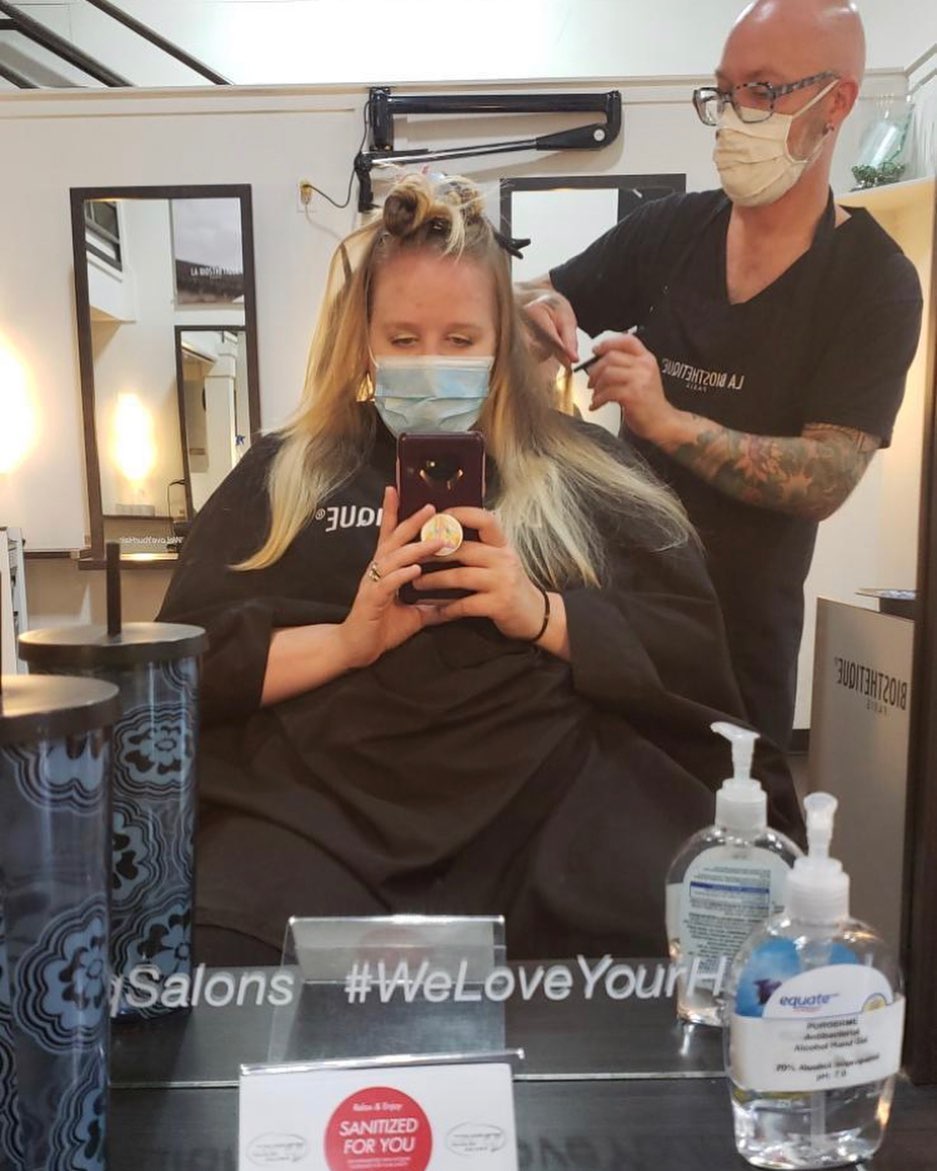
When I sat down with Rhino Gaudet, I knew we were in for a good conversation—but I didn’t realize just how much ground we’d cover, from rock-star dreams and livestock show floors to closing a salon and falling back in love with the basics of our craft.
Rhino’s story starts in Calgary and lands on the West Coast, where he moved in the mid-90s “to get away from the snow.” He didn’t come for hair—he came for the weather. Hair came later, at 26, after a couple of university degrees and a desire to be a platform artist. He laughs about it now: he didn’t actually know if he liked doing hair yet—he just wanted weird hair, cool clothes, and a stage.
What hooked him wasn’t the spotlight. It was the work.
From “rock star” dreams to commercial craft
Today, Rhino describes himself as a “commercial hairdresser” working independently in a seven-chair salon where everyone is 40+. Half his business is colour, and he has a soft spot for fixing broken colour and solving tricky technical problems.
“I don’t think of myself as artistic the way I used to,” he told me. “I’m more technical—but there’s creativity in that too.”
That technical creativity shows up in how he approaches a haircut: like a puzzle. Instead of seeing some grand Michelangelo-style vision in the hair, he’s thinking through steps, sequences, and alternatives—sometimes skipping step two and coming back to it later if that’s what the head of hair needs.
One of my favourite moments was when he told a story about a co-worker who used to say, “The first side I cut is my creative side; the second side is my ‘oh no’ side,” because he couldn’t remember what he did the first time. That was Rhino’s cue to lean into repeatable systems: step one/step one, step two/step two—so the art is supported by structure.
Onstage, backstage, and in the classroom
Rhino did get his platform moment—but it started in a very un-glam way. His first show? He was the AV guy because there was no budget. The venue? A livestock show barn in Regina, complete with flies and horse manure on the floor.
From there, he moved into education, working shows with legends like Chris Barron and Sam Villa, travelling across Canada, into the U.S., and even Taiwan. In the process, he realized something important: he preferred being a classroom educator to being a “rock star.” One-to-one and small groups, where he could really teach and connect, felt more satisfying than big-stage performance.
That theme—connection over ego—runs through his whole career.
Opening, closing, and redefining “success”
Rhino owned his own salon, Licrish, in downtown Victoria. He built it from a team of one to a team of eight over eight years. Later, he’d go on to own salons for close to 20 years total. Opening his first salon was a huge turning point: “It opened my eyes to everything I didn’t know about running a business.”
Closing was just as big.
When his lease came up in 2023, he chose not to renew. At first, it felt like failure. Over time, he realized it wasn’t. “It’s just a business—it’s not who you are,” he said. Closing wasn’t losing; staying in something that’s nose-diving, just because you’re afraid to let go, is often the bigger mistake.
Now, working independently, he’s using all that experience—minus the overhead and extra stress.
Retail, rebooking, and reframing “sales”
When I asked what he wishes he’d known earlier, Rhino didn’t hesitate: retail and rebooking are not greed—they’re service.
He used to resist recommending products and pushing pre-booking because it felt like “selling.” Now he sees it differently. Recommending a shampoo or bond builder is about protecting the work you’ve done and helping clients keep their hair looking and feeling great between visits. Booking the next appointment isn’t a hustle—it’s helping someone avoid bad hair days.
He also pointed out that he doesn’t earn commission on retail, and he still recommends it—because clients need good stuff and clear guidance.
Let your favourite clients help you grow
One of Rhino’s most practical business tips is beautifully simple: ask your long-time clients for help.
These are the people who’ve been with you 10, 15, 20 years. They already love you. Ask them for Google reviews, a short testimonial, or to send their friends. “They’ve already drunk the Kool-Aid,” he joked. “You might as well ask.”
But there’s strategy in it too: don’t ask difficult clients to send you their difficult friends. We tend to hang out with people like us, so if you want more dream clients, ask your dream clients to spread the word.
Mentors, education, and getting back into real classrooms
Rhino’s had both business coaches and hair mentors. He credits Summit Salon Systems with giving him a “business plan in a box” and raves about working with icons like Sam Villa and Chris Barron—Sam for his gift of explaining things in multiple ways until it clicks, Chris for his long-term creativity and passion. He also shouted out Vancouver educator Sarah Burke (@blacktoblonde) for her fresh, modern eye.
But the part that really stuck with me was his take on education in 2025 and beyond.
Online education, he says, is the gravy, not the meal. It’s amazing to have so much content at our fingertips—but you don’t get called out on your mistakes watching a video. Hands-on classes give you a safe place to mess up, get feedback, and grow. His mentor once challenged him to take two “big” in-person classes a year—full, one- or two-day immersions—and he passes that challenge on to other stylists now.
Why he runs on salonMonster
We also chatted about how he runs his business today. Rhino works in a salon where some of the team still use pen and paper, but he runs his column entirely on salonMonster.
The biggest win for him? Client communication and reminders. “I’m a terrible receptionist,” he laughed. If he accidentally books someone at 1:30 instead of 1:00, the confirmation catches it. Automated reminders mean his clients don’t forget, and he sees far fewer no-shows than his paper-based teammates.
He loves that he can access everything remotely, doesn’t have to do mental math at the end of the day, and can hand clean, organized reports to his accountant. Before SalonMonster, his software didn’t have texting or remote access; when he went independent, he knew he needed something that could do more of the heavy lifting. Knowing SalonMonster was local, he didn’t even shop around.
His advice to stylists considering us? Don’t overthink it. Try it for a month or two, see how it supports you, and let the results speak.
“We share what we know.”
If I had to sum up my chat with Rhino, it’s this: he came into hair to be “cool,” with weird hair and rock-star dreams, and stayed for the relationships, the puzzle-solving, and the chance to share what he’s learned—with clients, with fellow stylists, and with the next generation.
From opening and closing a salon, to teaching on manure-covered show floors, to rebuilding colour and rebuilding confidence, his journey is packed with real-world lessons on growth, humility, and redefining success on your own terms.
If you’re a stylist—especially if you’re independent or thinking about it—you’ll get a ton out of hearing Rhino tell these stories in his own words. Hit play on the interview, settle in with a coffee, and come hang out with us for the full conversation.
You can find Rhino at:
https://www.instagram.com/rhinogaudet/?hl=en
Transcript
Stephen Parslow (00:00)
interviews. I’m like, I’ve never had a job interview. That’s the weird thing, right? Like I’m now at this point where I’ve worked for myself for 25 years and it’s like, don’t know what that would be like. Yeah. I have no idea. So with that in mind, please tell me a little bit about yourself. All right. Well, should I look in the camera? No, just be whatever is comfortable for you. I was, I’m from Calgary.
I’ve lived on the coast now since about 94, so about 30 years. I moved here after university. I love the city. like to ride motorcycles. I like to ride bicycles. I’m a bit of a city guy, but not completely, but yeah, I love living here. Was it hair that brought you out here? No, originally it was weather. It’s time to get away from the snow and move away from the snow. And then I got into hair after I moved here. Yeah, I actually came here from Calgary as well.
It’s a nice move out here. like Calgary still, but I like the memories of Calgary. Totally. And so how did you get started in hairdressing? I had a good friend of mine who was in the business and he was dabbling in being a guest artist. His mentor was a guest artist.
I wanted to be a rock star and my first idea was I wanted to be a platform artist. I had no idea whether I liked hair or not but I wanted to have weird hair and stand in front of people and teach. Little did I know I would end up really liking the hair part of it and the service part of it more but yeah that’s how I originally got into it. That’s really cool. It’s so interesting what attracts people and then the number of people I’ve heard say that once they really get into it it just this passion holds.
I had no idea what being a hairdresser meant, but what it ended up being. What sort of age were you when you started? I would have been about 26 when I got into it. So little, I felt like I was a late bloomer, but in retrospect maybe not. What were you doing before that? High school, then into university. So I got a couple degrees under my belt before I got into hairdressing and then got into hairdressing. That’s really cool.
So tell me bit about your business. My business? Well I work independently in a salon of seven. Most of us are 40, well we’re all 40 plus. The majority are over 50. And I’m a commercial hairdresser. That’s another part I didn’t realize that I would enjoy the commercial work. Do a lot of retouches.
And I would say I do about half my business is colour. yeah. And I like fixing broken colours. I’ve realised like the technical side of it. I don’t think of myself as artistic in the real, in the way that I used to think of artisticness. I think of myself as more technical, which has its creative elements to it as well.
That’s really cool. Did you end up going and trying some platform work as well? I’ve had a lot of good luck doing that. was able to, my first time doing anything with a show, I was the AV guy. Yep. And because there was no budget for an AV guy and we worked a show, it would have been in Vancouver, once with Chris Barron and once with Sam Via.
the two best in the industry. then from that point I just sort of jumped in and became an educator and got to do some platform work. Been lucky all across Canada, I’ve been to Taiwan and a bit of the US. So yeah, I was able to try some of the things that I wanted to try, which is really That’s really cool. ⁓ it’s amazing to get out there and to get to explore like that. Funny part about it is like I say, I enjoyed teaching, but I liked it more.
When I realized I was a classroom teacher, I like a little bit closer one -on -one with people as opposed to the rock star side of it. I found if I was on stage, I was trying to teach too much, which is kind of contrary to what they want. So yeah. That’s really cool. And so when and why did you go independent? I went independent, I would say, just shy of a year ago.
And I’d owned a salon for combined probably about 20 plus years, or close to 20 years, I guess. And we closed our salon in 2023, and it just made sense. I had the skills, I had the knowledge, I had the background in helping coach young stylists after I was coached by my mentors. And I just thought it would be a good transition.
to just take care of myself. And how have you found it now that you’ve made that transition? It’s been good. It’s been good. The adjustments haven’t really affected me. For instance, we don’t get walk -in traffic. But working downtown, we haven’t had much walk -in traffic for the last few years anyway. So some of those things weren’t too difficult. Yeah, and just the reporting and taking care of, you know…
taxation and stuff like that were things I already did so it’s fairly straightforward for me anyway. Maybe just less of a burden of it than you used to have? Yeah, I’m not writing checks. Or as many checks. Just hopefully to yourself. Yeah, exactly. So what’s one thing you wish you’d known before you first started in hair? That recommending a shampoo or a styling product to my client.
not sales. It’s full service. I don’t want to sell things. Well, that’s not the way I think of it now. I’m not selling anything. I don’t even get commission off of what I sell, but I’m still selling because people need good stuff. I couldn’t agree more. Yeah. It really is. It’s part of helping your client protect and continue that work you’ve done in this salon. And I also think too, it’s just a recommendation.
If it becomes sales, if I’m really heavy handed, I just want the views to be good If you, again, treat it like education. completely. That’s really cool to hear. Is it something we come across a lot? Yeah. People’s fear over selling. Yeah, completely. And I think the other was a lot of the numbers that I was told growing up in hairdressing that were important, things like pre -booking and claim attention and those things.
that I thought were my boss’s greed, that’s not, that’s again, just understanding like how to keep your clients, you know, and me booking their next appointment just means I’m helping them out, you know, so they don’t have a bad hair day, that kind of stuff. Yeah.
Yeah, it is running a business too. I mean, you’re an artist, a technician and a business owner all wrapped in one package. And we don’t get that education on that business side as much. No, yeah. And like I say, I was lucky because I worked with business partners and business coaches and things. Yeah, it would have been a little bit steeper of a learning curve, I think, if I hadn’t have. But I still think that those resources are out there for us to learn from. Yeah, that’s really cool.
And so what’s one or two tips that helped you manage and grow your business throughout your career? I think using not being afraid to ask my clients for help. If those people who’ve been coming to me for 15, 20 years, they already like me, they already like what I do and asking them for some help with things like today’s Google reviews or
getting a testimonial from them that I can post or even just getting them to send their friends and things like that. That was a big one is to use that as a resource to just tell the people, just tell anybody that needs their hair done. Yeah. That’s brilliant. Cause it is a network, isn’t it? Yeah, it is. And they’ve already drank the Kool -Aid. They already like you. So, you you might as well ask for help. And a friend’s going to trust their friends review so much more than any ad or any. But on that same note.
don’t ask my difficult clients to send me their difficult friends. Because I find we tend to associate with like minded people. So I ask my favourite clients to send me their friends. There’s an element of curation and a good client list isn’t there? Yeah, exactly. That’s good. Have you ever had a mentor or a coach? Yeah, I have. I’ve had a couple coaches. I’ve had business coaches that I’ve met along the way that I’ve
not necessarily been hairstylists anymore, but they’ve run successful businesses. And I think when I my own salon outright, I had a coach and she was great because she didn’t listen to my BS and she called me on things because she didn’t have a vested interest in my business the same as I did. But she was able to say, you said you were going to do this. Did you do it? So the business coach was a great reward. And then I have, I’ve had.
the best in the business as a personal mentor. We’ve sort of lost track of one another because I’m no longer working for the same brand as I did. But Sammy, I got to work with Sammy like right from the beginning. I wasn’t even on the floor yet. And then right up to being able to stand beside him and doing platform work with him. So was pretty cool. So yeah, that’s incredible. a lot from that guy. Yeah, that’s been phenomenal to have that. those
Friendships as well as mentorships are just so powerful. And for business coach, was that something you hired a formal business coach or was that more just someone that you knew? I worked in the past in a couple salons through Redken, a company or a brand called Summit Salon Systems. The Summit System. Summit is, I kind of call it a business plan in a box.
And they have done a lot of the thinking for salon owners. And that way you can take it and just adjust it a little bit to yours. And a lot of that material has really, really helped me and I still use it today. It’s terrific. Yeah. that’s really, that’s a good one to know. I’ve definitely heard some good stuff about what they It’s really in depth. Yeah. there’s a lot of good stuff. And so for you, what’s your favorite thing about being a hairstylist?
It’s the relationships. Yeah, completely. Relationships with my suppliers. Over the years, you get to be friends with them, especially for the same people. But your clients become coaches, friends. They’ve also become my cooking instructors and gardening instructors. The other day, I having a hard time with a bunch of negativity in my…
client was a counselor so she gave me a little bit of on the fly so I get so much value from the people I work with and just they know stuff I don’t know I know stuff they don’t know and we just share so yeah I’d say relationships completely. Absolutely and it is the amazingly unique thing about being a hairstylist is you get to work with this cross -section of our population with so many different skill sets and so many different knowledge. Yeah very much so.
That’s really cool. And that sounds like it wasn’t an area that at the beginning you thought would really be a No, that is not. I got into hairdressing because I wanted to be cool. I wanted to have weird hair and dress weird and be a rock star. And then I lost my hair and I dressed more conservatively and I worked one on one with clients, but I couldn’t be happier. That’s so cool. It’s amazing where these journeys take us. Completely.
And so for you, I think you’ve alluded a little bit to this before, but what were some of the key turning points in your career? I think one of the key points would have been my first hair show. That I was the person doing some teaching. That was a big one. I remember it so well. was in Regina, Saskatchewan. Yeah. And the location doubled as a livestock
show barn. So there were flies and horse manure all over the place. But yeah, that was a turning point, unrelated to the location, but just being able to do that. So that was the first one. And then I’d say the next two would have been when I opened my own salon. That was a turning point. That opened my eyes a lot to everything I didn’t know about how to run a salon. And was that art here? No, the first salon I opened was called Licrish.
Yes. it was downtown Victoria. And it was a really good experience. We were open for eight years and saw it start with a team of one and grow to a team of eight. And yeah, that was a huge impact on me. I’d say the next would be closing the same salon. Yeah. Realizing that times have changed.
for me personally in my business, my lease was due and just deciding that it was a good idea to close it and to learn that I didn’t really fail, although I felt like it as I was closing. But yeah, opening and closing for different reasons were both big things. Yeah, and I think we need to generally talk more about the fact that closing something isn’t a failure. We move through different phases in our life and there are different things that are appropriate at different times.
Yeah, there’s always like a scale and things add on one side and move on the other and you just have to adjust and it’s just a business. It’s not who you are. Yeah. It’s so important for everyone to understand and hard to internalize. Yeah, it took me a year or two to realize, it took me longer than that to realize that it was okay and it was actually a positive. Yeah. Good on you. Yeah. Yeah. That’s really cool because that is, yeah, that’s something I think we could all
share a lot more of and that would help a lot of people. You don’t win every race. And closing isn’t losing. That’s the other bit. Yeah. Staying in something that is taking a nose dive, that’s probably a bigger mistake than closing. Exactly. Because there’s always opportunity cost in everything in this as well. Yeah, I agree. That’s really cool. Thanks for sharing that. So do you have any favorite tools or treatments that you like to use? Yeah.
I don’t use it enough, but I love my straight razor. I love the fact that I have to hold it different. I love the fact that it can cut me. I love the fact that I respect it. It’s a real free -form tool as opposed to my shears, which are a little more technical. yeah, I am thinking of that. I think I need to pick that up a bit more often.
But that’s one of my tools that I love the most. And in terms of treatments I love the most, I’m using a product that’s called MMC. And it’s a bond rebuilder from Lodeo Citi. And yeah, I think the bond rebuilders that we have right now have been game changers because we can do great work and have great care afterwards, within reason.
There’s been a lot of progress in that area. has and I’m anticipating more over the years, the next few years because we’ve seen those changes a little bit since they were introduced a few years ago. So from between the start of your career and now you really notice the difference in terms of what’s available for that? The products have just made my life so much easier. Color and the tech products for the most part I don’t have to work as hard and it takes a bunch of the guessing out of it.
And the hair feels better. That’s cool. And that’s a LaBiosteq product? That’s a LaBiosteq product. Wonderful. And so for you when you’re at work, how do you balance creativity with meeting client expectations? Yeah, I feel my creativity comes from trying to solve their problems. So when I look at a head of hair, don’t all of a sudden think like what I imagined.
Michelangelo thought, see a finished product that will look amazing. That’s not who I am or my skills. I look at it as being a puzzle and there are multiple ways to put that puzzle together. So I could go step one, two, three, but if I’m feeling creative, I might skip step two and go back to it after I’ve done step three. So that’s mostly how I work is I try to make them like their hair and pick out.
what’s going to make that happen for them as opposed to creating a work of art just off of the campus. I wish I had that other side of creativity as a skill. Maybe I will as time goes on, but I look at my creativity as being technical as opposed to being artistic. And that’s the amazing thing when you have that technical foundation, it frees you up to be artistic too. And there is that whole technical artistry side. I remember.
I remember one of my coworkers talking about the first side of the haircut he cuts as his creative side. And then the second side of it as being, no side. Because he said he had to remember, he was so creative, he couldn’t remember what he did on side one to get to side two. And that was the eye opener of like, okay, step one, step one, step two, step two, so that way I can.
make them look the same on both sides. mean asymmetry’s got its moments. Yeah, completely. There’s asymmetry and then there’s just crooked. ⁓ that’s really cool. And so we really love having you on the Salon Monster platform. Obviously, I was sort of wondering what for you are the most beneficial features or working with Salon Monster? Salon Monster, number one is the interface with my clients.
They’re getting reminders of when they book it and they’re also getting reminders of when their appointments are coming. It also helps me because I’m a terrible receptionist. So if they say, can I come at one and I accidentally put 130, they usually catch it, you know, with that. But yeah, that’s the biggest one is that being able to communicate with them and not have to do it on my own. I work with a team that still likes to use pen and paper.
and I have way fewer no -shows than they do. And it’s just because my clients aren’t forgetting because they’re getting the reminders. That’s wonderful to hear. Yeah. I don’t have to do any math. It does it all for me. We didn’t get into hair to do math. Yeah, no, we didn’t. Although I can add, I much prefer having all my reports giving me all the numbers that I need when I pass those on to my accountant, then they can take care of it. it doesn’t do it all, but it…
makes it nice and organized so that when somebody needs to set it up, they can. Perfect. How would you compare running your business now before you started using Slum Monster?
Well, before I started using SalonMonster, I was using more traditional software. And the software that we were using had, it great software, but it didn’t have the texting features. We couldn’t access it remotely. So that was the biggest one. I haven’t worked independently without SalonMonster. I knew before I even went independent that I needed a leica. I needed some software that would do some of those things because I just didn’t want to spend the time.
over and above cutting hair. So yeah, that really, really helped. And then knowing that it’s a local brand, I didn’t even look at another brand, which was great because it’s been great for me. Well, thanks. We so love getting to have the opportunity to work with you. And what would you say to someone considering signing up for Salon Monster? I would say don’t even think twice about it. I think the support is there.
Personally, I haven’t needed too much of that support because it’s fairly straightforward. memory serves me correctly, there are some trial times where you can, you know, get your fingers in and start using it and things. And yeah, it’s great. know, sign up for a month or two, give it a shot, but you won’t be disappointed because it does everything you need it to. Thanks. Yeah. And yeah, that was kind of what I had for questions. Were there any other things that you were interested in chatting about or?
Anything you’d like to share with up -and -coming stylists? I think, well with up -and -coming stylists, right now it’s amazing. We have so much online education out there and you know can look at classes ongoing and keep up to date. But I challenge us all to go to some classes. I think the online education is the gravy, but we need the meat and potatoes because you’re not getting called out.
on your mistakes when you’re doing it just watching online. And when you do it on a mannequin or a model or whatever the classes you’re going to hands on, you get to make some errors in a safe place. Whereas when you do online education, I don’t see those errors don’t happen or we get nervous, you know, to try these things on clients. So COVID is passed or at least the pandemic era of COVID is passed and it’s time to get into some of the classrooms.
and find, you know, it doesn’t have to be the brand you use. Like you just get into a class because bleach is bleach. Things don’t change that much. So find some education. That’s the big one. That’s terrific. Yeah. There’s something completely different about a hands -on applied situation where you’re getting that one -on -one feedback. It’s just so different. And yeah, it’s worth pushing ourselves that little bit. Get out of our comfort zone of it. I think my mentor challenged me a few years back to two.
a year, two big ones. That’s a nice idea. So when I say a big one, that’s a one to two day immersed, you where you’re actually investing some time into it. And do you have any educators that you particularly love or would like to recommend to people? Yeah, I’m a big fan of her name is Sarah Burke.
She’s a young stylist out of Vancouver, black to blonde. And I got to work with her during my time educating with reviews to teeth. And she’s young and vibrant and still on the cutting edge. Yeah, she’s great because she’s looking at everything through a very today set of eyes. Samvia, I’ve never in my life met somebody who is so gifted in explaining things as Sammy.
If you don’t understand it, he doesn’t just say it louder. He says it a different way and he’ll find a way to make it work for you. And then third is Papa Bear, Mr. Chris Barron. Chris is from Victoria and I’m good friends with his son too, which is super lucky to have those, I consider them friends. his, I wouldn’t say Sammy is so amazing at explaining, whereas Chris is
just so creative. The work he does just blows my mind. Like how did you think of that? And the fact that he’s been so passionate for so many years. Yeah, those are my top three right now. Those are some terrific recommendations. Thank you so much. Wonderful. Well, thanks so much for taking the time to chat with us today. you’re welcome. appreciate it. Thanks for chatting.