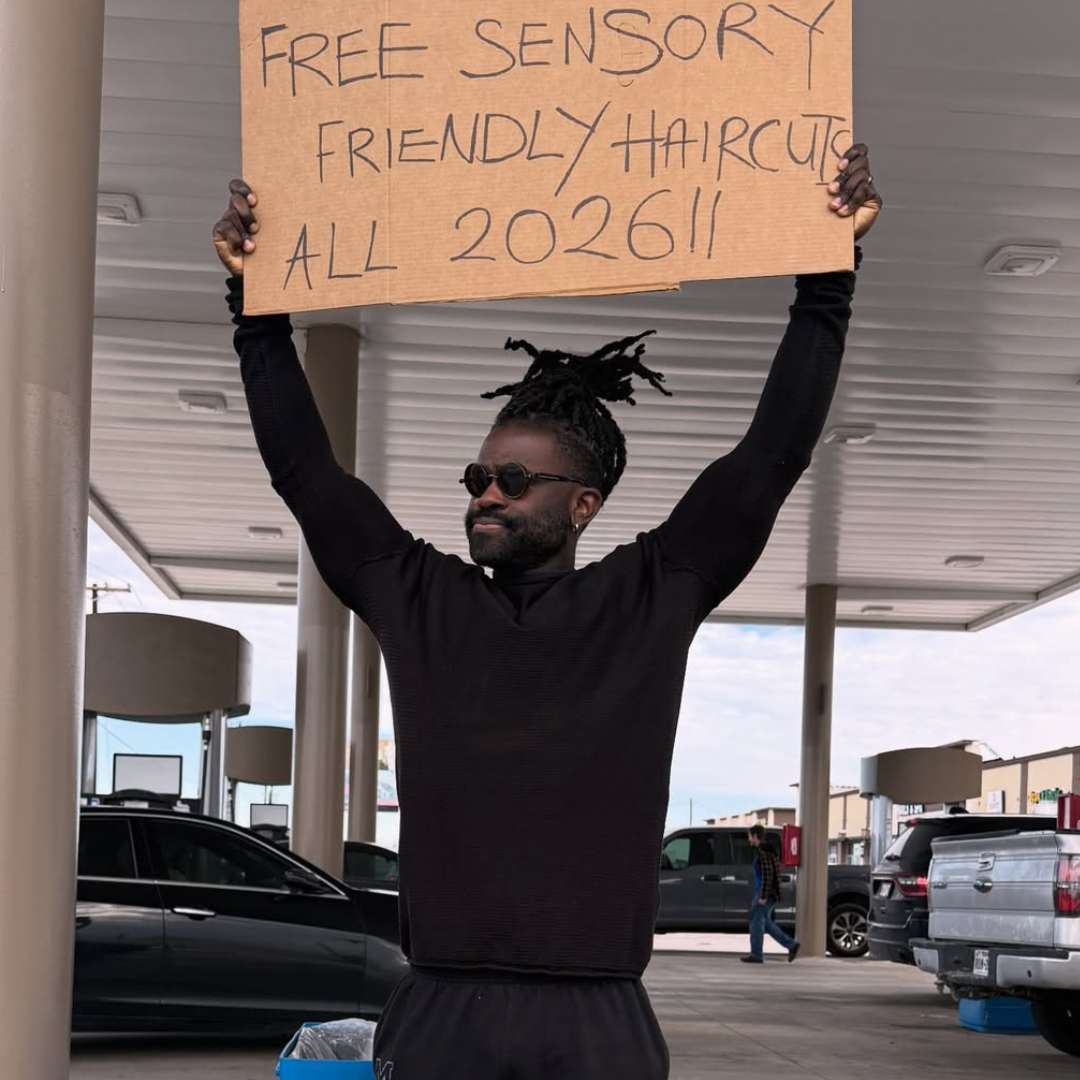
When I sat down with Dallas-based barber and creator of The Weighted Cape, Henry Tribes, I thought we were going to talk about a cool new product. Instead, I got a front-row seat to a whole new way of thinking about barbering, inclusion, and what it really means to reinvent yourself in this industry.
This wasn’t just a “how did you get started?” chat. It felt more like catching up with an old friend who happens to be on fire with purpose.
From “backup plan” to calling
Henry didn’t always see barbering as the path. After barber school in Minnesota, he took a corporate sales job in Charlotte because, as he put it, “I have a bachelor’s degree—let me put it to use. If it doesn’t work out, at least I have a backup plan, which is barbering.”
Spoiler: the corporate job didn’t stick.
He bounced from Minnesota to Charlotte, back to Minnesota, then to Washington, D.C., and finally Dallas—rebuilding from scratch in each city. Suites, shops, starting over again and again. Most stylists I know panic at the idea of moving across town, never mind across states.
By his second big move, Henry says he already had a system for building a clientele from zero. That alone tells you a lot: this is someone who doesn’t wait for a “busy shop” to make him busy. He builds.
The Weighted Cape that changed everything
Here’s the wild part: Henry didn’t set out to be a sensory-friendly barber.
He created The Weighted Cape because he thought it would be a nice extra layer to the client experience—especially for shaves—something to help people feel grounded and relaxed in the chair. He started quietly testing it on his regulars, and every single client loved it.
Then the market told him something he hadn’t expected.
On launch, parents of neurodivergent kids and people in autism communities started reaching out. The gentle pressure of the cape, it turned out, was incredibly regulating and calming for many clients with sensory needs. Henry realized he had accidentally built something that was more than “nice-to-have” — it was needed.
That’s when the real journey started.
Becoming a sensory-friendly barber
Instead of just slapping “sensory-friendly” on his marketing, Henry did the work.
He got Sensory Safe Certified through a nonprofit, dove into autism-centered Facebook groups, followed “autism moms” who were brutally honest about their experiences, and connected with other sensory-friendly stylists like Jelly Robinson in Houston—who he now calls an unofficial mentor.
Seven months into this focus, Henry told me, “It’s easily the most fulfilling thing I’ve done in my 10-year career… It kind of feels like this is my ministry and my calling.”
He’s still behind the chair full-time—about 40–45 cuts a week, packed into four long days—while seeing sensory-friendly clients, parenting two toddlers, and managing life with a pediatrician wife on crazy shifts. On his “days off” (Mondays and Tuesdays), he’s doing consults with parents, answering emails, shooting content, and sorting out everything Weighted Cape–related.
If you’ve ever wondered whether you can blend being a working stylist with building something bigger—he’s living proof.
Manufacturing, mentorship & loving the process
A lot of stylists have ideas for tools, education, or products. Few actually get them made.
Henry is deep in the unglamorous part: procurement, logistics, inventory headaches, and being sold out right when demand spikes. He’s learning how to manufacture, ship, and scale—all skills that have nothing to do with a fade, but everything to do with evolving as a pro.
The thing that keeps coming up with Henry is mentorship.
He reached out cold to people he admired, including Ryford Estores, creator of the Self-Cut System, who became a huge influence and mentor. Ryford pushed him to do pre-orders so he could start selling before inventory landed—practical advice that made a real difference.
Henry’s big reminder for anyone in the industry looking for guidance: don’t talk yourself out of reaching out.
“We tell ourselves, ‘They get a thousand DMs a day, they’re not going to respond.’ But you’d be surprised who’s willing to give you their time. You just have to be open, and willing to be vulnerable to rejection.”
And his favorite mindset shift? Learning to love the process.
Results are cool, but they’re always the end of something. The stories, the growth, the identity shift—that all live in the messy middle.
Advice to his younger self (and maybe to you)
If Henry could talk to a 22-year-old “just-graduated-barber-school” him, he wouldn’t rewrite the journey. But he would say:
- Don’t get stuck in the local “who does the best fades” bubble.
- What matters is the client in your chair—not the clout.
- Reinvent yourself. Start over. Be willing to suck at something new.
He even said, “It’s a privilege to actually suck at something because you’re starting over.” That line has been stuck in my head ever since.
What’s next for Henry & The Weighted Cape
Henry’s not just thinking about capes anymore; he’s thinking about an ecosystem:
- Weighted capes with fun kid prints and matching lap pads
- Education and certifications around sensory-friendly haircuts
- Tools and resources designed specifically for clients with special needs
- Maybe even sensory-focused shops and characters, and media down the line
He’s playing a long game—and doing it while still showing up behind the chair, four days a week, like the rest of us.
Why this conversation matters
Talking with Henry reminded me why I love this industry: we’re not just “doing hair.” We’re creating tools, spaces, and experiences that let more people feel safe, seen, and comfortable in our chairs.
If you’ve ever thought about serving neurodivergent clients, building a product, or just stepping into the next version of your career, Henry’s story is going to light a fire under you.
Hit play on the full interview to hear Henry tell it in his own words—how The Weighted Cape was born, how he rebuilt in every new city, and why loving the process might be the most important skill any stylist can learn.
You can find Henry at:
https://www.instagram.com/henrytribes/?hl=en
https://www.instagram.com/theweightedcape/?hl=en
Transcript:
Henry (00:02)
That makes me feel a lot ⁓ better. Like, it’s just, let it flow.
Liam Shea (00:04)
yeah, there’s no, it’s not,
it’s more, half of this is I just want to get to know everybody. ⁓ So I’m here with Henry from the Weighted Cape and why don’t we just start, Henry, do you just want to tell us ⁓ just a teeny bit about yourself?
Henry (00:11)
Okay.
I’m Henry Tribes, I’m veteran barber, professional barber now for 10 years. I currently reside in Dallas, Texas. I started my career in Minnesota and then I’ve literally been a barber in ⁓ Minnesota, Charlotte, North Carolina, Washington, D.C., and now Dallas, Texas. So in my 10-year career, I’ve moved around quite a bit and I’ve done quite a bit of things.
But ⁓ obviously right now I’m on this journey of being a sensory friendly barber. It’s been very exciting. If you would have told me when I was in barber school that this would be what I would be doing 10 years into my career, I would have said that that’s just not true. Like that’s not happening. ⁓ But ⁓ you know, I’ve had to kind of just reinvent myself on this journey. It’s been super exciting and I’m looking forward to what the future holds.
Liam Shea (00:56)
very exciting.
what I would be doing 10 years into my career, I would have said that that’s just…
Yeah, awesome. That’s super. That is a lot of not just moves, but huge location changes throughout 10 years. ⁓ Were you, was that a lot of work having to rebuild each time? Or did you end up in the type of barbershop where there’s enough people to sort of pouring through the doors that it wasn’t a big deal?
Henry (01:29)
Yes. Yes.
⁓ so the first move was immediately after barber school. remember graduating or passing my board exam to become a licensed barber in Minnesota. And two weeks later, I had to go start a sales training program for a corporate job in Charlotte, North Carolina, because you know, during barber school, I decided, you know, I have a bachelor’s degree, like let me put it to use. And if it doesn’t work out, at least I have a backup plan, which is barbering. So I kind of initially saw barbering as like a
Liam Shea (02:11)
Nice.
Henry (02:14)
side hustle, after work and weekend kind of thing. And, you know, fortunately, I’m not even gonna say unfortunately, fortunately, I didn’t like the job. ⁓ after six months training in North Carolina, I had to go back to Minnesota. Now in North Carolina, I remember just walking into a barbershop and telling the guy, hey, I want to cut hair. And he said, okay, you can start tomorrow. And I was like, okay, great.
Liam Shea (02:41)
Amazing.
Henry (02:42)
I was like, okay, great. So I was able to cut hair for about four or five months out there in Charlotte, North Carolina, and then moved back to Minnesota, worked at a barbershop in Minnesota for about two years, then quit that bar, not really quit, I would say I transitioned into a suite, and then did that for maybe eight months, and then I opened up my own barbershop in Minnesota.
Liam Shea (03:03)
Mm-hmm.
Wow.
Henry (03:10)
did that for two years and then moved to DC or the DMV area, because my girlfriend at the time, now wife, was at Georgetown Medical School. So I moved over there, started over, but in a suite this time. I never went to a barbershop, so I kind of had to build from ground up on my own. ⁓ So after that, moved to Dallas, Texas.
Liam Shea (03:16)
Mm-hmm.
Yep.
Yeah.
Henry (03:35)
because she started working at, she’s a pediatrician, so she did her residency, she’s doing her residency out here at the Children’s Hospital, so had to move again, had to start all over again, build my books from ground up, and I think by the second move, I already kinda had a formula on how to build from scratch in a new city or state, right? So I was able to do that successfully, and now I’m just coasting.
Liam Shea (03:57)
Yeah.
That’s so cool. That’s so cool. That’s, not everybody is built to rebuild like that or to build in the first place. You probably saw it at the very beginning when you were at busier barber shops.
Henry (04:05)
Thank you.
Yes.
Liam Shea (04:20)
there’s a lot of people who are waiting for someone else to make them busy, someone else to build their clientele. And I find, I’m gonna guess it’s similar in barbering with, with hairstyling in that it tends to attract people who don’t know what else to do, but they don’t. But the problem is if you’re not a hustler.
Henry (04:24)
Yes. Yes.
Yes.
Yes.
Liam Shea (04:42)
It’s really difficult to grow and you tend to ⁓ expect people to do that for you and it’s just not what happens, especially not with moves. And then obviously you have an entrepreneurial spirit because you became self-employed pretty early on. That’s a lot. That’s a lot of work. Yeah.
Henry (04:48)
Yes. Yes.
Yes.
Yes, it is
a lot of work, but it’s a lot of work, good work that I love. ⁓ It’s been fun, it’s been fun so far.
Liam Shea (05:06)
Sure.
Yeah. Yeah, I went self-employed pretty early, but not that early. think did my apprenticeship and then maybe a couple more years. So I was about four years at the first place and then self-employed after that. I’ve been cutting hair for 25, almost 26 years now. Yeah. I mean, that’s not 10 years. 10 years is plenty long, plenty long.
Henry (05:14)
Yeah.
Okay. Okay, nice.
⁓ you’re the real veteran. I’m just, I’m still new. ⁓
Liam Shea (05:34)
Okay, so you you moved to Dallas, Texas. You rebuild your clientele. Are you in a one room suite? Are you in okay? And
Henry (05:37)
Yes, sir.
Yes. I’m in a one
room suite. I’m at a MySama suite in downtown Dallas. In the next few months, I’m definitely looking to expand maybe into a double or to like just a bigger space in general. Especially with this new journey that I’m on being a sensory friendly barber, I need all the space that I can get. I want to add more toys and you know, more…
Liam Shea (05:57)
Sure.
Henry (06:08)
sensory tools and my space is starting to get little congested. And it’s also nice for the kids to have space to kind of just run around and not feel so boxed in and claustrophobic, you know.
Liam Shea (06:18)
Yes,
yes, yes. remember when I first began, because I myself do quite a bit of sensory friendly hair cutting as well. It’s not something I specifically do. Probably it was similar for you that the minute you do that successfully, especially for someone’s child, ⁓
every parent that they’ve ever met finds out through like a Facebook group or like the minute you hit one of those Facebook groups or a subreddit or something like that, everyone’s there. ⁓ I had seen a piece on the news about a hairdresser out of England and I didn’t realize I was already doing it without doing it and I saw that she just followed
Henry (06:56)
Yeah.
Liam Shea (07:11)
the kids where they wanted to go. So sometimes she’d end up outside. She just sort of let them wander around. And I remember thinking, well, I do that. I mean, I just thought, why wouldn’t I want to make a kid as comfortable as possible? Obviously, this is a weird place to be at the best of times. So why wouldn’t I want to make them comfortable? ⁓ When did you?
Henry (07:18)
Yeah.
Yes.
Yes.
Liam Shea (07:36)
When did it turn into sensory friendly hair cutting? Like at what point did you realize, were you already doing it and then realized it was a thing?
Henry (07:45)
No,
no. My journey’s been very unique in that it was a bit of serendipity in that, ⁓ you know, I’m the creator of The Way to Capes and a lot of people presume that I started this journey and then created The Capes, but it was actually the other way around. I created The Capes and then I started this journey. ⁓ Creating The Capes took me down this path that I didn’t even realize.
Liam Shea (07:55)
Yes.
Interesting.
Henry (08:14)
was a need. So the CAPES helped me realize, my God, this is a need and you have, well, not all the tools, but you have most of the tools you need to start like now. But the first thing you need is to get more information, more education. So I got Sensory Safe Certified, which is ⁓ a course offered by a nonprofit called Sensory Safe Solution. So that course was
Liam Shea (08:26)
Right.
Henry (08:43)
very, very, it was life changing, right? So that started putting me into the mentality of like, whoa, like a lot of kids, a lot of parents struggle with this problem. And, you know, not just your capes, but you and your patients and your understanding and other sensory friendly tools and toys and things like just bringing it all together was kind of ⁓ prompted by that Sensory Safe Certification course.
Liam Shea (08:46)
Yeah.
Yeah.
Henry (09:12)
And then
I reached out to other sensory friendly barbers and stylists in the area. There’s a lady named Jelly Robinson out of Houston. She’s amazing. She absolutely is like my, you know, de facto mentor. And, you know, went down the rabbit hole on YouTube. I mean, even the Facebook, the autism centric Facebook groups you’re talking about. I’m in all of them. I am in all of them. And I follow all the autism moms who are…
Liam Shea (09:33)
Sure, I know. That’s awesome.
Henry (09:39)
very transparent about their experience of raising a child on the spectrum. So I’ve learned a lot from these autism mamas. ⁓ honestly, about seven months, yeah, about seven months in, just now, it just now feels like I’m just putting everything together and I’m starting to just like, everything is just starting to align. ⁓ you know, I know I still have a lot more to learn and a long way to go, but now it’s starting to feel like, okay, this, this.
Liam Shea (09:59)
down.
Henry (10:09)
It kind of feels like this is my ministry and this is like my calling. It comes supernatural to me. I don’t know if it’s because I’m a parent of two toddlers. So I think maybe they’ve prepped me for this journey that I’m on, but it’s easily the most fulfilling thing I’ve done in my 10-year career.
Liam Shea (10:22)
Sure.
Yeah, I can absolutely imagine that would be the case. ⁓ That’s so cool. when did you start the weighted cape? Like when did you, how did that come about?
Henry (10:43)
Um, so I created the capes for comfort, right? I thought it would be a nice extra layer to the customer service experience. You know, I thought it would help my clients relax. So I essentially created it for my clients. You know, I thought, Hey, while I’m doing a razor shave, you know, wouldn’t it be nice to have weights, you know, around your shoulders and upper chest and upper back to just to help you, you know, relax and stay grounded and things like that. Right. And I, uh,
Liam Shea (10:56)
Yeah.
Yeah.
Henry (11:11)
You know, started testing it on my clients, I think last March or April. And every single client loved it. And I’m like, ⁓ okay, well, this is the validation that I need to like put this thing out there. So I launched it last June or pre-launched it last June. And the market, like on day one, the market told me, hey, this is an amazing invention for a
certain type of individuals. This is actually a need for a certain type of individuals. I don’t really know at the time, I didn’t really personally know any, any individuals on the spectrum. So I really couldn’t wrap my mind around why like the weights could be so beneficial for neurodivergent individuals. And that’s why I just needed to just go down the rabbit hole and do all my research because it felt very
Liam Shea (11:42)
Right.
Sure. Yeah.
Henry (12:06)
disingenuous marketing this product to a community I knew nothing about and a community I wasn’t serving. Okay. ⁓ and that’s what kinda, you know, make me go full force learning everything, getting all the certifications, reaching out to different people, OTs, RBT’s, BCBA, speech therapists. I mean, countless conversations, right? And I think it’s a combination of all these things that like make me feel like, okay, I’m better prepped now to serve these kids.
Liam Shea (12:34)
Yeah, that’s amazing. I mean, it’s interesting because I get that you feel that you aren’t prepped, but nobody was serving them. it’s like, even without certification, you were already just by making something that ended up being for someone else, you were more prepped than half the people out there. That’s really, really, really cool. So it’s happened. This has happened really fast then.
Henry (12:37)
Thank you.
Yeah.
Yeah.
Yes.
Yes. Thank you so much.
It’s been, yeah, it’s been a lot.
Liam Shea (13:06)
Like, yeah, yeah,
and you said you have two toddlers?
Henry (13:10)
I have a three-year-old and a two-year-old. And a pediatrician wife. So I’m busy. Oh yeah, 15 hours a week, if that.
Liam Shea (13:13)
Dude. ⁓
Right. Yeah, right. Yeah. And she hardly ever works obviously, as we all know about new doc. Yeah.
Yeah. That’s amazing. You said she’s at the Children’s Hospital in Dallas. That’s a heck of a Children’s Hospital to end up at.
Henry (13:30)
Yes, she is. It’s a great hospital. It’s a great
hospital, yes.
Liam Shea (13:37)
That’s amazing. ⁓ Okay, so you started the Weighted Cape essentially for a completely different reason. Or it’s not a different reason, but it wasn’t necessarily directed at that audience to begin with. You discover that there’s this other audience, you get a bunch of certification training. I still can’t believe the short timeframe that you’ve pulled all this off in. ⁓
Henry (13:38)
Thank you.
Yes.
Yes.
Yeah,
it’s been busy. ⁓
Liam Shea (14:04)
And then, I mean, you’re at the point where you’re manufacturing a thing, which is a whole other ball of wax, like that’s trying to get things made. ⁓ have you found it difficult? Sometimes I find when you’re, when you’re at that stage where you’re doing something like manufacturing something.
Henry (14:12)
Right. Right.
Liam Shea (14:25)
The problem isn’t can you sell it? The problem is can you make enough to sell? Can you figure out how to get it to people? you all the logistics around that? ⁓ Was there a crash course? Did you find your previous education ⁓ helped in there? Like how hard was that for you to make that happen? I mean, obviously you’re in the process of making it happen still. ⁓
Henry (14:33)
Yes. Yes.
Yeah, yeah, yeah, I’m still
learning procurement and logistics is, you know, a huge task. ⁓
Liam Shea (14:59)
That’s not related
to barbering. Do you know what I mean? Like those are not like skills that tend to overlap in a dramatic way.
Henry (15:01)
No, it’s not. It’s not. It’s not related to Barbara. Yeah, it’s
not related to Barbara. But I think I think one thing that I did that really helps me with this process is, you know, the first thing I did was I reached out to a mentor and this mentor in so many ways inspired me to create the weighted capes. Right for right for the estores is the.
creator of the self-cut system, which is like the three-sided mirror to like help people. Yes. Yes. Yes.
Liam Shea (15:33)
Yeah, that’s right. Yes. Okay. I’m gonna make sure
I’m gonna get all these links from you because I want to make sure at least in the YouTube video that we have the links to like to like your mentor in Houston and the weighted cape and this ⁓
Henry (15:42)
Yeah. Yes. Yes. So, yes.
Shout out to Jelly Robinson, my, you know, mentor in this sensory friendly haircut journey. Shout out to Right For The Stores for giving me the confidence and just giving me a lot of game on like, like you said, the manufacturing piece. And, you know, the problem is always, you know, how much inventory do I order? And, you know, and
Liam Shea (16:03)
Yeah.
Henry (16:09)
Ryfer just really helped me in the beginning and I could remember specifically him ⁓ telling me or advising me to do like a pre-launch or pre-orders and honestly that helped a lot because I was able to start selling before I even started making them, right? So that really helped me get ahead and I’m still running into issues like I’ve been sold out for two or three weeks now which is terrible because it’s back to school. ⁓
Liam Shea (16:20)
Yep.
capital. Sure.
yeah.
Henry (16:39)
I’m still figuring it out as I go. There’s still a lot of kinks that I gotta clear up. But ⁓ I think having Riford as a mentor really helps. And then just having that mentality of like, just keep going, just keep putting one foot in front of the other. It doesn’t have to be pretty. It doesn’t have to be perfect. Just keep going. And then, you know, I’m an avid reader. So reading books like Shoe Dog by Phil Knight, The Jobs.
Liam Shea (17:07)
Yeah, great book.
Henry (17:09)
Great book, my God, amazing book. It taught me that even a company as big as Nike had humble beginnings and it wasn’t pretty. It was not pretty. Honestly, I still don’t, and those are stories like that are very, they’re kind of reassuring because it’s like, if they could get over all those hurdles they had back then, and think about it, back then it was.
Liam Shea (17:17)
⁓ and then some. No. They had no business surviving like that.
Henry (17:36)
I would make the argument it was even harder because you actually had to travel, physically travel to Asia to talk to manufacturers. ⁓ Now we can do it over a phone or over email, right? ⁓ So I think it’s a combination of the mentor of the books and just the mindset of, just keep going.
Liam Shea (17:43)
Yeah, yes.
Yeah.
Yeah, that’s awesome. I mean, one of the things I tend to ask everyone that I interview like this, and you’ve helped transition right into that, is ⁓ about…
whether there was a mentorship that affected you or how you got a mentor because a lot of people struggle with finding the right person that speaks to them that helps them on their journey. ⁓ did you go about, I don’t know if you were actively looking for a mentor, like this is going to sort of lead into what would you tell somebody who’s starting out? How did you find your mentors?
Henry (18:21)
Yes.
Yes.
Okay. ⁓ For me, with Ryford, that, I think I found Ryford ⁓ just on YouTube. ⁓ So I’m a big fan of Shark Tank, right? And there’s a guy that was on Shark Tank, God, I can’t remember his name, but he created the Twisted Sponge, which is essentially like, I swear, it’s like a mini tennis racket that like people with coarse hair like mine can use to kind of.
Liam Shea (19:02)
I remember that. Yeah.
Henry (19:03)
Set their natural curls in, yes.
And that just blew my mind, because I’m like, hey, this is a guy who looks like me. This is a guy who created a product for people who looks like me. And this is a guy who’s in the hair space, OK? So I just watched all his interviews. I just studied the guy as much as I can. And I think in that process was when I kind of started discovering other guys, like the guy who invented the cup buddy, who was also on Shark Tank.
And then I think that’s what led me to write for the stories who created the self-cut system and then come to find out he had just launched his mentorship program. Yes, he’s just launched it. I’m like, what? I’m like, reaching out. I’m going to reach out to him today. So reached out to him and he was just super excited. It’s like, my God, bro. Like, I remember when I was in this stage, when I had that idea and it was super exciting and like, you know, you might not believe me, but like.
Liam Shea (19:34)
Okay.
⁓ amazing.
That’s good timing.
Henry (20:00)
That was the fun part. Now that it’s like, yeah, I’ve had some success with this, but I don’t think you understand. If I could go back to the beginning where was like everything was fresh and it’s like I had this novelty product that I was gonna launch and I was figuring things. He said, that’s the fun part and just love, love, love, love the process. And he was just willing to help. So shout out to Reifert.
Liam Shea (20:18)
yeah.
Yeah,
I love that he said love the process. It’s something I talked to almost everyone about because because results are the end, right? Results are things are over or it’s transitioned to a new thing. The process is what you’re going to end. It’s what you’re going to remember. You’re not going to look back on the end of it. You’re going to look back on the process. And if you can learn to love your processes. ⁓
Henry (20:34)
Yes.
Yeah, the reward. Yeah.
Liam Shea (20:50)
just life will be better. ⁓ So you just reached out to him, that’s amazing that that mentorship program was launching. What would you tell a new barber or hairstylist or cosmetologist of any sort if they were struggling with, if they seemed like they needed mentorship, what would you tell them ⁓ to do or how to go about it?
Henry (20:52)
Absolutely.
⁓
would say it
Liam Shea (21:20)
Like not everybody’s going to be lucky enough to find a person who happens to launch a mentorship program. You know, like would you tell people just to get in touch with someone, reach out, like what do you think?
Henry (21:22)
Yeah. Yeah.
⁓ I think you just have to be open to speaking to people and not be afraid of like just like sending that cold DM or even picking up the phone and just like calling somebody. ⁓ I’ve done that many times. I’ve sent out many cold emails and you’ll be surprised who’s willing to, you know, give you the time of the day and actually help you on your journey.
Liam Shea (21:43)
Yeah.
Yeah.
Henry (21:56)
But I
think sometimes we just kind of talk ourselves out of it saying, well, I’m sure he gets a thousand emails a day. He’s not going to respond to me or they get a thousand DMs a day. They’re not going to respond to me. think just, you know, leaving yourself open to be vulnerable to rejection, even if that’s the case, I think is what will make you actually take action and get that response that you’re looking for. yeah.
Liam Shea (22:03)
show.
Awesome, yeah,
awesome. Yeah, I think mentorships are ⁓ so important and we’re not all lucky enough to start in a place where there are mentors built into our direct surroundings. It can take a while to find the person that speaks to you. ⁓ Certainly in the industry that you and I are in.
Henry (22:25)
They’re huge.
Yes. Yes.
Liam Shea (22:44)
there’s a limited quantity of people who are interested in or experienced in.
starting a different type of business or whether it’s manufacturing products, even opening shops like that, you know, the majority of people are going to work for someone that’s all they’re ever going to do. They’re not they don’t want to be their own boss. So it’s it’s interesting when you’re trying to figure out how to expand within this industry when there’s so few people that do it. ⁓ That’s amazing that you found who you found. ⁓
Henry (22:53)
Yes. Yeah.
Yes.
Yes.
Yes.
Liam Shea (23:23)
Second here, let’s try and I forgot.
Okay, it’s just letting me know. Storage on your phone is running low because I forget it records locally onto a phone and then comes up. We can always pick… Well, we each record locally.
Henry (23:36)
Okay, so this is my phone.
Okay.
Liam Shea (23:41)
and
then it will upload at the same time. that way, even if you’re looking at my picture and saying that’s terrible quality, what’s gonna happen? Because of our internet connection, we’re recording natively on each end and then it goes up to the cloud in full quality. That’s how it happens. But that’s okay. We can always pick it up again later on if we need to, if it just drops out completely. ⁓
Henry (23:55)
Okay.
Okay, so it might
kick me out soon, basically.
Liam Shea (24:03)
I don’t know if it’ll
kick you out, it’ll stop, it’ll tell us it’s stopped recording. It’s saying what we can do is pause and you can free up storage, but I don’t really want you to have to spend a bunch of time figuring out how to delete, ⁓ delete stuff. ⁓
Henry (24:06)
Okay.
Okay.
Okay, ⁓
Liam Shea (24:17)
It’s okay. We’ll just rock another five minutes and if we need to pick the rest up another time, we can pick the rest up another time. We can just post clips. ⁓ So are you, how much are you behind the chair at this point?
Henry (24:23)
Sounds good. Sounds good.
So I am still full time. ⁓ Yes, so I’m doing about.
Liam Shea (24:36)
Wow.
Henry (24:43)
⁓ let me think about this for a second.
I’m probably still doing 40, 45 haircuts a week. ⁓ And I pack them into a four day schedule. So I work from Wednesday to Saturday. So I try to maximize those four days. And some Fridays I’m at work for 12, 14 hours. ⁓ So I’m still a full time barber. And ⁓ on my Mondays and Tuesdays, I kind of do everything with a…
you know, phone calls and emails and interviews like this and, you know, content, you know, stuff with the weighted cape. And so it’s nice to have Mondays and Tuesdays to start off the week, like kind of just getting my life together and making sure everything is in order before I start my crazy schedule at the suite, you know, Wednesday. So tomorrow, essentially, you know. Yeah, is a luxury these days.
Liam Shea (25:38)
Right. So just skip sleep. It’s no big deal.
That’s right. Yes,
yes, yes, it is. I hear you there. That’s awesome. ⁓ So right now you’ve got a bit of a back order you’re saying. So what’s the what’s the next thing on your plate? Is it just focusing on manufacturing and getting orders out? ⁓ Yeah, what’s the next thing next aspect of this that you’re working on or the biggest aspect of your career you’re working on right now?
Henry (26:04)
⁓
man, right now my sensory friendly haircuts are taking up a lot of my energy and ⁓ you know, I’m just trying to do everything I can to provide the best possible experience. So I’ve been investing in a lot of like tools and toys and resources and a thing and a lot of content. And I’m also doing a lot of the legwork as far as like
Liam Shea (26:15)
Yeah.
Yeah.
Henry (26:34)
I’m still manually doing preliminary phone consultations with the parents. And, you know, I haven’t systemized it yet, but I will soon here in the next like few weeks. But I just kind of wanted to just do the grunt work in the beginning. ⁓ So when I systemize it, I know exactly, you know, what what will work, you know, as far as being efficient, but still not losing the essence of like, you know, connecting with the parents and making the parents and the kids feel comfortable with me before they even come in. Right. ⁓
Liam Shea (26:39)
Yep.
for sure.
Henry (27:05)
So that’s been taking up a lot of my time. And then obviously figuring out the inventory issues. Got a huge order coming in in about two to three weeks. So it’s actually good that sometimes I’m like, okay, it’s a bad thing that I’m sold out, but it’s also good because then I can like breathe. I can breathe instead of packaging orders and running to the post office every day and shipping stuff off to Amazon. can just kind of reset. So I have like a two or three week.
Liam Shea (27:24)
Yeah.
Henry (27:35)
Window here to kind of like get things in order before the huge ⁓ package comes in But yeah, we’re also working on You’re hearing it first, but we’re also working on a weighted cape with that that’ll come with lap pads. So I’m super yes Super excited about that and then we’re gonna have different colors for the kids come the holiday season, you know Numbers dinosaurs, you know, we’re gonna make the case a little a lot more fun. And right now we only have black
Liam Shea (27:49)
⁓ okay.
Henry (28:04)
just because, you know, when we launched, like, I didn’t even know if this thing was gonna work, you know? So I just wanted to keep it simple and standard with just one color. And as you know, like, black is the most popular color for capes. So played it safe with that. And then as far as long-term, honestly, I think what I’m doing or what we’re doing is gonna go, you know, way beyond, you know, way to capes. I think I envision a future where we
Liam Shea (28:08)
Sure. Yeah.
Sure. Yes.
Henry (28:33)
create a whole ecosystem around making haircuts more comfortable and inclusive for people with special needs. ⁓ So whether it’s through education, whether it’s through tools and like the weighted capes, whether it’s through sensory friendly or sensory ⁓ specific barbershops and salons, ⁓ whether it’s through even ⁓
Liam Shea (28:37)
Yeah.
Yeah.
Henry (29:01)
know, media and branding, like even like creating characters around anything sensory haircuts related. So there’s just big goals that I have in a pipeline. But, you know, I know it’s like a long road ahead and I’m just trying to focus on what’s in front of me and hopefully have ⁓ the right people in my corner as I move forward.
Liam Shea (29:12)
Love it.
Yeah, let’s have a weighted cape certification process. I love it. I love it. I’ll need to get on there and order a couple of things for Soul Monster so we can do a couple of giveaways down the road here. I think that would be a lot of fun. ⁓
Henry (29:31)
Yeah, yes, let’s do it. Yes.
Yeah, absolutely. And if you want to do
some co-brainy stuff too, just let me know. You know, we can talk about that. For sure.
Liam Shea (29:46)
Yeah, absolutely. I think the
more partnerships, the merrier for everybody. Like it’s just, let’s all grow and share with as many people as possible. Well, I want to be cognizant of time and making sure we don’t run out of space here. ⁓ So why don’t we ⁓ plan to do another one these and we can delve a little further into another aspect of what you’re doing. Yeah.
Henry (29:51)
I’m open to it. Yes.
Okay.
Yes.
That sounds good. ⁓
Let me clear up some stories on my phone and whenever you’re ready, just send me an email for like a few options for dates, you know, in the next few weeks. And ⁓ as long as it’s on like a Monday or Tuesday like we’re doing now, yeah, that should work.
Liam Shea (30:16)
Yeah.
Yep. Tuesdays always work. I have strange
work days. I cut hair Sunday and Monday. At the height of COVID, I took a friend’s days off in their private suite. I left a salon to do that. And then I kept doing that. I’m going to shift that later on because both of my kids will be in school soon and I’d like to have weekends off with them. But we’ll make that adjustment. ⁓
Henry (30:31)
Okay.
Yeah. OK. OK.
Yes.
Liam Shea (30:48)
Yeah, so one last question I just wanted to ask. ⁓ If you got to talk to brand new in the industry you, is there one piece of advice you’d give yourself? Is there something that held you back or slowed you down or put you off a little bit or something someone told you that was the opposite of helpful?
Henry (30:52)
Yes, sir.
You mean like knowing what I know now? Okay.
Liam Shea (31:11)
Yeah, knowing what you know now, what would you
tell Brand New? Because I know you said you went and did six months of training for a totally different job. ⁓
Henry (31:17)
Yeah. Yeah. Yeah.
Honestly, my journey has been so exciting and it’s been a lot of change. So there’s not too much I would change per se because everything led me up to this moment. ⁓ But if I could tell 22 year old Henry graduating barber school anything, I would just tell him like, bro, you have no idea what’s coming.
Liam Shea (31:32)
Yeah.
Henry (31:47)
You have no idea what’s coming. ⁓ Stay the course. ⁓ Never stop learning. ⁓ You know, even if you’ve graduated college, still keep taking courses, keep learning from mentors, and ⁓ always think outside the box and try not to, and I think I made this mistake very early on, is like, I felt like I was caught up in a little bubble, in a little.
Barbering industry bubble in my local city or town where it was like I was more concerned about a you know I’m a guy who does really good work and I do really good fades and I’m the best at this and I want to be Noticed for this and I like I think I was caught up in that bubble for like a few years and I would tell 22 year old me that hey That isn’t really what matters
Liam Shea (32:17)
Yep. Yep.
Henry (32:40)
That is not what matters. What matters are the clients who sit in your chair and you’re giving them a good service. What matters is you trying out different things and experiencing new things, reinventing yourself, starting over, sucking at something again. Oh my God, that’s a privilege. It’s a privilege to actually suck at something because you’re starting over. Yes. Yes. Yes.
Liam Shea (32:55)
Yes, it is. It gets harder. It gets harder to be comfortable with, but it’s it’s where all the juicy stuff is, is like stepping into that. Yeah.
Henry (33:08)
Don’t be afraid. Yes, you’ve mastered how to do fades and how to do a crispy lineup. Don’t be afraid to start over and be a novice again at something. If I could do it all over again, actually, one thing I would change is I would have went to cosmetology school after a year as a barber so I can have that dual license because I think that would have just opened up so much more opportunities for me. And, you know, never say never. It’s not too late. But.
Liam Shea (33:23)
Yeah.
Henry (33:36)
yeah, I think those are some of the things I would tell. Yeah, those are some of the things I would tell young Henry graduating barberschool for sure. Thank you.
Liam Shea (33:37)
your free time.
I love it. I love it. That’s fantastic. I love it.
Thank you so much for doing this. Really appreciate it. Tell everybody where they can find you.
Henry (33:48)
Of course. you. Thank you for having me.
So you can find me on my personal Instagram page at Henry Tribes or you can find The Weighted Capes on every social media platform, TikTok, Facebook, Instagram, Twitter, at The Weighted Cape. Or honestly, you could just email me at theweightedcape.gmail.com. I’m very responsive. And yeah, I’m excited to hopefully get some of you guys reaching out to me here pretty soon.
Liam Shea (34:14)
Love it.
Yeah, count on it, I have no doubt. Okay, thanks a
ton, Henry, really appreciate it. We’ll do it again soon.
Henry (34:25)
Yes, thank you so much.
Yes, sir, we will. Now, I got a question for you before you leave. Please tell me about, and I know this is probably not gonna be, the recording or whatever, but I wanna know more about Salon Monster. Like, I wanna hear just a little bit about how this was even a thing where you’re at now and how you transitioned from being, you know, ⁓ a full-time professional to now doing what you’re doing.
Liam Shea (34:31)
Yeah, go on.
Doesn’t matter.
Yeah. Yeah.
Sure.
I’m going to, I’m just.